

This page is the reference background for the Recurrent C. difficile infection page. It goes through all fifteen papers: what they measured, what they found, and where the limits lie. For patients and treating physicians alike.
Recurrent Clostridioides difficile infection is the best-established application area of microbiota transfer therapy. This is not a matter of the data merely being encouraging: randomised trials, international professional guidelines and several years of safety follow-up stand behind it.
What this literature does support. The first randomised trial was stopped earlier than planned in 2013, because the difference between donor stool and the antibiotic given alone was so large that further randomisation was not considered acceptable.29 In a randomised trial of 116 patients the capsule form given by mouth proved equivalent to colonoscopy: 12 weeks after a single treatment 96.2% of patients had no recurrence of the infection, at the same rate in both arms.8 Both the European and the American guideline recommend the procedure for second and further recurrences.17, 28
What it does not support. In a first episode FMT is not yet a guideline recommendation. A 2025 Norwegian, eighteen-centre trial compared FMT with vancomycin in primary infection and the non-inferiority criterion was met — this, however, is a single trial with an open-label design, and it does not override the current recommendations.57 Nor does it establish that the effect is the same in every patient group: the 75% cure rate measured in elderly patients with multiple relapses is lower than that seen in younger populations.52
Safety. The largest pooled review processed the data of 4241 patients in 129 studies.15 A prospective follow-up of 609 patients over a median of 3.7 years and the ten-year follow-up of the original randomised trial both found no late event attributable to FMT.87, 30 This is not the same as saying that there is no risk: mild, transient complaints are common, and in immunosuppressed patients the risk requires individual assessment.
An important distinction. The data listed here relate to the MTT (FMT) method and not to a specific product. The trials differ in route of delivery, preparation and dose; the capsule, lyophilised form is the subject of the most recent papers.52
The dose is set neither by body weight nor by the patient's age, but by the severity of the condition — condensed into a single score in the 0–100 range. Below we go through, band by band, what lies behind the score: what it measures, which validated scales it is made up of, and what the starting dose is in each band.
No two cases are the same — which is why no two protocols are the same either. The success of the treatment depends on the bacterial concentration and the duration of the treatment, and we determine the appropriate dose on the basis of the SIS (Symptom Importance Scale) score. This structured clinical scoring system takes 23 weighted variables into account — the symptoms you report, the laboratory results, the data of previous treatments and the known risk factors — and combines four validated medical models: the Zar score254, the ATLAS score255, the Hines VA severity score256 and the CARDS score27. This way you receive evidence-based treatment tailored to your own condition.
The Symptom Importance Scale turns your symptoms, laboratory results and risk factors into a single number in the 0–100 range. That number decides how strong a treatment we start with, how long the initial phase lasts, and when the dose can be reduced. You do not have to fill it in yourself: we calculate it from the questionnaire and your results, and we show you which band you fall into.
The SIS severity scale (PDF) →The more severe the condition (the higher the SIS score), the higher the initial bacterial concentration and the longer the course. As your condition improves, the dose is reduced according to the rule of the scale: a minimum of 10 days on the starting (or escalated) dose, then −1 capsule every 3–4 days for as long as the symptomatic gate holds. At level 1 (SIS 0–24) no capsule is needed.
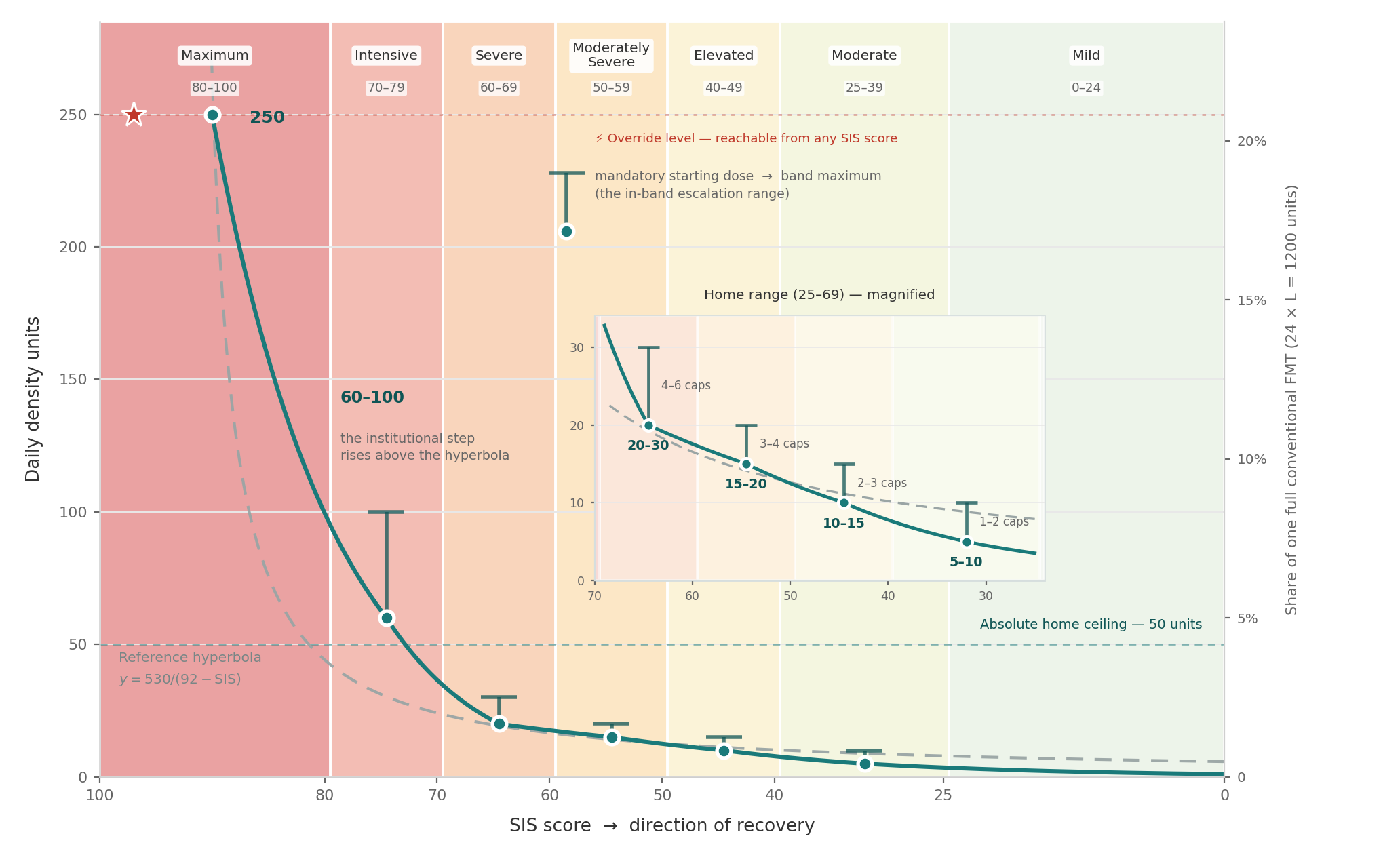
Treatment intensity scales hyperbolically with severity. The patient slides down the curve from left to right during recovery.
Home: DiffBiome 30(V)+ only (V = 5×). Institutional: HospBiome 5(XX) (20×) and 5(L) (50×). 1 density unit = 1 capsule of density (I) = 1/1200 of the dry matter of a 150 g donation.
The The starting dose is a mandatory initial value. The band maximum is an escalation value only, if the patient does not respond beyond 48 hours — it is not a freely chosen range.
The safety data measured in the published studies are set out above: a large pooled review, several years of follow-up, and the caveat that mild, transient complaints are common. What goes into the capsule, however, does not follow from the literature but from our own procedure.
Donor screening. Every donor goes through our DSQ donor screening framework: bacteriological, virological, parasitological and serological testing, a stool test and a detailed questionnaire.
The window period. A recent infection is not necessarily detectable at the moment the sample is taken. The donation is therefore held frozen in quarantine: for at least eight weeks, and it is never released before the result of the repeat test performed after the eighth week has arrived. The repeat test covers those infections that could already have occurred before the sample was taken but became detectable only during those eight weeks.
Always take the capsules under the guidance of your treating physician.
The facts and figures on this page come from fifteen papers in all: three randomised controlled trials, one open-label and one retrospective cohort study, two international professional guidelines, one European consensus document, one systematic safety review and two long-term follow-ups.
[8] Kao, D., Roach, B., Silva, M., et al. Effect of Oral Capsule– vs Colonoscopy-Delivered Fecal Microbiota Transplantation on Recurrent Clostridium difficile Infection: A Randomized Clinical Trial JAMA 2017. doi:10.1001/jama.2017.17077
A non-inferiority randomised trial in 116 adults with recurrent CDI at three Canadian academic centres, comparing oral capsule FMT with FMT delivered by colonoscopy (enrolment 2014–2016; non-inferiority margin 15%). The trial tested whether the less invasive capsule route reaches the colonoscopy result in preventing CDI relapse. The findings support the clinical equivalence of the two routes, allowing broader and less burdensome access to FMT in recurrent CDI.Source: references-v2.bib · ref-008
[15] Marcella, C., Cui, B., Kelly, C. R., Ianiro, G., Cammarota, G., Zhang, F. Systematic review: the global incidence of faecal microbiota transplantation-related adverse events from 2000 to 2020. Aliment Pharmacol Ther 2021. doi:10.1111/apt.16148
A systematic review of FMT safety summarising adverse events (AEs) over 20 years from 129 studies, which covered 4,241 patients and 5,688 FMT cycles (EMBASE, MEDLINE, Cochrane, CNKI and Wanfang databases, 2000–2020). The AEs were divided into delivery-related and microbiota-related ones. The review provides the largest pooled FMT safety data set and supports the generally favourable safety profile of FMT in recurrent CDI, while indicating that complications may be under-reported in the literature.Source: references-v2.bib · ref-015
[16] Cammarota, G., Ianiro, G., Tilg, H., et al. European consensus conference on faecal microbiota transplantation in clinical practice. Gut 2017. doi:10.1136/gutjnl-2016-313017
A European consensus conference that developed evidence-based recommendations for the clinical use of FMT, with the participation of 28 experts from 10 countries, working in groups. The statements were prepared through an evidence-based review, assessed in an electronic Delphi process and finalised at a plenary consensus meeting. The recommendations cover the indications for FMT, donor selection, preparation of the faecal material, clinical management, faecal delivery and the minimum requirements for establishing an FMT centre. The document provides a European standardisation framework for safe and regulated FMT delivery.Source: references-v2.bib · ref-016
[17] van Prehn, J., Reigadas, E., Vogelzang, E. H., Bouza, E., Kuijper, E. J., et al. European Society of Clinical Microbiology and Infectious Diseases: 2021 update on the treatment guidance document for Clostridioides difficile infection in adults. Clinical Microbiology and Infection 2021. doi:10.1016/j.cmi.2021.09.038
The ESCMID 2021 treatment guidance for C. difficile infection in adults. It no longer recommends metronidazole where fidaxomicin or vancomycin is available; in a first episode and a first recurrence fidaxomicin is the preferred agent; in a second or further recurrence, faecal microbiota transplantation (FMT) or bezlotoxumab alongside standard antibiotic treatment is the primary recommended option. Compared with the previous edition, the emphasis has shifted from the severity of the disease to the risk of relapse: the treatment strategy is determined by the patient's individual recurrence risk. This approach supports the idea that classification should measure not only the current symptoms but also the prognostic risk.Source: references-v2.bib · ref-017
[19] Youngster, I., Russell, G. H., Pindar, C., Ziv-Baran, T., Sauk, J., Hohmann, E. L. Oral, capsulized, frozen fecal microbiota transplantation for relapsing Clostridium difficile infection JAMA 2014. doi:10.1001/jama.2014.13875
Twenty patients with recurrent C. difficile infection received encapsulated stool from pre-screened donors, stored frozen at -80 degrees: 15 capsules on two consecutive days. No serious side effect attributable to the treatment occurred. After a single course the diarrhoea resolved in 14 patients (70 per cent); after repeat treatment of the six non-responders the overall result was 90 per cent (18/20). The daily stool count fell from a pre-treatment median of 5 to 2 by day 3 and to 1 by week 8. This was the first study to achieve a result comparable to interventional delivery with frozen, encapsulated, orally administered FMT — without sedation and endoscopy.Source: references-v2.bib · ref-019
[28] Johnson, S., Lavergne, V., Skinner, A. M., Gonzales-Luna, A. J., Garey, K. W., Kelly, C. P., Wilcox, M. H. Clinical Practice Guideline by the Infectious Diseases Society of America (IDSA) and Society for Healthcare Epidemiology of America (SHEA): 2021 Focused Update Guidelines on Management of Clostridioides difficile Infection in Adults. Clinical Infectious Diseases 2021;73:e1029–e1044. doi:10.1093/cid/ciab549
A focused update of the 2017 IDSA/SHEA guideline, confined to the treatment recommendations. The most important change is that in a first episode fidaxomicin is placed ahead of vancomycin — a conditional recommendation with moderate evidence — because although initial cure is similar, sustained cure is better. In a recurrent episode fidaxomicin is again the first choice, or a slow taper or pulse regimen of vancomycin. Bezlotoxumab comes into consideration as an adjunct in patients at high risk of recurrence. The guideline states that where fidaxomicin is not available, vancomycin remains an acceptable choice. Metronidazole has moved into the background even in mild cases. The guideline matters for the SIS because it confirms that the treatment decision depends not only on the current severity but also on the risk of recurrence — this duality is the basis of the acute and prognostic sub-scores of the SIS.Source: references-v2.bib · ref-028
[29] van Nood, E., Vrieze, A., Nieuwdorp, M., Fuentes, S., Zoetendal, E. G., de Vos, W. M., Visser, C. E., Kuijper, E. J., Bartelsman, J. F., Tijssen, J. G., Speelman, P., Dijkgraaf, M. G., Keller, J. J. Duodenal infusion of donor feces for recurrent Clostridium difficile The New England Journal of Medicine 2013;368:407–415. doi:10.1056/NEJMoa1205037
The first randomised controlled trial, which compared faecal microbiota transplantation with standard antibiotic treatment in recurrent Clostridioides difficile infection. The patients were assigned to three arms: donor stool given through a duodenal tube after a short vancomycin course, vancomycin alone, and vancomycin with bowel lavage. The trial was stopped earlier than planned because the difference was so large: in the transplantation arm 81 per cent of patients were cured after the first procedure and 94 per cent including repeat procedures, against 31 and 23 per cent in the vancomycin arms. After treatment the diversity of the patients' stool flora became similar to that of the donors. This paper made microbiota transplantation an evidence-based treatment, and it is also the starting point for the dosing regimen of the present protocol.Source: references-v2.bib · ref-029
[30] Ooijevaar, R. E., van Nood, E., Goorhuis, A., Terveer, E. M., van Prehn, J., Verspaget, H. W., van Beurden, Y. H., Dijkgraaf, M. G. W., Keller, J. J. Ten-Year Follow-Up of Patients Treated with Fecal Microbiota Transplantation for Recurrent Clostridioides difficile Infection from a Randomized Controlled Trial and Review of the Literature. Microorganisms 2021;9(3):548. doi:10.3390/microorganisms9030548
This long-term follow-up study followed those 34 of the 43 randomised patients of the original van Nood et al. (2013) trial who received FMT; the median follow-up was 3.5 years, and seven of the patients reached the ten-year mark. The authors document lasting clinical efficacy with no late safety signals — no infection transmitted from donor stool and no new immune-mediated disorder was identified; in connection with a single death from urosepsis the authors note that a link with FMT cannot be excluded with complete certainty in the absence of microbiological data. No stool samples were available to examine the long-term microbiota effect; the authors themselves flag this as a limitation of the study. The paper also synthesises a review of the literature on rCDI–FMT results collected globally. It supports the conclusion that microbiota transfer therapy is durable when correctly applied; the ecological nature of the resolution, however, cannot be inferred from this study, because no microbiota sampling was carried out.Source: references-v2.bib · ref-030
[52] Daneri, L., Urbano, A., Escudero-Sánchez, R., Halperin, A. V., Moreno-Blanco, A., Corbacho, M. D., Suárez-Carantoña, C., Rodríguez-Jiménez, C., Serrano-Villar, S., del Campo, R., Cobo, J. Lyophilised fecal microbiota transfer in capsules for recurrent Clostridioides difficile infection. Int J Antimicrob Agents 2025;66:107561. doi:10.1016/j.ijantimicag.2025.107561
This 2025 Spanish retrospective cohort study covered 36 patients with multiply recurrent CDI and 38 procedures, with a median age of 78.5 years and a median of four previous episodes; the great majority of the authors work at a single centre in Madrid. The lyophilised capsule product achieved a 75 per cent cure rate at three months in this elderly, treatment-resistant patient group, with no serious side effect linked to the procedure. The authors note that FMT failures can be successfully managed with further therapy, which need not necessarily be another FMT — this supports flexible escalation pathways. The paper validates capsule-based, ready-made FMT as a logistically simpler alternative to colonoscopic delivery — which fits directly with the format used for the MicroBiome Bank protocol, as section IV also describes.Source: references-v2.bib · ref-052
[57] Juul, F. E., Bretthauer, M., Johnsen, P. H., et al. Fecal Microbiota Transplantation Versus Vancomycin for Primary Clostridioides difficile Infection: A Randomized Controlled Trial. Ann Intern Med 2025;178:940–947. doi:10.7326/ANNALS-24-03285
COLONIZE (NCT03796650) is a Norwegian, eighteen-centre, open-label, non-inferiority phase III trial: in primary CDI it compared a single rectal FMT without pre-treatment with ten days of oral vancomycin (125 mg four times a day). According to the trial registry, the trial was stopped at the pre-specified interim analysis because the non-inferiority criterion was met; one hundred and four patients were randomised, of whom one hundred were analysable. The primary endpoint — clinical cure at fourteen days and freedom from relapse within sixty days without further treatment — was reached by 34/51 (66.7%) patients in the FMT arm and 30/49 (61.2%) in the vancomycin arm (difference 5.4 percentage points; 95.2% CI −13.5–24.4; for non-inferiority pSource: references-v2.bib · ref-057
[87] Saha, S., Mara, K., Pardi, D., Khanna, S. Long-term Safety of Fecal Microbiota Transplantation for Recurrent Clostridioides difficile Infection. Gastroenterology 2021. doi:10.1053/j.gastro.2021.01.010
Long-term safety of FMT in rCDI: low risk of infection transmission, new diagnoses probably not FMT-related — Mayo Clinic, 609 patients, 6.8 years of prospective data — 609 patients, median follow-up 3.7 years (range 2.0–6.8 years). At 1 year: 9.5% reported a further CDI episode. In the long term, 73 new diagnoses (13% GI, 10% weight gain, 11.8% infection) — all of them judged not to be related to FMT. Higher risk of diarrhoea in IBD, in dialysis-dependent kidney disease and in patients treated with repeat FMT.Source: references-v2.bib · ref-087
The four scoring systems below are not about the effectiveness of FMT but about judging the severity of the disease. The SIS combines them into a single scale in the 0–100 range. All four items appear in our reference manager (references-v2.bib); the bibliographic data were checked against the PubMed identifier.
[27] Kassam Z, Cribb Fabersunne C, Smith MB, Alm EJ, Kaplan GG, Nguyen GC, Ananthakrishnan AN. Clostridium difficile associated risk of death score (CARDS): a novel severity score to predict mortality among hospitalised patients with C. difficile infection. Alimentary Pharmacology and Therapeutics 2016;43(6):725–733. doi:10.1111/apt.13546
CARDS is the first objectively derived severity scoring system that predicts in-hospital mortality in Clostridioides difficile infection from a national administrative database. The authors used 77,776 hospital cases from the 2011 US Nationwide Inpatient Sample to build the model, and validated it on the 2010 data (67,715 cases). Eight independent predictors remained in the model — age, intensive care admission, acute renal failure, liver disease, inflammatory bowel disease, malignancy, cardiopulmonary disease and diabetes — with the following point values: intensive care admission 5 points, 81-100 years 4 points, 61-80 years 3 points, 41-60 years 2 points, acute renal failure 3 points, liver disease 2 points, inflammatory bowel disease 2 points, malignancy 2 points, cardiopulmonary disease 1 point, and diabetes, as a protective factor, -1 point. In principle the score can range from -1 to 19; in the cohort studied it actually ranged from 0 to 18. Mortality is 1.2 per cent at 0 points and 100 per cent at 18 points; the discrimination of the model was c = 0.77 in both cohorts. Section IV of the SIS adopts this weighting logic: comorbidity is not a separately handled factor but is scored as part of severity.Source: references-v2.bib · ref-027
[254] Zar FA, Bakkanagari SR, Moorthi KMLST, Davis MB. A comparison of vancomycin and metronidazole for the treatment of Clostridium difficile-associated diarrhea, stratified by disease severity. Clinical Infectious Diseases 2007;45(3):302–307. doi:10.1086/519265
This study introduced the stratification by severity that the literature now refers to as the Zar score. The authors compared vancomycin with metronidazole in diarrhoea caused by Clostridioides difficile, classified the patients as mild or severe on the basis of pre-defined clinical and laboratory characteristics, and then evaluated the outcome of treatment separately in the two groups. The significance of the stratification is that the severity classification changes the choice of agent. The MicroBiome Bank SIS scoring system uses this stratification as one of its inputs; the item therefore belongs to the assessment of severity, not to the effectiveness of FMT.Source: references-v2.bib · ref-254
[255] Miller MA, Louie T, Mullane K, Weiss K, Lentnek A, Golan Y, Kean Y, Sears P. Derivation and validation of a simple clinical bedside score (ATLAS) for Clostridium difficile infection which predicts response to therapy. BMC Infectious Diseases 2013;13:148. doi:10.1186/1471-2334-13-148
ATLAS is a scoring system for Clostridioides difficile infection that can also be calculated at the bedside. It takes its name from the initials of the five input variables: age, the number of days with fever, albumin level, white blood cell count and concomitant systemic antibiotics. The authors derived and validated the score primarily to predict the response to treatment rather than mortality, on clinical trial data. Its practical advantage is that it can be calculated from routine data, without a separate test. The MicroBiome Bank SIS scoring system builds this consideration into the band classification.Source: references-v2.bib · ref-255
[256] Belmares J, Gerding DN, Parada JP, Miskevics S, Weaver F, Johnson S. Outcome of metronidazole therapy for Clostridium difficile disease and correlation with a scoring system. Journal of Infection 2007. doi:10.1016/j.jinf.2007.09.015
The Hines VA severity score comes from this work. The authors compared the outcome of metronidazole treatment with a scoring system that weights clinical and laboratory signs, and examined how well the score predicts treatment failure. The study was carried out in patients of the Edward Hines Jr. VA Hospital, hence the colloquial name of the scale. The MicroBiome Bank SIS scoring system also takes this model into account in the band classification.Source: references-v2.bib · ref-256
If you want to find out whether your case is suitable, what happens when and what it costs, you will find that on the service page.
The MicroBiome Bank service is not a substitute for professional medical advice, diagnosis or treatment. The decision to use it rests in every case with the treating physician.