


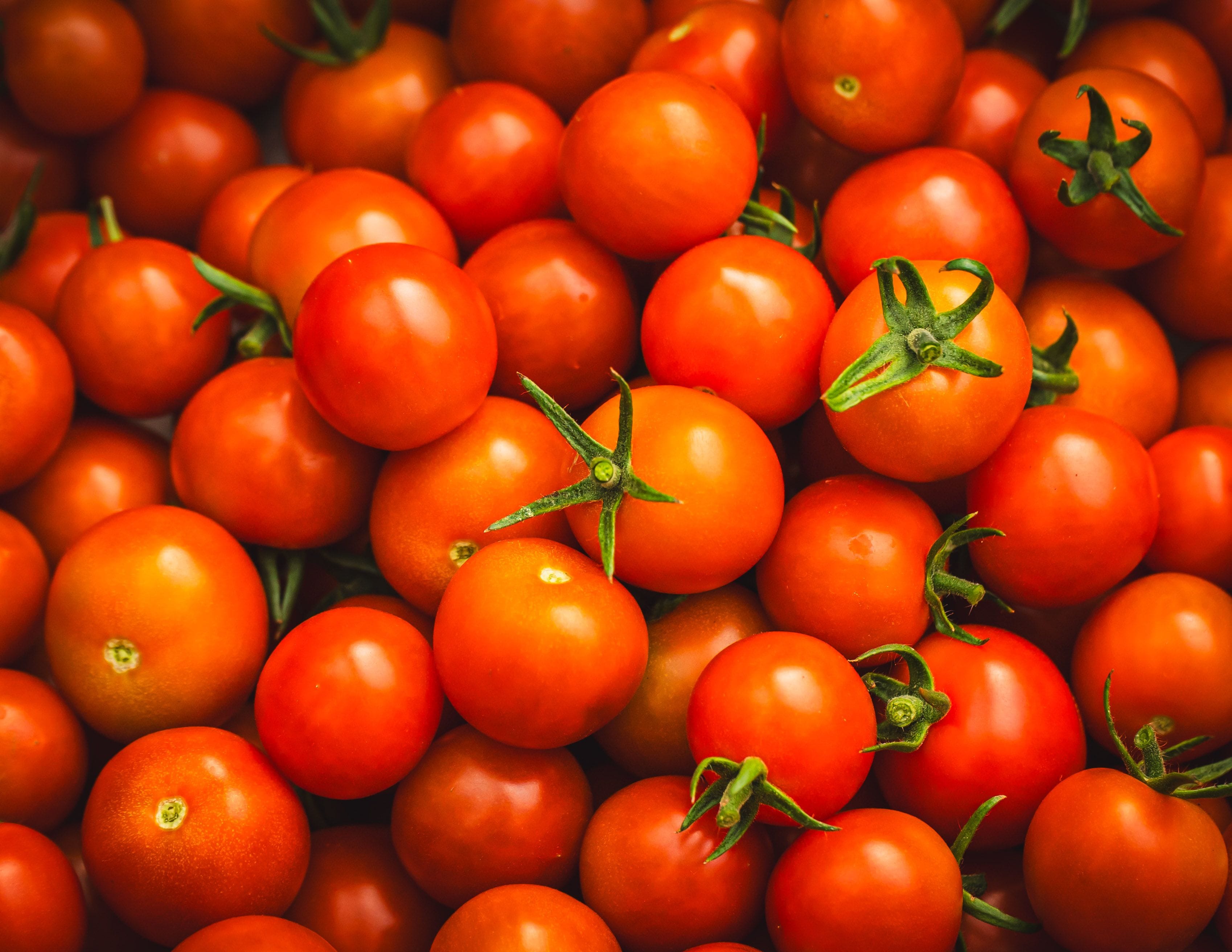
Tomato
The Neapolitan fruit — lycopene + oil + heat synergy for 3-4× bioavailability.
In 1 minute
What does it provide? Lycopene (carotenoid, antioxidant), pectin (soluble fiber), polyphenols (quercetin, naringenin, chlorogenic acid — plant pigments with vascular-protective and anti-inflammatory effects), vitamin C, and potassium — circulatory and microbiome benefits.
How much? 1-2 medium tomatoes (≈ 150–300 g)/day raw, or 1-2 tbsp tomato purée/concentrate for cooking. For lycopene focus: cooked + with oil (Fielding 2005: 25 g tomato sauce + olive oil raises plasma lycopene ≈ 3× compared to raw tomato).
When to avoid? GERD/reflux disease flare, histamine intolerance (aged + cooked forms), active gastric ulcer, Solanum allergy, severe kidney disease (potassium).
Tomato's ancestors are native to western South America at the foot of the Andes, where wild, currant-sized forms were gathered by pre-Inca peoples; domestication is linked to the Mesoamerican region, where the Aztecs cultivated several varieties under the name "xitomatl" ("navel fruit"), and the Spaniards first encountered the red fruit at the markets of Tenochtitlán after 1521. The plant was brought to Europe by the Spaniards in the mid-16th century; one of the earliest mentions is in P. A. Mattioli's 1544 herbarium, where it appears as "pomi d'oro" (golden apple) — origin of the Italian name pomodoro. In 1548 it was documented at the Medici court when Duke Cosimo I received the first shipment to his estate.
The first Italian cookbook recipes are known from the late 17th century, from Antonio Latini's 1692 "Lo Scalco alla Moderna," but for a long time it was considered an ornamental plant across much of Europe — many botanists thought it poisonous due to its kinship with deadly nightshade in the Solanaceae family, and the acidity of pewter tableware in wealthier households actually caused lead poisoning incidents, reinforcing the misconception. In the 18th–19th centuries it became the foundation of Mediterranean cuisines; later spreading to Asia through Spanish and Portuguese intermediation. In the 20th century the processing industry (concentrate, canned, sauce) made it a global ingredient — Naples's Pizza Margherita in 1889 received its Italian-flag colors in honor of Queen Margherita, launching the tomato's worldwide everyday-food journey. (pmc.ncbi.nlm.nih.gov)
🔬 Scientific Background
Tomato's lycopene content is the most-researched carotenoid: a strong antioxidant (8× singlet oxygen quenching compared to β-carotene), and in epidemiological studies shows inverse association with prostate cancer, CVD, and metabolic syndrome risk. The clinical key is bioavailability: lycopene in raw tomato is in the trans-isomer (poorly soluble), while cooking (≥ 88 °C, 30 min) and chopping cause cis-isomerization and cell wall breakdown, increasing absorption 2.5–4× fold. Adding oil (extra-virgin olive) further elevates it — lycopene is lipophilic, absorbed via micellar transport (Stahl & Sies 1996).
Pectin (soluble fiber) and polyphenols (quercetin in the skin, naringenin in Chinese canned products) ferment in the colon, yielding SCFAs. A 2018 human RCT (Wiese 2019) with lycopene + dark chocolate combination over 4 weeks in moderately obese adults showed favorable microbiome composition shift, identifying a prebiotic effect. Tomato pomace (skin/seed/processing byproduct) is extremely fiber-rich (up to 59% dry weight) and SCFA-positive in in vitro fermentation (Mehrjardi 2024).
The histamine angle: raw, ripe tomato has moderate histamine content (≈ 5–22 mg/kg), but the main issue is its histamine-releasing effect. Aged, cooked, concentrated, and canned tomato has very high histamine content, and triggers symptoms in sensitive individuals (DAO deficit) — headache, flushing, GI. The red color is anthocyanin-free — lycopene is responsible for it.
- + Extra-virgin olive oil + cooking (sofrito, ragu): 3-4× lycopene bioavailability, "Mediterranean golden combination."
- + Onion + garlic (sofrito base): Allium-fructan + polyphenol synergy.
- + Avocado (on salad): fat matrix for lycopene absorption, two-carotenoid (lutein) synergy.
- + Basil + oregano: terpene-polyphenol synergy, antioxidant effect.
- + Legumes (chickpea-tomato stew): GOS + ITF + lycopene.
- + Long slow cooking (passata, ragù alla bolognese 2-4 hours): maximizes isomerization.
- GERD/reflux + acidic tomato sauce: severe reflux symptoms.
- Histamine intolerance + cooked/aged tomato: headache, itching, flushing.
- Severe kidney disease with potassium restriction + tomato juice: concentrated potassium (≈ 230 mg/100 g juice).
- Lithium therapy: theoretical sodium balance (salted tomato products).
- Iron supplementation + large polyphenol amount: time separation (≥ 2 hours).
- MAO inhibitor (old type) + high-tyramine aged tomato: theoretical interaction.
- GERD/reflux disease flare: avoid (acidic, low LES pressure).
- Histamine intolerance (DAO deficit): especially aged, cooked, canned forms should be avoided.
- Active peptic ulcer: moderate consumption, not on empty stomach.
- Severe kidney disease (CKD 4-5): potassium monitor.
- Solanum allergy (rare): complete avoidance.
- IBS with fructose malabsorption: moderate amount.
- Infant under 8 months: avoid (acidic).
- Lithium therapy: salted tomato products separated.
Daily/weekly serving
1-2 medium tomatoes (≈ 150–300 g)/day raw or cooked. Concentrate: 1-2 tbsp for FODMAP-sensitive (≈ 28 g still low FODMAP). Passata/sauce: 100-200 ml.
Preparation pattern
- Wash thoroughly (skin lives).
- Raw: sliced and salted + olive + pepper + basil.
- Sofrito: 1 tbsp olive + finely chopped onion + garlic + diced tomato, slowly 15-20 min.
- Classic ragu: sofrito + meat + tomato passata + 2-4 hours low heat.
Classic patterns
Caprese: sliced tomato + mozzarella + basil + olive + balsamic — raw, fresh classic.
Pomodoro pasta sauce: oil + garlic + passata + basil — 15 min.
Shakshuka: sofrito + tomato + pepper + egg — Middle Eastern breakfast.
Gazpacho (Spanish): blended raw tomato + cucumber + pepper + bread + olive — cold soup.
Bolognese ragu: classic 2-4 hour slow cooking, maximizes lycopene.
Storage
Fresh ripe tomato: at room temperature 3-5 days (NOT in fridge — flavor loss). Unripe: ripens at room temperature. Cut or very ripe: refrigerated max 2 days. Passata/concentrate after opening: refrigerated 5-7 days.
What not to do
Don't refrigerate unripe or medium-ripe tomato — flavor loss. Don't cook in aluminum vessel (acidity + aluminum = flavor change). Don't panic at white mold spots on the surface of concentrate — superficially removable, good underneath (but if it goes deeper, discard).
References
[1] Stahl W, Sies H. Lycopene: a biologically important carotenoid for humans? Arch Biochem Biophys 1996;336(1):1–9.
[2] Gärtner C et al. Lycopene is more bioavailable from tomato paste than from fresh tomatoes. Am J Clin Nutr 1997;66(1):116–122.
[3] Fielding JM et al. Increases in plasma lycopene concentration after consumption of tomatoes cooked with olive oil. Asia Pac J Clin Nutr 2005;14(2):131–136.
[4] Wiese M et al. Prebiotic effect of lycopene and dark chocolate on gut microbiome with systemic changes in liver metabolism, skeletal muscles and skin in moderately obese persons. Biomed Res Int 2019;2019:4625279.
[5] Story EN et al. An update on the health effects of tomato lycopene. Annu Rev Food Sci Technol 2010;1:189–210.
[6] Maiani G et al. Carotenoids: actual knowledge on food sources, intakes, stability and bioavailability and their protective role in humans. Mol Nutr Food Res 2009;53 Suppl 2:S194–S218.
[7] Monash University. Tomato and tomato paste FODMAP content. Monash FODMAP database.
[8] Maintz L, Novak N. Histamine and histamine intolerance. Am J Clin Nutr 2007;85(5):1185–1196.