


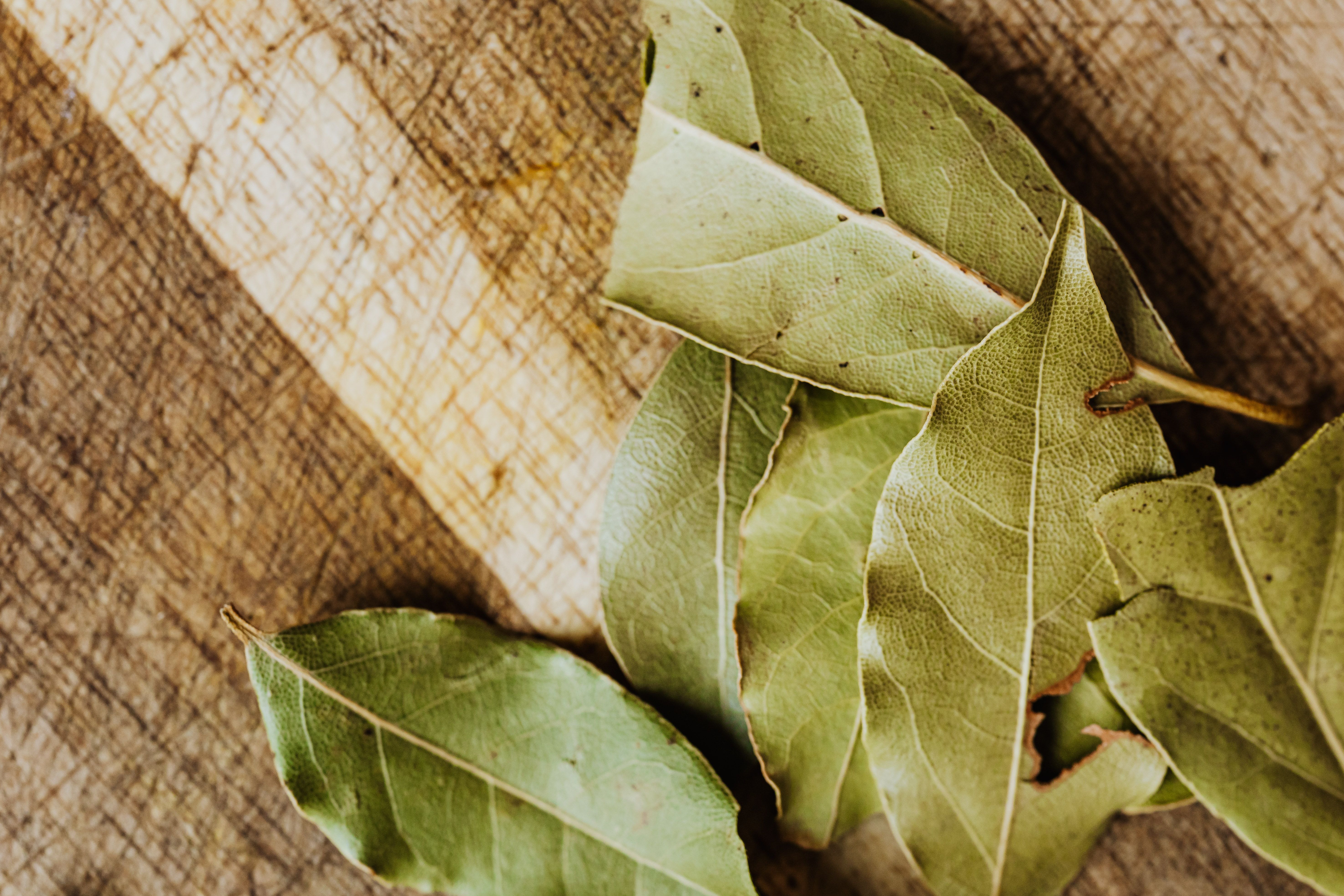
Bay Leaf
Mediterranean classic essential-oil matrix — eucalyptol, linalool, and in vitro insulin-like activity, with limited
Bay Leaf in 1 minute
What does it provide? Eucalyptol (1,8-cineole, ≈ 30–50% of the essential oil), linalool, α-pinene, and eugenol — together they create bay's characteristic balsamic-mentholated aroma. Effects: in vitro antimicrobial (H. pylori, E. coli, Candida inhibition), preclinical antidiabetic (Khan 2009 — small dose-comparison trial, n=40, 1/2/3 g daily arms, 30 days, improved fasting glucose and lipid profile in type 2 diabetics), anti-inflammatory. Sayyah (2002) showed anticonvulsant activity in animal models.
How much? In the kitchen, 1–3 whole leaves for a long-cooked dish (soup, stew, sauce) — over 30+ minutes the essential oils slowly dissolve. A daily intake of 1 leaf (≈ 0.3–0.5 g dried) is sufficient — therapeutic supplement doses (1–3 g powder/day in the Khan study) only with care, as a dietary source.
When to avoid? Swallowing a whole leaf is a CHOKING HAZARD (the leaf is hard with sharp edges — restaurant and home practice has caused airway and esophageal injuries; it must be removed before serving); Lauraceae allergy (rare); high-dose extract in pregnancy (uterotonic potential in animal data); seasonal bay pollen allergy. Detailed contraindications in the condition-specific section.
The bay leaf is the dried leaf of an evergreen tree native to the eastern Mediterranean basin, regarded as a sacred spice in ancient Greece: the priestess of Delphi (Pythia) chewed bay leaves to achieve visions (modern interpretations attribute this to the mild psychotropic effects of the essential oil), it was the sacred tree of Apollo, and winning athletes, poets, and generals received a laurel wreath (corona triumphalis). The Latin "laurus" is the root of expressions like "resting on one's laurels" and "Nobel laureate." Romans used it in the kitchen too: Apicius's "De re coquinaria" (1st century) frequently mentions it in sauces and marinades.
In medieval Arab and European medicine, Avicenna and Hildegard von Bingen alike described it as a digestion-supporting and rheumatism-relieving agent. In the first half of the 20th century, Sayyah and colleagues (2002, Iranian neuropharmacology group) demonstrated anticonvulsant and anti-inflammatory effects in animal experiments. The most clinically significant human study comes from Khan and colleagues (2009): a small dose-comparison trial in which 40 adults with type 2 diabetes received 1, 2, or 3 g/day of dried bay leaf powder for 30 days, with significant improvements in fasting glucose and HbA1c levels at all three doses. Reproductive studies and EFSA currently classify it as a dietary spice, but further data are needed for supplement-level clinical use. (Sayyah 2002; Khan 2009)
Scientific Background
Bay leaf essential oil content is ≈ 1–3% of dry weight; of this, ≈ 30–50% is eucalyptol (1,8-cineole), 8–12% α-pinene, 5–10% linalool, with smaller proportions of eugenol, sabinene, and β-pinene. Eucalyptol is a monoterpene ether that is well absorbed systemically, and is a bronchodilator (at clinical doses — e.g., Soledum 200 mg capsule), anti-inflammatory (LTB4 and PGE2 inhibition), and mild secretolytic.
The preclinical antidiabetic mechanism: aqueous and methanolic bay leaf extracts enhance insulin-receptor signaling efficacy and exert in vitro insulin-like effects on muscle and liver cells. In Khan's (2009) small dose-comparison trial (n=40, 1/2/3 g/day arms, parallel placebo) diabetics received bay leaf powder for 30 days: fasting glucose decreased by 21–26%, HbA1c by 0.4–0.7 units — a promising result, but the sample is small and independent confirmation is needed.
In the antimicrobial profile, bay leaf essential oil inhibits the growth of H. pylori, E. coli O157:H7, Listeria monocytogenes, and Candida albicans in vitro. Commensal Lactobacillus and Bifidobacterium strains are relatively spared. This explains the traditional use as a food preservative (sauerkraut, pickled cucumber, fish marinade).
Neuropharmacologically, in Sayyah's (2002) Iranian study, bay leaf essential oil was anticonvulsant in a rat seizure model (PTZ-induced) — parthenolide-like sesquiterpene lactones are the presumed active components. No human epilepsy data exist.
At the microbiome level, the bay leaf polyphenol-fiber matrix delivers prebiotic micro-components, while the essential-oil fraction selectively reduces opportunistic pathogens. The effect is dose-dependent — culinary amounts are mild, clinical doses (1+ g/day) more pronounced.
- + Long-cooked dishes (soup, goulash, stew, sauce): essential oils dissolve slowly over 30+ minutes of cooking — the classic Mediterranean and Central European practice is optimal.
- + Fatty matrix (olive, butter, ghee, coconut oil): eucalyptol and linalool are fat-soluble — better absorption in a rich matrix.
- + Onion, garlic, thyme, rosemary (Mediterranean spice bouquet): the classic "bouquet garni" — synergistic antioxidant and antimicrobial profile.
- + Meat broths, bone broth: bay is traditionally a foundation of bone broth and Central European meat soups — collagen and aroma balance.
- + Legumes (beans, lentils, chickpeas): reduces bloating (carminative essential oils), classic ingredient in bean dishes and Italian minestrone.
- + Pickling (vinegar, brine): bay's antimicrobial activity stabilizes fermentation — sauerkraut, pickled cucumber, fish marinade.
- Antidiabetic medications (metformin, sulfonylureas, insulin) + high-dose bay leaf extract: additive hypoglycemia risk. Regular 30+ day intake at 1–3 g/day requires medical monitoring in diabetes.
- Anticoagulants (warfarin, DOACs, aspirin) + high-dose bay leaf extract: theoretical antiplatelet effect — additive bleeding risk. Culinary dose is safe.
- CYP3A4 substrates: bay leaf essential oil modulates some CYP enzymes in vitro — caution with clinical-dose supplements.
- Sedative agents (benzodiazepines, alcohol): high-dose eucalyptol may enhance sedation — theoretical additive.
- Whole-swallowed bay leaf in any setting: sharp edges and hard structure can cause esophageal and pulmonary aspiration injury — MUST BE REMOVED before serving.
- High-dose oral bay essential oil (NOT FOR CULINARY USE — concentrated aromatherapy product): theoretical hepato- and nephrotoxic risk.
- Choking and aspiration risk: swallowing a whole bay leaf is INDIGESTIBLE — sharp edge, hard structure, esophageal puncture, pulmonary aspiration documented. MUST BE REMOVED BEFORE SERVING — especially with infants, small children, dementia patients, intoxicated state, or rapid eating.
- Diabetes on insulin therapy: bay potentially adds hypoglycemic activity — medical supervision for regular intake.
- Pregnancy, at high doses: uterotonic animal data — culinary 1–2 leaves safe, but 1+ g/day powder to be avoided.
- Breastfeeding: clinical dose to be avoided, culinary OK.
- Lauraceae allergy: rare, but cross-reactivity with cinnamon, sassafras, avocado possible.
- Active epilepsy with high-dose essential oil: paradoxically, concentrated eucalyptol-containing essential oil may provoke epileptic seizures (dietary bay is safe).
- GERD/reflux disease flare: essential oil may irritate — large amounts of bay-rich sauce during flare to be avoided.
- 2 weeks before surgery: clinical-dose supplement to be avoided (bleeding risk).
- Infants and small children: the whole leaf poses a choking hazard — extra care, removal mandatory.
Daily serving (culinary): 1–3 leaves for a long-cooked dish (4–6 people).
Timing of addition: add at the BEGINNING of cooking (NOT at the end) — essential oils dissolve optimally over 30+ minutes. 60+ minutes of cooking further concentrates the aroma.
Classic patterns:
- Hungarian goulash/stew: 2 leaves under the onion-fat base, 90 min cooking.
- Italian ragù (bolognese, osso buco): 1–2 leaves, 2 hours slow cooking.
- Bouquet garni (French): 1 bay + 2 thyme stems + parsley stems tied with kitchen string → soup, stew, sauce.
- Bean stew/lentil soup: 1–2 leaves in the cooking water with legumes → carminative effect.
- Meat broth (chicken, beef, fish): 1–2 leaves, 2 hours cooking.
- Pickled cucumber, sauerkraut, fish marinade: 1–2 leaves per 1 L brine — antimicrobial stabilization.
- Bay tea (with medical consultation, NOT routine): 1 leaf + 250 ml water, 10 min boil. Khan protocol: 1 g powder daily for 30 days in diabetes.
Storage: in an airtight glass jar, dark and cool. High-quality dried leaf retains its aroma for ≈ 1 year. Fresh leaf in the fridge 2 weeks, frozen 6 months. "Old" (3+ years) leaf loses essential oil content.
What not to do: don't serve the whole leaf in the dish — puncture, choking risk. Don't cook above 100 °C for 2+ hours — essential oil loss causes aroma decline. Don't use bay essential oil orally or for cooking (aromatherapy/external use only). Don't confuse Laurus nobilis with California bay (Umbellularia) or cherry laurel (Prunus laurocerasus — TOXIC).