


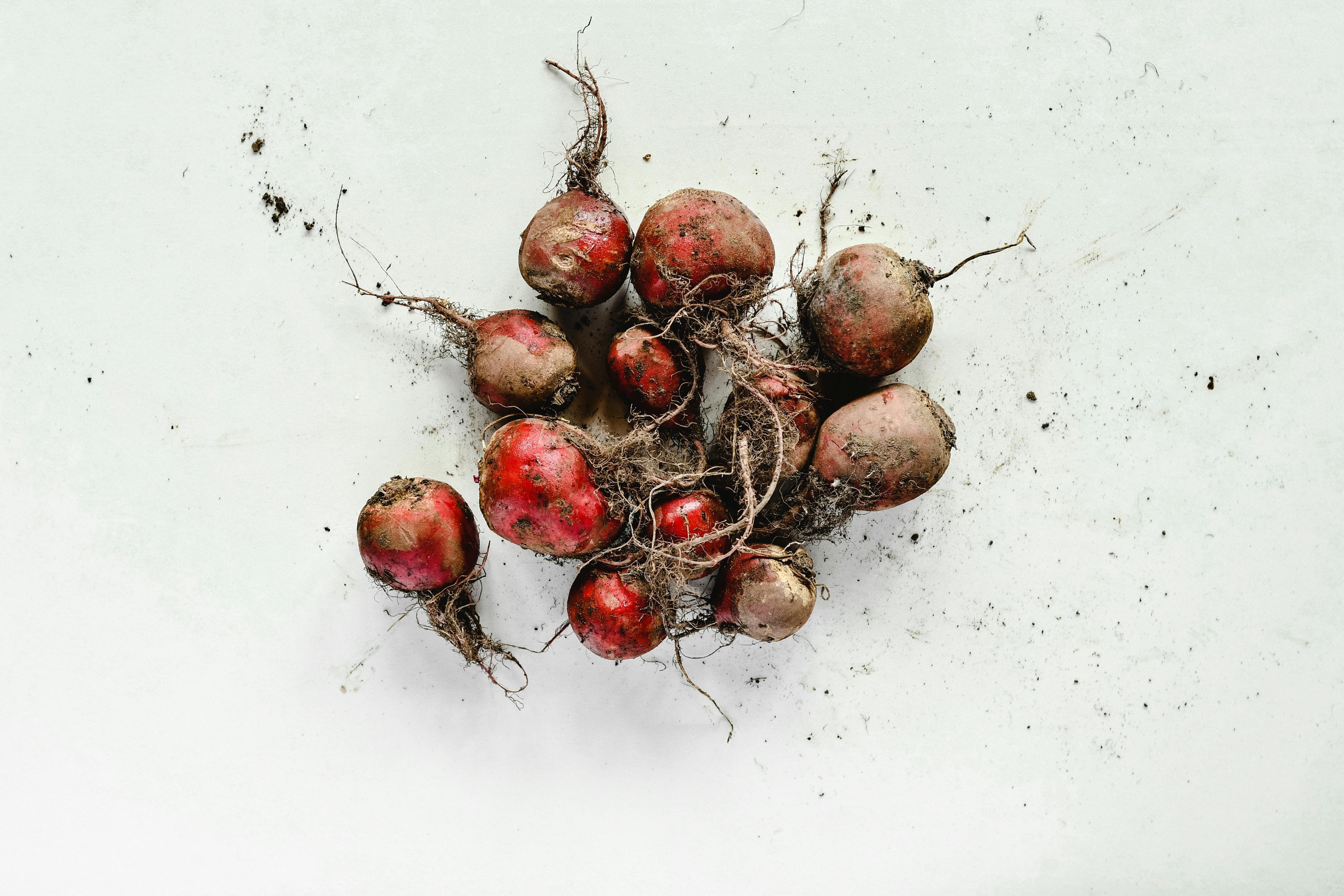
Beetroot
The nitrate king — blood pressure reduction via oral flora, with betalain on the kidney-stone gray zone.
In 1 minute
What does it provide? Dietary nitrate (250–500 mg/100 g) → converted to nitrite by oral bacteria → NO, which is vasodilatory and BP-lowering. Plus pectin, betalains (antioxidant pigments), folate.
How much? ½–1 medium beetroot (≈ 100–150 g) steamed/roasted/in soup 3-4×/week; or 250–500 ml beetroot juice for acute BP effect (≈ 5–7 mmHg drop within 2-3 hours).
When to avoid? Calcium oxalate kidney stone predisposition (oxalate ≈ 45–105 mg/100 g), active kidney stone, hypotension flare, when using antibacterial mouthwash (nitrate effect is abolished).
Beetroot was domesticated from the wild sea beet (B. vulgaris subsp. maritima) lineage along the Mediterranean coasts; it was already cultivated in ancient Egypt, Greece, and Rome — initially primarily for its leaves, as a chard-like vegetable, and only later for its swollen, sweet root. Classical authors such as Theophrastus and Pliny mention "Beta" uses in detail in their botanical and medicinal works; the Roman cuisine particularly favored it in Apicius's recipes, where it appeared together with honey, wine, and vinegar. In the Middle Ages it was used as medicine due to its red color and digestive effect, and in the 17th century it was even used to color wines.
The modern form of beetroot with its swollen root finally took shape in 16th–17th century Europe, and the 18th–19th centuries brought an industrial-history revolution within the species complex: Andreas Marggraf discovered in 1747 that sugar beet relatives contain sucrose, and his student Franz Karl Achard opened the world's first sugar beet factory in Silesia in 1801 — a revolution in industrial sugar history that reorganized all Western nutrition. Chard, the celery-stalk-like stem, fodder beet, and sugar beet all come from the same species complex. Today it is consumed worldwide in fresh, cooked, pickled, and fermented forms — particularly the Eastern European beet kvass. (en.wikipedia.org, topostext.org)
🔬 Scientific Background
Beetroot has three distinct mechanisms: (1) Dietary nitrate–nitrite–NO pathway: ingested nitrate is reduced to nitrite by the oral microbiome (especially Veillonella, Actinomyces), which then converts to NO with gastric acid and in tissues. NO is vasodilatory, BP-lowering, endothelial-function-improving. (Webb 2008 classic RCT: 500 ml beetroot juice → -10/-8 mmHg within 2-3 hours.) (2) Betalain antioxidants: the betacyanin (betanin, dark purple) and betaxanthin (yellowish) pigments have strong antioxidant + Nrf2-activating potential. (3) Pectin fiber + polyphenols: colon fermentation, SCFA production.
The clinical BP effect is dose-dependent: 5–6 mmol nitrate (≈ 250 ml beetroot juice) is significant, 8–13 mmol gives a robust effect. Meta-analyses (Siervo 2013) confirm an average -4.4 mmHg systolic reduction in hypertensives. Sports performance: nitrate supplementation provides VO2 efficiency and endurance increase (Lansley 2011).
Critical mechanism: if antibacterial mouthwash (chlorhexidine, Listerine) is used, the oral reducing bacteria are killed and the nitrate-BP effect is abolished (Govoni 2008). The oxalate angle: beetroot is moderately high in oxalate, which is relevant for those prone to calcium oxalate kidney stones. Boiled-then-drained beetroot has 30-50% lower oxalate content.
- + Calcium source (yogurt, kefir, feta): oxalate binding in the gut, reduced absorption.
- + Lemon + olive: classic Mediterranean dressing, betalain stabilization.
- + Apple cider vinegar + horseradish (classic Russian-Hungarian): color fixing, acidic medium.
- + Live cultures (beet kvass, fermented beetroot): synbiotic, more bioavailable.
- + Legumes (lentil-beetroot salad): fiber + GOS + nitrate combo.
- + Roasting in skin (110-120 min, 180 °C): caramelized, betalain-preserved.
- Antibacterial mouthwash (chlorhexidine, Listerine): nitrate-BP effect is abolished — DO NOT rinse around meals.
- Long boiling with discarded liquid: betalain loss, nitrate leaching.
- Iron supplementation + large polyphenol amount: time separation.
- Magnesium-containing antacid + large oxalate dose: theoretical kidney stone promoter.
- Hypotension-sensitive individuals + 500 ml juice at once: sudden BP drop, dizziness.
- PDE5 inhibitors (Viagra, Cialis) + high nitrate intake: NO synergy, excessive vasodilation.
- Calcium oxalate kidney stone predisposition: moderate consumption, boiled-drained form, with calcium accompaniment.
- Active kidney stone: avoid large dose.
- Severe hypotension: start with small dose, BP monitor.
- PDE5 inhibitor therapy: nitrate synergy contraindicated.
- Methemoglobinemia predisposition (rare): avoid large nitrate dose.
- Infant under 6 months: nitrate poisoning risk — clearly avoid.
- Acute gout flare: moderate purine, restraint.
- After beeturia (red urine) appearance: harmless phenomenon, but signals iron absorption decrease — worth checking iron status.
Daily/weekly serving
½–1 medium beetroot (≈ 100–150 g)/day in cooked/roasted/pickled form. For acute BP effect: 250–500 ml beetroot juice.
Preparation pattern
- Wash thoroughly, don't peel (cooks/roasts best in skin).
- Roasting in skin: at 180 °C for 60-90 min in foil — sweet, concentrated.
- Steaming: whole 30-45 min.
- Raw: grated on salad (lemon dressing).
- In juice: in blender + apple + ginger + lemon.
Classic patterns
Beet kvass (Polish-Ukrainian): raw beetroot + water + salt + starter, fermented 5-7 days at room temperature — synbiotic, nitrate-preserved.
Borscht (Ukrainian): beetroot soup with beef, potato, cabbage + sour cream.
Beetroot salad (Russian/Hungarian): grated roasted beetroot + horseradish + apple + walnut + olive.
Goat cheese + roasted beet salad: roasted beetroot + goat cheese + walnut + balsamic.
Hummus de remolacha: beetroot + chickpea + tahini + lemon + garlic — vibrant pink.
Storage
Fresh whole (in skin): refrigerated 2-3 weeks. Cooked: refrigerated 3-5 days. Kvass in jar refrigerated: 3-4 weeks. Frozen (roasted cubes): 8-10 months.
What not to do
Don't boil 30+ min uncovered (betalain loss, tasteless). Don't peel before cooking (juice runs out, bleeding texture). Don't rinse with antibacterial mouthwash before/after beetroot meals. Don't panic about beeturia (red urine).
References
[1] Webb AJ et al. Acute blood pressure lowering, vasoprotective, and antiplatelet properties of dietary nitrate via bioconversion to nitrite. Hypertension 2008;51(3):784–790.
[2] Siervo M et al. Inorganic nitrate and beetroot juice supplementation reduces blood pressure in adults: a systematic review and meta-analysis. J Nutr 2013;143(6):818–826.
[3] Lansley KE et al. Acute dietary nitrate supplementation improves cycling time trial performance. Med Sci Sports Exerc 2011;43(6):1125–1131.
[4] Govoni M et al. The increase in plasma nitrite after a dietary nitrate load is markedly attenuated by an antibacterial mouthwash. Nitric Oxide 2008;19(4):333–337.
[5] Clifford T et al. The potential benefits of red beetroot supplementation in health and disease. Nutrients 2015;7(4):2801–2822.
[6] Hobbs DA et al. Acute ingestion of beetroot bread increases endothelium-independent vasodilation and lowers diastolic blood pressure in healthy men. J Nutr 2013;143(9):1399–1405.
[7] Holmes RP et al. Dietary oxalate and the risk for nephrolithiasis. J Am Soc Nephrol 2004;15(12):3225–3232.
[8] Monash University. Beetroot FODMAP content. Monash FODMAP database.