


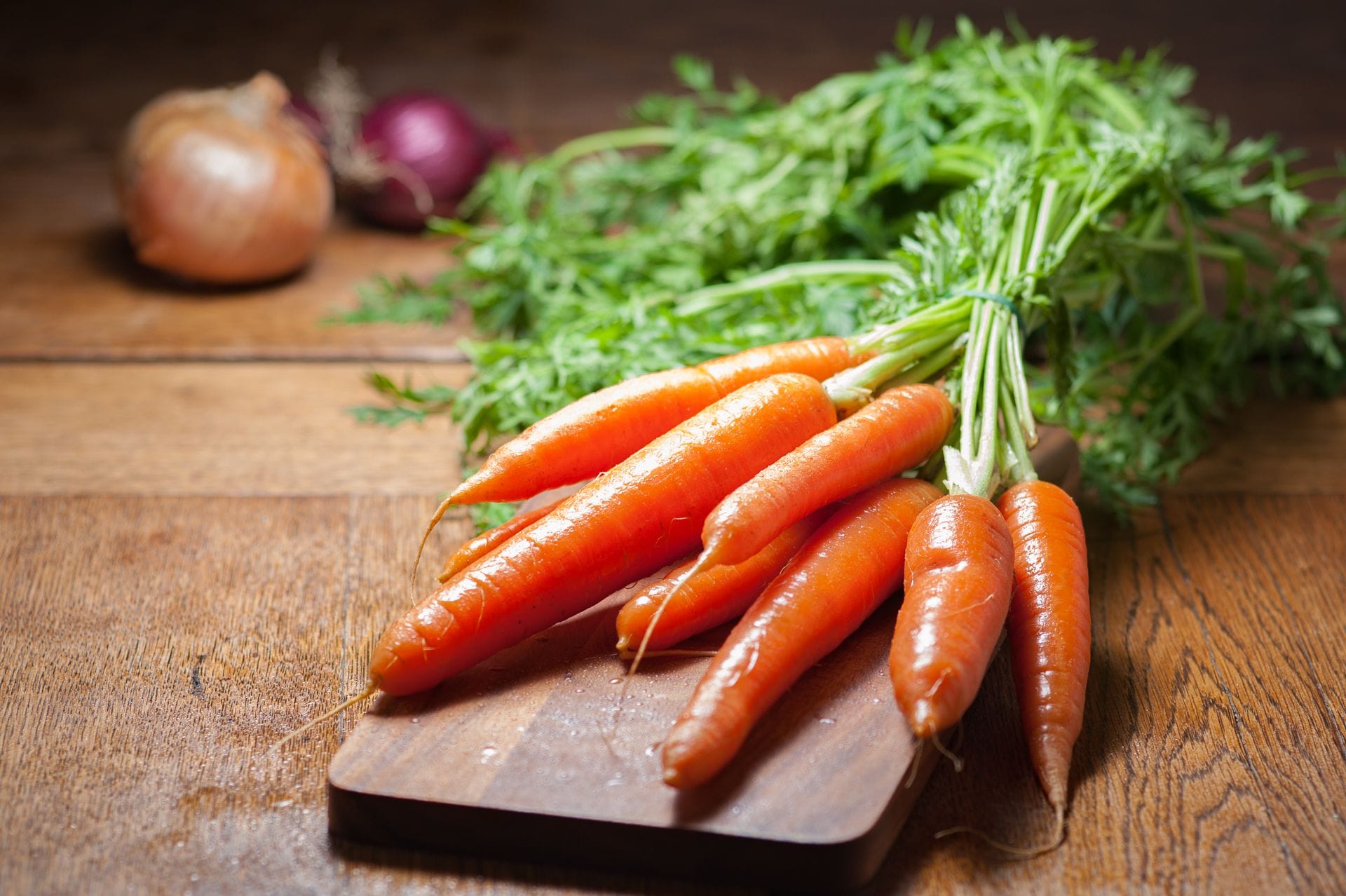
Carrot
The orange foundation side — RG-I pectin + β-carotene + falcarinol, low-FODMAP IBS-friendly.
In 1 minute
What does it provide? Soluble fiber (RG-I pectin and arabinogalactan — selectively prebiotic, characteristically propionate-producing plant fiber fractions), β-carotene (provitamin A), falcarinol (polyacetylene, inflammation modulator), as well as vitamin K and potassium — selective propionate-positive SCFA shift.
How much? 1-2 medium carrots (≈ 100–200 g)/day raw, cooked, or in soup. For carotenoid focus: pureed + with oil.
When to avoid? Large amounts of carrot leaves during warfarin therapy (vitamin K); active gallstone attack (carotenoids are moderately choleretic); Apiaceae allergy (celery, parsley, anise cross-reactivity); infant under 6 months (nitrate content). Detailed contraindications in the condition-specific section.
Carrot cultivars were domesticated in the West-Central Asian region during the early Middle Ages according to genetic and historical data — the early Eastern domesticated carrot was purple or yellow in color, and by the 13th century was already grown in Europe and China. Starting from the Eastern world's colorful palette, Afghan purple carrots reached Europe through Arab trade. The orange "Western" types were selected only in the 16th–17th centuries, probably in Western Europe, as carotenoid-rich lines — a recurring scene in 17th-century Dutch painting is the vibrant orange market carrot bundle.
The "orange equals Dutch royal tribute" story is more legend; according to modern population genomics work, conscious selection of the orange type happened during the Renaissance, amplifying carotenoid accumulation — the famous color of the Dutch "Oranje" house inspired a later popularizing narrative, though Dutch variety breeding indeed was decisive in fixing the final carotenoid-rich lines. By the 19th–20th centuries, carrot became a worldwide staple vegetable. (Nature, pmc.ncbi.nlm.nih.gov)
🔬 Scientific Background
Carrot's soluble fiber has a unique profile: the main fraction is rhamnogalacturonan-I (RG-I) type pectin, structurally different from artichoke and other vegetables. The "cRG-I" (carrot RG-I) fraction is a well-documented prebiotic: in human fecal fermentation studies it produced a strong and reproducible propionate-positive SCFA response across multiple donor microbiotas. The arabinogalactan protein (AGP) fraction adds further selective effects.
β-carotene bioavailability dramatically depends on preparation and fat matrix: from raw grated carrot ≈ 3-4% absorption, from cooked-pureed + olive oil ≈ 60-65% (Tang 2009 human RCT). "Carrot puree + olive oil" is the classic bioavailability maximization — perfect matrix in baby food and soups.
Falcarinol and falcarindiol (polyacetylenes) have documented anti-inflammatory and chemoprotective effects in preclinical models; human data are limited, but in vitro they also cause microbiome shifts. Carrot leaves are particularly vitamin K-rich (≈ 350 μg/100 g) — anticoagulant users should watch quantities.
2024 in vitro work detailed cRG-I structure-dependent fermentation dynamics — the ratio of galactose-mannose side chains determines the propionate/butyrate ratio.
- + Extra-virgin olive oil + heat (cream soup, pureeing): 10-20× β-carotene bioavailability increase.
- + Avocado (grated raw on salad): fat matrix for carotenoid uptake.
- + Ginger + turmeric (classic Indian-Asian): polyphenol synergy, anti-inflammatory.
- + Yogurt / kefir (grated carrot salad): synbiotic (RG-I + LAB).
- + Cumin, coriander (Middle Eastern): essential oil synergy, better digestion.
- + Fermented carrot (LAB starter): postbiotic, more bioavailable.
- + Honey (carrot-honey-ginger juice): easy-to-drink breakfast, polyphenol stabilization.
- Too long boiling (≥ 30 min) with discarded water: RG-I pectin and carotenoid leaching.
- Iron supplementation + large polyphenol amount: time separation (≥ 2 hours).
- Anticoagulants + large amount of carrot leaves: vitamin K fluctuation.
- Too much raw carrot (3+ medium/day for weeks) with skin issues: carotenoderma (harmless but cosmetically bothersome).
- Extreme honey-carrot juice in the morning for diabetics: glucose spike, especially concentrated.
- Bowel inflammation flare (Crohn's, UC) + large raw dose: raw fiber irritation.
- Carotenoderma risk: too much raw carrot for weeks — skin becomes yellowish-orange. Harmless, reduce dose.
- Severe kidney disease with potassium restriction: moderate potassium — portion control.
- Diabetes mellitus + sweetened carrot juice: avoid (glycemic when sweetened).
- Acute Crohn's/UC flare: moderate raw, cooked-pureed is safe.
- Apiaceae allergy (rare): avoidance (celery-family cross-reactivity).
- Infant under 4-6 months: avoid (due to nitrate content).
- Anticoagulant therapy (carrot leaves): consistent dose.
- Gout: very low purine — safe.
Daily/weekly serving
1-2 medium carrots (≈ 100–200 g)/day. For carotenoid focus: ½ cup cooked + 1 tbsp olive oil.
Preparation pattern
- Wash thoroughly, don't peel (if organic).
- Raw: grated on salad with lemon dressing.
- Steaming: thin rounds 5-7 min.
- In oven: whole with skin at 200 °C for 25-35 min.
- Cream soup: olive + onion + carrot + stock + 20 min + pureeing.
Classic patterns
Carrot ginger soup: carrot + ginger + coconut milk + lime — vibrant, immune-supporting.
Glazed carrots (French): in butter + sugar + water slowly evaporates → glossy side dish.
Moroccan carrot salad: cooked carrot + cumin + harissa + olive + lemon.
Grated raw carrot salad (German Karottensalat): grated raw carrot + apple + walnut + olive + lemon.
Tzimmes (Jewish): carrot + sweet potato + prune + honey, slowly cooked festive side.
Storage
Fresh whole: refrigerated (vegetable drawer) 3-4 weeks. In baby spinach bag fresh-kept. Grated: refrigerated 1-2 days. Cooked: refrigerated 3-4 days. Frozen (blanched): 8-10 months.
What not to do
Don't store with potatoes (ethylene softening). Don't boil 30+ min (flavor, color, RG-I loss). Don't discard the green leaves (in pesto as a green herb!).
References
[1] Tang G. Bioconversion of dietary provitamin A carotenoids to vitamin A in humans. Am J Clin Nutr 2010;91(5):1468S–1473S.
[2] Mortelé O et al. Consistent prebiotic effects of carrot RG-I on the gut microbiota of four human adult donors in the SHIME® model despite baseline individual variability. Microorganisms 2021;9(10):2109.
[3] Van den Abbeele P et al. A novel non-digestible, carrot-derived polysaccharide (cRG-I) selectively modulates the human gut microbiota while promoting gut barrier integrity. Nutrients 2020;12(7):1917.
[4] Larsen LR et al. Polyacetylenes (falcarinol type) in vegetables. J Agric Food Chem 2019.
[5] Brown L et al. Polyacetylenes from carrots and their potential health benefits. Food Funct 2020.
[6] Bode AM et al. Carotenoids and human health. Adv Nutr 2014.
[7] Iorizzo M et al. A high-quality carrot genome assembly provides new insights into carotenoid accumulation and asterid genome evolution. Nat Genet 2016;48(6):657–666.
[8] Monash University. Carrot FODMAP content. Monash FODMAP database.