


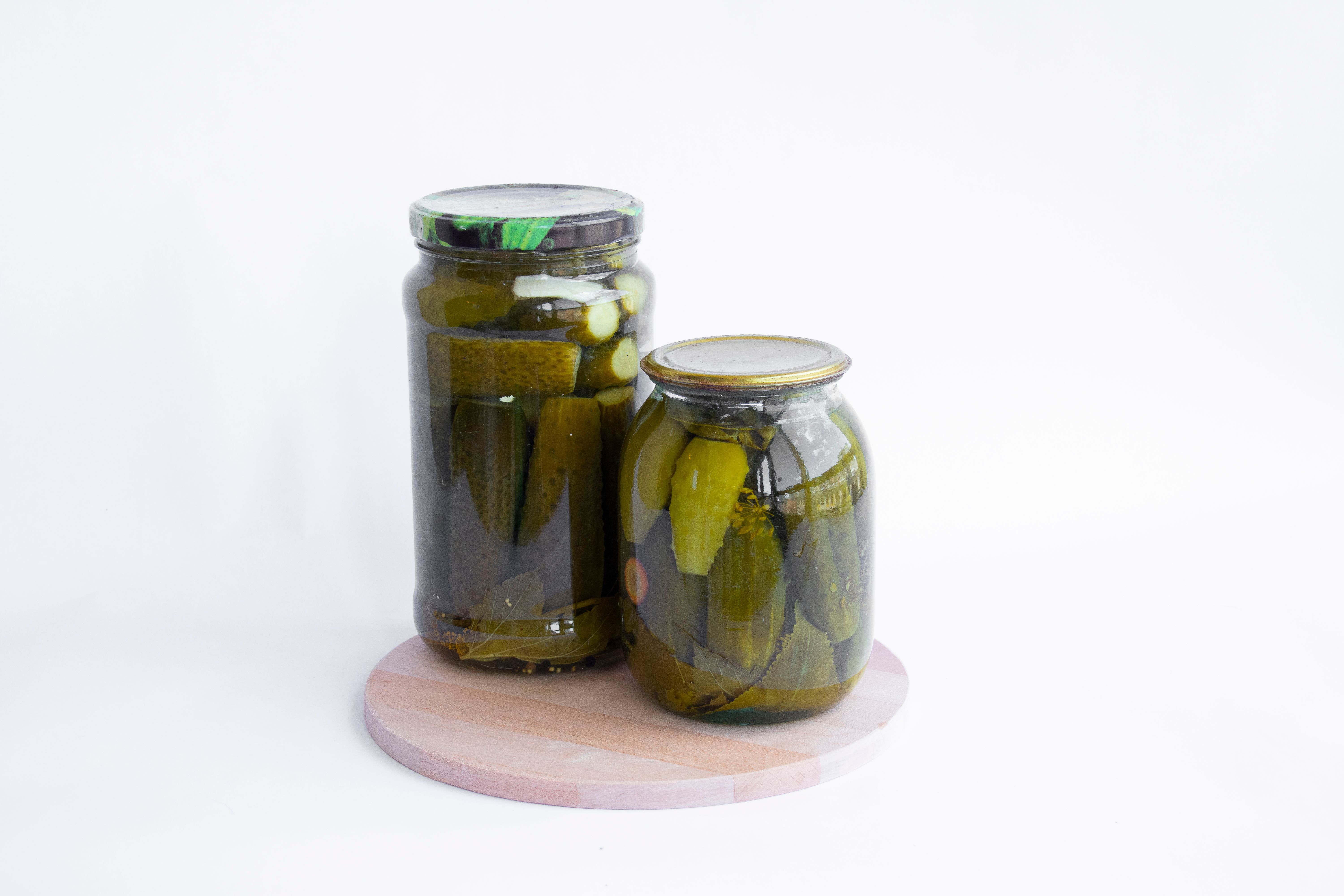
Brined / lacto-fermented cucumber
Natural lactic acid bacteria in a sun-ripened summer matrix — NOT the same as vinegar pickles.
In 1 minute
What does it provide? Live lactic acid bacteria (mainly Lactiplantibacillus plantarum and Leuconostoc mesenteroides — they ferment successively in the brine, bringing pH below 4.2), lactic acid, exopolysaccharides (postbiotic matrix), and cucumber fiber. NOT THE SAME as vinegar pickles (which are preserved with acetic acid, without live microbes). Wastyk 2021 (Stanford, 10 weeks, fermented foods): microbiome diversity increase, reduction in 19 inflammatory signaling proteins — analogous matrix.
How much? 1–3 medium slices (≈ 30–80 g) daily or 3–4 × 100 g per week, with meals, from a REFRIGERATED, NON-pasteurized product (label: only "water, salt" — if "vinegar" appears first, it is NOT lacto-fermented). 50–100 g/day is the practical upper limit due to sodium.
When to avoid? MAO inhibitor therapy (tyramine → hypertensive crisis); strict Na restriction (hypertension, heart failure — 600–900 mg Na/100 g); active reflux disease or gastric ulcer flare; severe immunosuppression (live microbes). Detailed condition-specific contraindications (histamine intolerance, SIBO flare, young children, CKD) in the section below.
The story of brine-fermented cucumber begins in Mesopotamia: according to archaeologists, settlements along the Tigris were already pickling cucumber-like vegetables around 2030 BCE, and the method spread from there along the Silk Road from India, where the cucumber was domesticated some three thousand years ago. In the kitchens of Central and Eastern Europe, brined cucumber became a favorite of both winter preservation and early-summer souring; the essence of the process is the same everywhere — lactic acid bacteria naturally present on the raw material preserve the cucumber in a salty anaerobic medium by producing lactic acid and aroma compounds.
In Hungarian peasant tradition, the sun-ripened, bread-started variant of brined cucumber was tied to the hot summer months: the dill, garlic, and the yeasts released from a slice of sourdough bread placed on top, combined with summer heat, created the ideal environment for the Leuconostoc → Lactobacillus succession. Twentieth-century industrial fermentation added control to this — starter cultures (e.g., Lactiplantibacillus plantarum), even pH curves, and regulated temperature — and we now know that the same LAB family that works in sauerkraut and kimchi is also at work in the brined-cucumber barrel.
🔬 Scientific Background
Brined cucumber is a lactofermentation, started either spontaneously or with a starter culture. The cucumber is covered in 2–3% brine, stored in an anaerobic environment, and the LAB present on the cucumber surface convert sugars → lactic acid. The characteristic microbial sequence: Leuconostoc mesenteroides → Lactiplantibacillus plantarum/pentosus → Pediococcus — each stage operates in a different pH range and produces different aroma compounds.
The IMPORTANT difference: brined / lacto-fermented cucumber is NOT the same as vinegar pickles. The vinegar (acidified) version is soured with acetic acid, NOT fermented — there are no live microbes in it, only acid preservation. The lacto-fermented version has pH < 4.6, with live LAB and fermentation metabolites.
Clinical evidence stands mainly at the fermented-vegetable category level: the Wastyk et al. 2021 10-week Stanford study (fermented foods + sauerkraut + kefir + yogurt + kombucha) produced increased microbiome diversity and reduction in 19 inflammatory signaling proteins. A 2018 Nielsen pilot RCT with sauerkraut showed IBS symptom improvement — analogous matrix.
There are not yet many cucumber-specific RCTs, but the LAB ecosystem described by the McDonald-led USDA group (documented since the 1990s) is consistent: in every properly fermented brined cucumber, Lb. plantarum dominates, and the end product has pH < 4.2.
- + Whole-grain bread, legumes: fiber + LAB = synbiotic synergy, broader SCFA profile.
- + Resistant starch (cooked-then-cooled rice, potato): RS3 + LAB → stronger butyrate production in the colon.
- + Yogurt, kefir, sauerkraut: multi-fermented-food diet — the Wastyk study validated this pattern.
- + Cold platter, cheese, meat: classic Central/Eastern European pattern, natural salad complement.
- + Caraway, coriander, dill (whole): carminative effect, reduces the bloating potential of fermented vegetables.
- + Cold consumption (NOT cooked): if live LAB is the goal — heating above 70 °C destroys it.
- High-Na meals (bacon, salted fish): brined cucumber has 600–900 mg Na/100 g — totals add up.
- MAO inhibitor therapy: tyramine can form during fermentation → risk of hypertensive crisis.
- Anticoagulant therapy (warfarin): if the product contains high amounts of vitamin K–rich green dill — INR may fluctuate.
- Hot soup or cooked dish (≥ 70 °C): don't cook it in, as live LAB will be destroyed.
- Large amounts on an empty stomach: acidity can provoke reflux.
- Iron supplementation: separate by ≥ 2 hours (acids/polyphenols can chelate).
- Severe hypertension, heart failure, Na restriction: avoid due to high sodium.
- Histamine intolerance: biogenic amines can form during fermentation — test with a small portion.
- MAO inhibitor therapy (phenelzine, tranylcypromine, moclobemide): strictly avoid due to tyramine.
- Active reflux disease, gastric ulcer flare: acidity can aggravate GI irritation — wait for remission.
- IBS, SIBO flare: start with a small portion; some are sensitive due to osmotic load.
- Chronic kidney disease with Na/K limits: portion control.
- Infant, child < 2 years: high Na, choking risk — avoid.
- Severe immunosuppression: live microbes should be avoided.
Daily serving
Introduction: 1–2 slices (≈ 30 g) daily.
Maintenance: 2–4 slices (≈ 50–100 g) daily or 3–4 × 100 g per week.
Preparation pattern — homemade brined cucumber
- 1 kg small pickling cucumbers, washed, de-spined, scored at both ends.
- 1 liter water + 30 g (non-iodized) salt (3% brine).
- Layer into a jar with dill, 2–3 cloves of garlic, caraway, mustard seed.
- On top: a slice of sourdough bread or grape leaf (tannin → keeps them crisp).
- Press down with a weight so all cucumbers stay submerged.
- Room temperature for 3–7 days (to taste), then refrigerate.
Classic patterns
Hungarian sun-fermented cucumber: dill + garlic + sun-ripening, bread-started.
Polish ogórki kiszone: longer fermentation, cold-stored — dill, garlic, horseradish.
Russian solyonye ogurtsy: currant leaf, oak leaf, coriander, mustard seed.
On salad: sliced over greens, no dressing (the acidity is the dressing).
Smoothie boost: 1 tbsp brine in a morning green smoothie.
Storage
Refrigerated airtight for 3–4 months. White surface bloom → skim off the top, the rest is fine. Color change, off smell → discard.
What not to do
Don't cook at high heat (loss of live LAB). Don't use iodized salt (it slows fermentation). Don't skip the grape/horseradish leaf if you want a crunchy end result.
References
[1] McDonald LC et al. Acid tolerance of Leuconostoc mesenteroides and Lactobacillus plantarum. Appl Environ Microbiol 1990;56(7):2120–2124.
[2] Wastyk HC et al. Gut-microbiota-targeted diets modulate human immune status. Cell 2021;184(16):4137–4153.
[3] Nielsen ES et al. Lacto-fermented sauerkraut improves symptoms in IBS patients. Food Funct 2018;9(10):5323–5335.
[4] Marco ML et al. Health benefits of fermented foods: microbiota and beyond (ISAPP). Curr Opin Biotechnol 2017;44:94–102.
[5] Pérez-Díaz IM et al. Fermentation of cucumbers — review of the microbial ecology. USDA-ARS.
[6] Behera SS et al. Lactic acid fermentation of vegetables: a review. Crit Rev Food Sci Nutr 2018;58(15):2456–2470.
[7] ISAPP. Fermented foods consensus statement. Nat Rev Gastroenterol Hepatol 2021.
[8] Monash University FODMAP database. Pickled cucumber serving guide.