


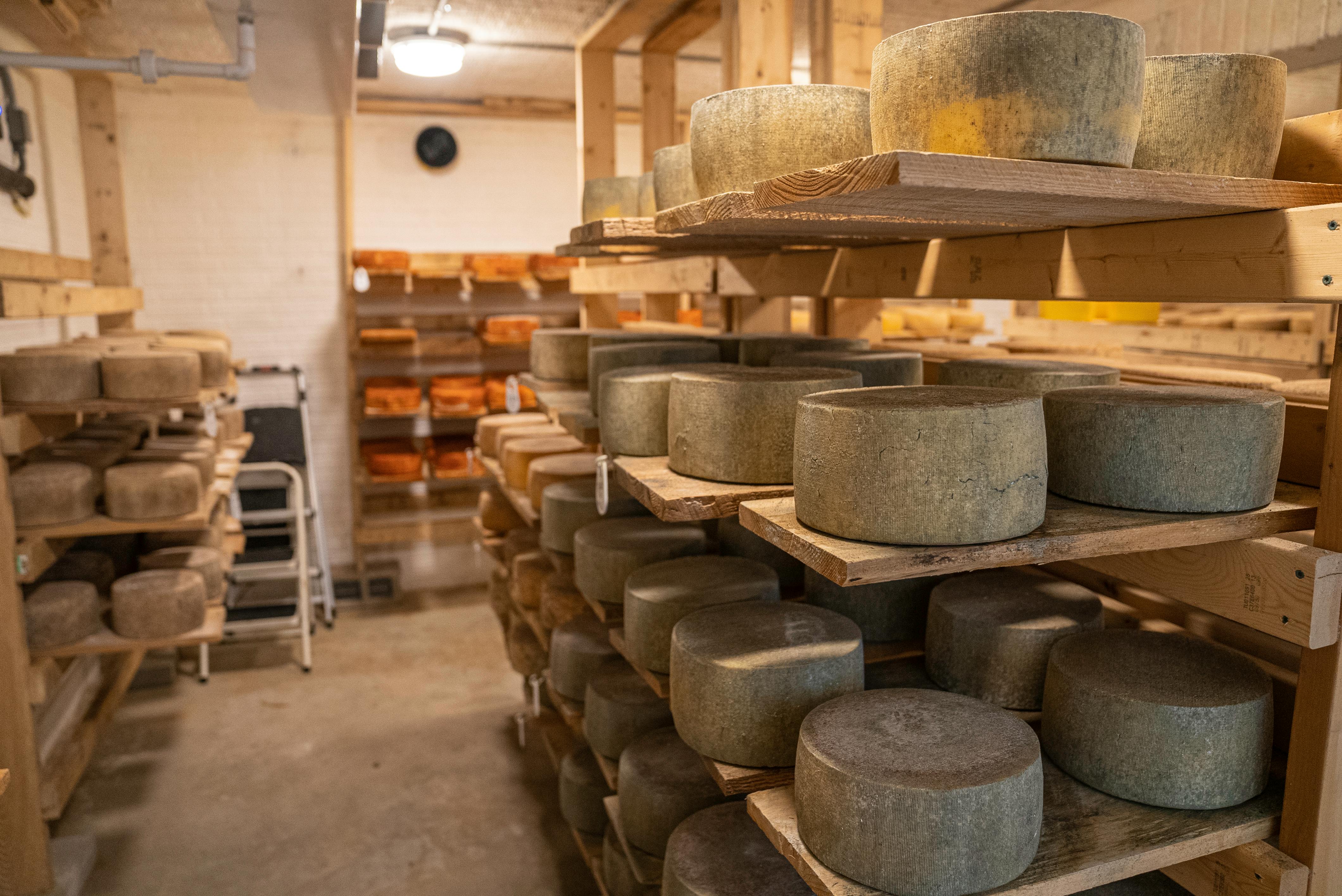
Aged cheese (with live cultures)
Cheese matrix as a probiotic carrier — Cheddar, Gouda, Swiss, blue cheese. ⚠️ MAO inhibitor + aged cheese = FORBIDDEN.
In 1 minute
What does it provide? Live lactic acid bacteria (Lactococcus lactis, Lb. helveticus, Lb. paracasei), ripening microbes (Propionibacterium freudenreichii — Swiss; Penicillium roqueforti — blue cheese), peptides, vitamin K₂ (MK-8/9), calcium.
How much? 30–40 g (≈ 1 slice) daily or 3–5 × 50 g weekly.
When to avoid? ⚠️ STRICTLY FORBIDDEN with MAO inhibitor therapy (tyramine → crisis). Listeria-sensitive groups (pregnant, immunosuppressed), cow's milk protein allergy, histamine intolerance.
The earliest direct evidence of cheese making comes from today's Poland, from archaeological finds in Kuyavia around 5500 BCE: the "cheese strainer" potsherd fragments with milk-fat residues, proven in Salque and colleagues' 2013 Nature article, show that Neolithic European farmers were already straining whey from curds. Ancient Roman writers — Columella in De re rustica and Pliny in Naturalis Historia — already gave detailed descriptions of rennet coagulation, salting, and ripening, and Pliny catalogued some fifty cheese varieties of the Empire — including the cheese of the Helvetic Alps, which may be the ancestor of today's Swiss cheeses. In the Middle Ages, monasteries and abbeys became the centers of cheese science: Camembert was developed in 1791 by Marie Harel, a Normandy peasant woman, allegedly following guidance from a fugitive priest who taught her Brie ripening.
Regional technologies — moldy Roquefort, blue Stilton, washed-rind Munster, holey Emmentaler — took shape between the 12th and 18th centuries, each with its own microbial ecology: in the caves of Roquefort, Penicillium roqueforti spontaneously colonized bread slices and was used to inoculate the milk, while Emmentaler's holes are created by CO₂ bubbles produced by Propionibacterium freudenreichii. Modern microbiology (20th–21st century) finally identified the players of the rind and interior flora by name — Geotrichum candidum, Brevibacterium aurantiacum, Debaryomyces hansenii, Lactococcus lactis — and standardized the starter cultures.
🔬 Scientific Background
Aged cheese is the product of a long, controlled microbial process:
1. Coagulation: Milk is started by Lactococcus lactis and Streptococcus thermophilus (acidification), then rennet enzyme (chymosin) coagulates it.
2. Internal ripening (1–24 months): Lactobacillus helveticus, Lb. paracasei, Lb. casei produce peptides and amino acids (proteolysis). In Swiss cheeses, Propionibacterium freudenreichii produces propionic acid and CO₂ (the holes!).
3. Rind ripening: External flora develop: - White-mold (Camembert, Brie): Penicillium camemberti. - Blue cheese (Roquefort, Stilton, Gorgonzola): Penicillium roqueforti. - Washed-rind (Munster, Limburger): Brevibacterium aurantiacum (the classic "sweaty foot" aroma), Geotrichum candidum. - Salt-crust (Parmigiano-Reggiano): Debaryomyces hansenii yeast.
The cheese matrix as a probiotic carrier: According to several in vitro and human studies, the fat-protein matrix of cheese acts as a protective shield for added probiotic strains against gastric acid and bile salts — often better survival than in yogurt or in a beverage.
Clinical human evidence: - Elderly volunteers: Probiotic Gouda (Lb. rhamnosus HN001 + Lb. acidophilus NCFM) 10-week RCT → NK cell activity↑. - Lipids: Lactobacillus casei 01 cheese produced favorable lipid-profile shift in a human study. - Propionibacteria: P. freudenreichii GI-transit survival is confirmed, with immunomodulatory potential.
Limitations and warnings:
⚠️ Tyramine + MAO inhibitor: Aged cheeses (particularly long-aged blue, cheddar, parmesan) are HIGH in tyramine (up to 1000+ mg/kg). With MAO inhibitors (phenelzine, tranylcypromine, moclobemide, selegiline) they can cause a hypertensive crisis. This is an absolute contraindication.
⚠️ Listeria: Soft cheeses made from raw milk (Roquefort, raw-milk Brie, Munster) carry a Listeria monocytogenes risk — to be avoided by pregnant women, the immunosuppressed, elderly/infants.
Penicillin allergy: Blue-cheese-derived Penicillium roqueforti is a separate mold species, and clinical cross-reactivity with the penicillin antibiotic is NOT TYPICAL. Penicillin-allergic patients generally can consume blue cheese — but extremely rare mold-specific IgE reactions have been described.
Lactose: Long-aged cheeses (Cheddar 12+ mo, Parmesan) are nearly lactose-free (< 0.1 g/100 g) — particularly favorable for the lactose-intolerant.
- + Fiber-rich sides (whole-grain bread, walnuts, greens): fiber + LAB synbiotic.
- + Resistant starch (cooked-then-cooled potato, pasta): SCFA support.
- + Berries, apple, pear: polyphenol + cheese classic combination.
- + Mediterranean olive-oil matrix: classic Mediterranean diet.
- + Cool consumption (NOT melted ≥ 80 °C): if live LAB is the goal.
- + Red wine in moderation: classic polyphenol-cheese combination.
- ⚠️ MAO inhibitor therapy (phenelzine, tranylcypromine, moclobemide, selegiline): STRICTLY FORBIDDEN — tyramine crisis risk.
- Hot-melted (≥ 80 °C): live LAB is inactivated (but protein + Ca remain).
- High-dose iron supplements: calcium-iron chelation — separate by ≥ 2 hours.
- Levothyroxine (T4): calcium interferes — separate by ≥ 4 hours.
- Tetracycline, ciprofloxacin antibiotics: calcium chelation — separate by ≥ 2 hours.
- Alcoholic drinks that provoke migraine (hidden amines): can be a combined trigger.
- ⚠️ MAO inhibitor therapy: STRICT CONTRAINDICATION for aged cheese (tyramine).
- Migraine with tyramine-trigger history: avoid aged and blue cheeses.
- Histamine intolerance: aged cheeses are high in histamine — to be avoided.
- Cow's milk protein allergy: strictly avoid.
- Severe lactose intolerance: hard aged OK (lactose-free); fresh cheeses are not.
- Pregnancy, severe immunosuppression, frail elderly: avoid soft cheeses made from raw milk (Listeria).
- Gout flare: moderate purine content — portion control.
- Severe kidney failure with Na/phosphorus restriction: high Na and P — portion control.
- Hypertension, heart failure: portion control (cheese 500–1500 mg Na/100 g).
- Penicillin allergy + Penicillium-molded cheese: theoretically minimal cross-reactivity, in practice safe. With a history of anaphylaxis, medical consultation.
Daily serving
30–40 g (≈ 1 thin slice or 2 tbsp grated) daily or 3–5 × 50 g per week.
Classic usage patterns
Cheese board (charcuterie-style): 3–5 types + apple + pear + walnut + baguette — tasting plate.
Grated parmesan over cooked pasta / risotto: classic, NOT cooked (at serving).
Cheddar melted (cheese toast, mac and cheese): postbiotic matrix remains.
Blue cheese on salad: quince + walnut + blue cheese + balsamic.
Cheese + pear + honey as dessert: classic Mediterranean.
Camembert or Brie alongside baked apple: autumn dessert.
Storage
Refrigerated in cheese paper or parchment: 1–4 weeks (hard longer, soft shorter). Never wrap in plastic (mold risk).
What not to do
Don't freeze (texture degrades). Don't melt at too high a temperature. Don't combine with MAO inhibitors. Don't give soft cheese made from raw milk to a pregnant woman.
References
[1] Salque M et al. Earliest evidence for cheese making in the sixth millennium BC in northern Europe. Nature 2013;493(7433):522–525.
[2] Stadhouders J. Cheese as carrier for probiotic bacteria. Int Dairy J 1999.
[3] Sharp MD et al. Probiotic Gouda enhances immune function in elderly. J Dairy Sci 2008.
[4] Cousin FJ et al. Probiotic Propionibacterium freudenreichii. Microorganisms 2017.
[5] EFSA. Tyramine and biogenic amines safety. EFSA Journal 2011.
[6] FDA. Soft cheeses and Listeria monocytogenes risk. 2023.
[7] Walther B et al. Cheese in nutrition and health. Dairy Sci Technol 2008.
[8] Monash University. Hard cheese FODMAP serving guide (≈ 30–40 g green).