

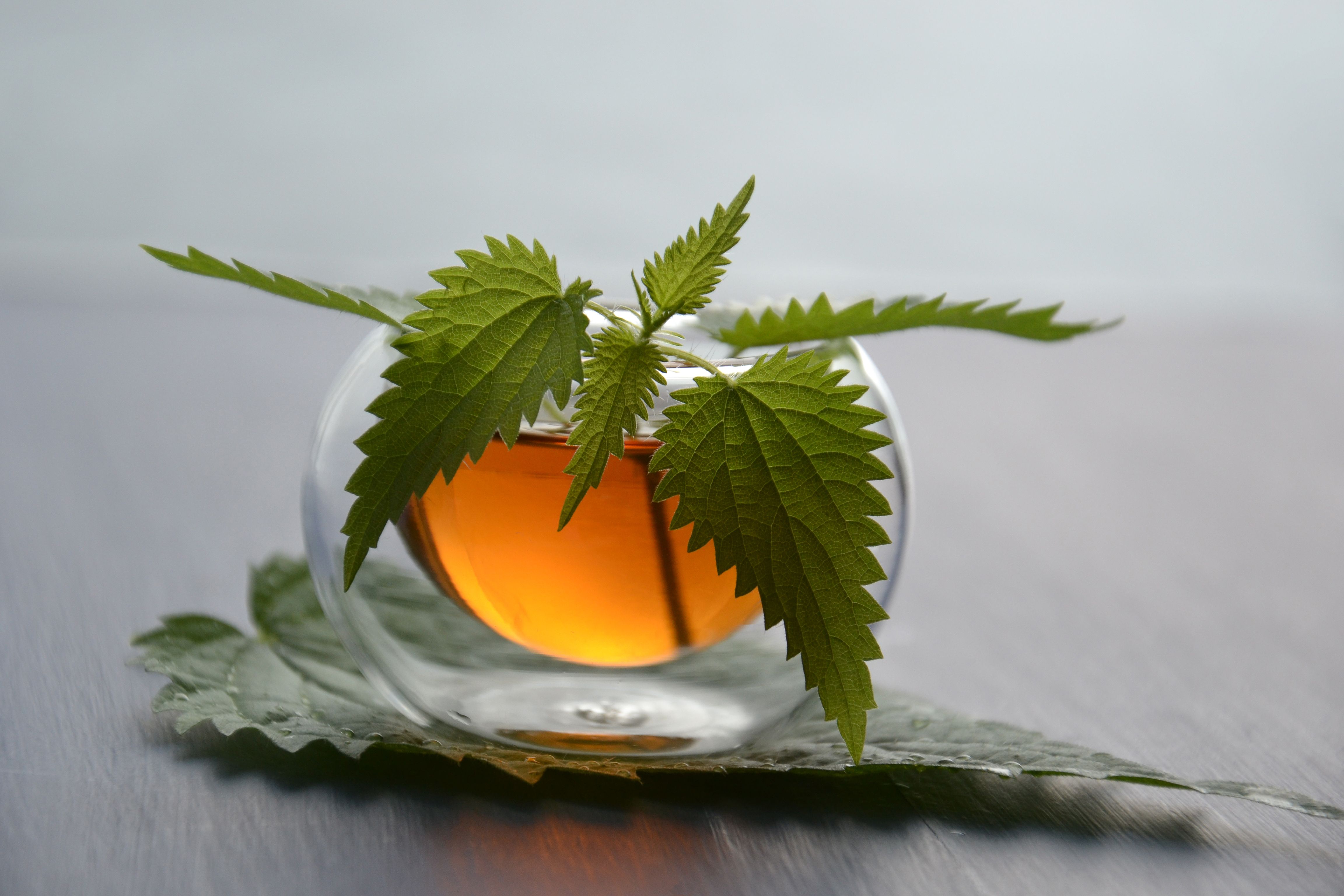
Nettle tea
"Wild phytotherapy" — high iron, chlorophyll-rich, prostate RCTs, and a spring cleansing tradition.
In 1 minute
What does it provide? A flavonoid matrix — quercetin and kaempferol (antioxidant, histamine-receptor modulating) —, chlorophyll, silica (silicon dioxide — connective-tissue and hair supporting), as well as non-heme iron (≈ 4.1 mg/100 g dried leaf) and outstanding vitamin K. The root's beta-sitosterol (phytosterol) inhibits the 5-alpha-reductase enzyme — Safarinejad 2005 RCT: 600 mg nettle root extract/day for 6 months significantly reduced BPH symptoms in 558 men.
How much? Hot tea: 1 tbsp (≈ 2 g) dried leaf / 250 ml water at 90–95 °C, covered, 8–10 min. 2–3 cups/day, with a 2-week break after 4–6 weeks. Cold macerate (for iron/silica maximization): 2 tbsp / 500 ml cold water for one night.
When to avoid? Pregnancy (emmenagogue, uterine-contracting effect — risk of miscarriage), lactation (data gap), warfarin treatment (high vitamin K destabilizes INR), lithium therapy (diuretic effect reduces clearance — toxic serum level), concurrently with diuretics (furosemide, hydrochlorothiazide — dehydration, electrolyte disturbance), severe kidney failure, uncontrolled T2D on glucose-lowering drugs (additive hypoglycemia).
Nettle is one of the most ancient medicinal plants of the Carpathian Basin. Galen, the ancient Greek physician, already recommended nettle compresses for joint pain. In Hungarian folk medicine, Péter Melius Juhász's "Herbarium" (1578) describes it in detail: "The Nettle, which some call Urtica..." for iron deficiency, joint complaints, as a diuretic. Spring nettle soup was a key element of the Lenten diet in Catholic tradition. From the mid-20th century, phytopharmacology began its scientific investigation; from the 1990s, standardized Urtica extracts appeared with BPH indication.
🔬 Scientific Background
#### Active-substance profile
- Iron — 4.1 mg/100 g dried leaf (non-heme form) - Chlorophyll — high, "green blood" composition - Quercetin, kaempferol — flavonoids - Carotenoids — vitamin A precursors - Silica (silicon dioxide) — connective-tissue supporting - Beta-sitosterol (mainly in the root) — BPH effect - Histamine, serotonin — in the fresh leaf (responsible for the sting, inactivated by cooking)
#### Clinical studies
Safarinejad 2005 randomized, double-blind, placebo-controlled study in 558 BPH men: 6 months of 600 mg nettle root extract/day significantly reduced IPSS (International Prostate Symptom Score) and improved maximum urinary flow (Journal of Herbal Pharmacotherapy 5(4):1-11).
Lopatkin et al. 2005 German multicenter randomized study in 257 BPH patients: a nettle + saw palmetto combination significantly improved symptoms, with a strong effect vs. placebo (World Journal of Urology 23(2):139-146).
Roschek et al. 2009 in an allergic rhinitis study, demonstrated the histamine-receptor antagonism of nettle extract in vitro (Phytotherapy Research 23(7):920-926).
#### Mechanism
- BPH: beta-sitosterol inhibits testosterone-to-DHT conversion (5-alpha-reductase); 17β-HSD inhibition; reduction of SHBG-binding affinity. - Diuretic: Na+/K+ pump modulation in the kidney. - Anti-inflammatory: NF-κB pathway and TNF-α inhibition. - Iron source: although it contains iron, it is not sufficient on its own for clinical-level iron-deficiency replacement.
- Lemon juice — vitamin C increases iron absorption (from non-heme iron).
- Fresh chopped leaf into soup — Hungarian spring diet.
- Dandelion leaf — synergistic diuretic.
- Honey — folk tradition, flavoring.
- Diuretics (furosemide, hydrochlorothiazide) — additive effect, risk of dehydration and electrolyte disturbance.
- Lithium — diuretic effect may reduce lithium clearance, toxic serum level.
- Anticoagulant (warfarin) — high vitamin K content (nettle is richer in vitamin K than spinach!) → risk of INR drop.
- Glucose-lowering drugs — synergistic effect → risk of hypoglycemia.
- Pregnancy — emmenagogue (uterine-contracting) effect; potentially can induce miscarriage.
- Lactation — data are limited.
- Severe kidney failure — although it supports excretion, in severe cases it burdens the kidney.
- Warfarin treatment — vitamin K destabilizes INR.
- "Anyone can drink it without limit." — A strong diuretic and vitamin K source → drug interactions.
- "Nettle loses its effect when cooked." — INCORRECT; cooking only inactivates the histamine and serotonin that cause the sting; flavonoids and chlorophyll are stable.
Steeping (hot tea)
- Leaf-to-water ratio: 1 tbsp (≈ 2 g) dried nettle leaf / 250 ml water.
- Water temperature: 90–95 °C.
- Steeping time: 8–10 min covered (preserves chlorophyll and volatiles).
- Serving: max. 2–3 cups daily; with a 2-week break after 4–6 weeks.
Cold macerate (maximizing iron source)
- 2 tbsp dried nettle / 500 ml cold water.
- One night at room temperature, steeping.
- In the morning, strain, add lemon juice, drink freshly sip by sip.
- Cold extraction retains more minerals and silica.
Fresh nettle soup (Hungarian folk recipe)
- Young spring nettle shoots (pick with gloves!).
- 2 min scalding removes the sting.
- Onion, potato, nettle; sour cream, lemon juice.
- A complete "spring cleansing" meal on its own.
Storage
In a dark, airtight container; 1-year stability. The vivid green color is a sign of freshness; brownish-gray → already degraded.
References
[1] Safarinejad MR (2005). Urtica dioica for treatment of benign prostatic hyperplasia: a prospective, randomized, double-blind, placebo-controlled, crossover study. Journal of Herbal Pharmacotherapy, 5(4):1-11.
[2] Lopatkin N, Sivkov A, Walther C, et al. (2005). Long-term efficacy and safety of a combination of sabal and urtica extract for lower urinary tract symptoms — a placebo-controlled, double-blind, multicenter trial. World Journal of Urology, 23(2):139-146.
[3] Roschek B Jr, Fink RC, McMichael M, Alberte RS (2009). Nettle extract (Urtica dioica) affects key receptors and enzymes associated with allergic rhinitis. Phytotherapy Research, 23(7):920-926.
[4] Chrubasik JE, Roufogalis BD, Wagner H, Chrubasik SA (2007). A comprehensive review on the stinging nettle effect and efficacy profiles. Phytomedicine, 14(7-8):568-579.