


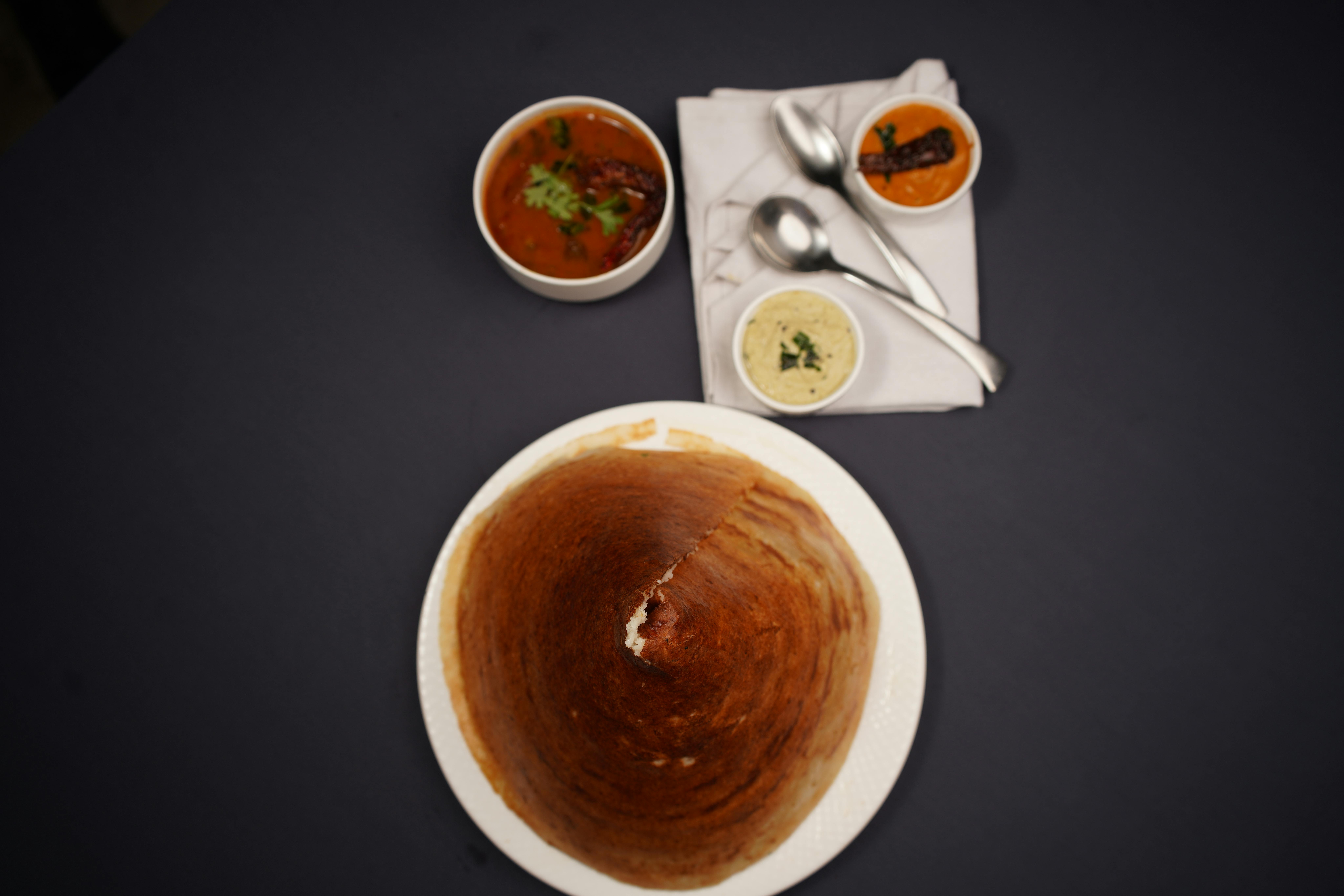
Idli / dosa
South Indian rice-lentil fermentation — lactic Leuconostoc + Saccharomyces + spontaneous B12 synthesis, easy digestibility and reduced phytate.
- Latin név
- Oryza sativa (rice) + Vigna mungo (urad dal) + spontaneous Leuconostoc/Lactobacillus + Saccharomyces cerevisiae
- FODMAP
- 🟡 moderate (lentil content)
- Evidence
- ★ ★ (human pilots — glycemia + B vitamins)
- Microbiota
- Live LAB (idli batter) + postbiotic matrix (cooked dosa)
- What does it provide?
- The classic South Indian breakfast: rice + urad lentil (3:1 or 4:1) spontaneously fermented for 8–24 hours. The ferment contains live lactic acid bacteria (Leuconostoc mesenteroides, Lactobacillus fermentum, L. plantarum) and wild yeast (Saccharomyces cerevisiae) — this gives idli its "pillowy," airy texture. Fermentation increases B-vitamin levels (B12, riboflavin, folate — synthesized by Leuconostoc), reduces phytate content (better mineral absorption), and produces galacto-oligosaccharides (GOS) — prebiotic. Idli is steamed (live matrix preserved), dosa is pan-fried (postbiotic).
- How much?
- 2–4 idli (≈ 100–200 g) or 1–2 dosa for breakfast. With sambar (lentil soup) + chutney.
- When to avoid?
- Rice or lentil allergy (rare); active IBS flare (lentil FODMAP); celiac disease in certain "rava dosa" versions (contains semolina — check the label; classic idli/dosa is gluten-free); severe histamine intolerance (fermented); infant < 6 months.
Idli and dosa have been a cornerstone of South Indian breakfast for over a thousand years. The word "idli" first appears in a 920 CE Kannada text ("Sivakotyacharya: Vaddaradhane"); it was already widespread in the Chalukya and Hoysala royal court kitchens. A 12th-century Sanskrit text, Manasollasa (1130), details the preparation of "iddarika" — black gram (urad) and rice paste, fermenting, steaming. Modern South Indian (Tamil Nadu, Karnataka, Andhra Pradesh, Kerala) breakfasts could not be imagined without it.
"Dosa" is probably older: in 1st-millennium BCE Tamil literature "dosai" appears as a rice-bran pancake — originally without lentils, only from rice porridge; later the addition of urad gave today's characteristic flavor and texture. "Masala dosa" (with potato filling) is the innovation of 19th–20th century Udipi restaurateurs — today the world's most popular Indian street food. Modern microbiome research (Soni 1985, Sridevi 2010) investigates B12 synthesis and the Leuconostoc-dominant fermentation — idli is one of the few vegetarian foods that naturally provides B12.
🔬 Scientific Background
The preparation of idli/dosa is a 24+ hour bio-process: 1. Soaking (4–6 hours): rice + urad lentil + fenugreek seed soaked separately. 2. Pasting: from lentils, a foamy, airy paste forms (saponin-protein matrix); from rice, fine-grained pulp. 3. Spontaneous fermentation (8–24 hours at room temperature, 25–30 °C optimal): wild LAB (Leuconostoc mesenteroides, L. fermentum, L. plantarum, Enterococcus faecium) and Saccharomyces cerevisiae dominate. The pH drops from 6.5 to 4.5, with CO₂ formation (airy texture). 4. Idli: steamed (100 °C, ≈ 10–15 min) — some LAB remains live at the inner cool points; mostly postbiotic matrix. 5. Dosa: thin, pan-fried crepe on a hot griddle (180–200 °C) — live LAB destroyed, postbiotic remains.
B12 synthesis: According to Soni and Sandhu (1985, 1989 Food Microbiol), the Leuconostoc ferment in idli batter measurably produces B12 (or B12 analogs) — 0.2–0.5 µg/100 g level, which is 10–20% of the daily requirement. This is a critical consideration for South Indian vegetarian dietary basis; not necessarily the entire requirement, but contributes.
Phytate reduction: 16–24 hours of fermentation reduces phytic acid content by 40–60% (LAB phytase enzyme hydrolyzes). Result: better zinc, iron, calcium absorption.
GOS formation: Leuconostoc dextransucrase activity produces short galacto-oligosaccharides — prebiotic, Bifidobacterium-increasing.
Glycemia: According to Sandhu (2010), the glycemic index of 12-hour fermented idli is ≈ 70 (vs. white rice ≈ 73) — modest improvement. Unfermented rice mass is ≈ 85. The fermentation thus moderately improves it.
The 2017 Marco et al. (Curr Opin Biotechnol) review mentions idli as an example of the classic "spontaneous LAB-yeast symbiosis" — complex microbiome matrix, and intermediate postbiotic value.
- + Sambar (lentil soup with vegetables + tamarind): classic South Indian, high-fiber + ferment combination.
- + Coconut chutney + vegetable chutney: fat + polyphenol + ferment matrix.
- + With potato filling (masala dosa): classic street food, high energy.
- + Fresh ginger + curry leaves at serving: digestion aid, flavor deepening.
- + Honey or ghee a drop: South Indian home breakfast (small amount).
- + With yogurt on the side: classic South Indian "idli + curd" combination — LAB doubling.
- High sugar / sweetened treats: loses the glycemic advantage.
- High-dose iron supplements at the same meal: residual phytate may chelate.
- Meat/fish heavy breakfast: unjustified, South Indian context is vegetarian breakfast.
- Too long steaming (> 20 min): further LAB reduction after steam serving.
- Combined with high-histamine foods (cheese, aged meat): in histamine sensitivity.
- Active IBS flare, SIBO: lentil + ferment FODMAP synthesis → bloating. Small portions.
- Celiac disease: "rava dosa" (semolina) NOT (gluten); classic rice + urad idli/dosa is safe (check label for contamination).
- Severe lentil allergy (rare): avoid.
- Histamine intolerance: moderate, fresh-made, not 2-day old.
- Infant < 6 months: avoid (infant feeding).
- Diabetic carb counting: 1 idli ≈ 15 g carbs — calculate.
- Strict glycemic diet: max 2–3 idli, combine with protein + vegetables.
- Thyroid disorder + iodine sensitivity: small amounts OK.
- Severe zinc deficiency: ferment reduces phytate, so positive (but not a complete supplement).
- For vegetarian B12 supplementation: can be supplementary, NOT a replacement for B12 supplement if needed.
"Idli is a full B12 supplement for vegetarians." Overstated. Soni and Sandhu research showed 100 g idli ≈ 0.2–0.5 µg B12 — 10–20% of the daily requirement (2.4 µg). It contributes, BUT does not replace a supplement in a strictly vegetarian diet. Note: some B12 analogs (pseudo-B12) are not active in humans — measurement is method-dependent.
"Idli is a low-glycemic-index food." Partly a myth. Idli GI ≈ 70, white rice ≈ 73 — barely lower. The "low-GI" label is not warranted; medium GI. If glycemic target: combine with vegetables, sambar, this reduces it.
"Dosa is healthier than bread." Partly true. Glycemic-wise similar, BUT ferment + phytate reduction + B vitamins are positive. Masala dosa with potato filling, however, is high energy (≈ 400–500 kcal/dosa) — watch with diet target.
"The ferment kills gluten, so it is safe for celiacs." Partly a myth. Classic rice + urad idli/dosa is made from gluten-free ingredients — safe. BUT: "rava dosa" (contains semolina), "pesarattu" (mung lentil, gluten-free), some street dosas have wheat-paste cross-contamination — check label/ask.
"'Instant idli mix' is as good as traditional." Myth. "Instant" versions are pasteurized, fast-fermented, with little live LAB — postbiotic matrix is smaller, B-vitamin synthesis is absent. The traditional 16–24 hour ferment is the source of clinical benefits.
"Idli is a '0-calorie' healthy food." Overstated. 1 idli ≈ 60–80 kcal — low, but not zero. 3–4 idli + sambar + chutney = ≈ 350–450 kcal breakfast.
"The ferment eliminates allergens (lentil)." False. The ferment reduces phytate and some antinutrients, BUT lentil protein allergen structure is preserved. Not safe for lentil-allergic patients.
🍳 Kitchen Protocol
Daily serving: 2–4 idli or 1–2 dosa for breakfast or a light lunch.
Preparation pattern — homemade idli batter: 1. 3 cups idli rice (parboiled, sona masuri) + 1 cup urad lentil (split) + 1 tsp fenugreek seed. 2. 4–6 hours soaking, rice and lentils separately. 3. Pasting: lentil paste super-smooth, airy; rice paste finely grained. 4. Mixing: lentil paste + rice paste + 1 tsp salt. 5. Fermentation: 8–16 hours at room temperature (25–30 °C optimal). Volume ≈ 2x. Fresh-sour aroma (NOT vinegar-smelling, NOT rotten). 6. Idli preparation: in steamer for 10–12 minutes. 7. Dosa preparation: spread thinly on hot griddle, pan-fry.
Classic patterns:
Sambar: tuvar lentil + vegetables (carrot, eggplant, pumpkin) + tamarind + sambar spice.
Coconut chutney: grated coconut + green chili + ginger + tamarind + mustard-seed-sesame tempering.
Masala dosa: dosa + potato filling (fried potato + mustard seed + curry leaves).
Idli-curd (yogurt): leftover idli diced + yogurt + curry leaf, mustard-seed tempering.
Rava idli (quick): rava (semolina) + yogurt + vegetables — faster, but contains gluten.
Storage: batter in refrigerator 3–5 days. Idli/dosa fresh-made (or frozen 1 month).
What not to do: don't leave batter at room temperature beyond 24 hours (over-acidic, alcohol matrix). Don't pan-fry too hot (calcium-rust form). Don't add sugar to the batter (glucose creeps).
📚 References (selected)
1. Soni SK, Sandhu DK. Indian fermented foods: microbiological and biochemical aspects. Indian J Microbiol 1985;29:355–366. 2. Sandhu KS et al. Effect of fermentation on the in vitro digestibility of rice-blackgram blends. J Sci Food Agric 2010. 3. Marco ML et al. Health benefits of fermented foods: microbiota and beyond. Curr Opin Biotechnol 2017;44:94–102. 4. Tamang JP et al. Functional properties of microorganisms in fermented foods. Front Microbiol 2016;7:578. 5. Steinkraus KH. Industrialization of indigenous fermented foods. Marcel Dekker, 2004. 6. Sridevi N et al. Effect of fermentation on the nutritional quality of idli batter. Indian J Nutr Diet 2010. 7. Reddy NR et al. Phytates in legumes and cereals. Adv Food Res 1982;28:1–92. 8. Battcock M, Azam-Ali S. Fermented fruits and vegetables — global perspective. FAO Agric Serv Bull 134, 1998.