


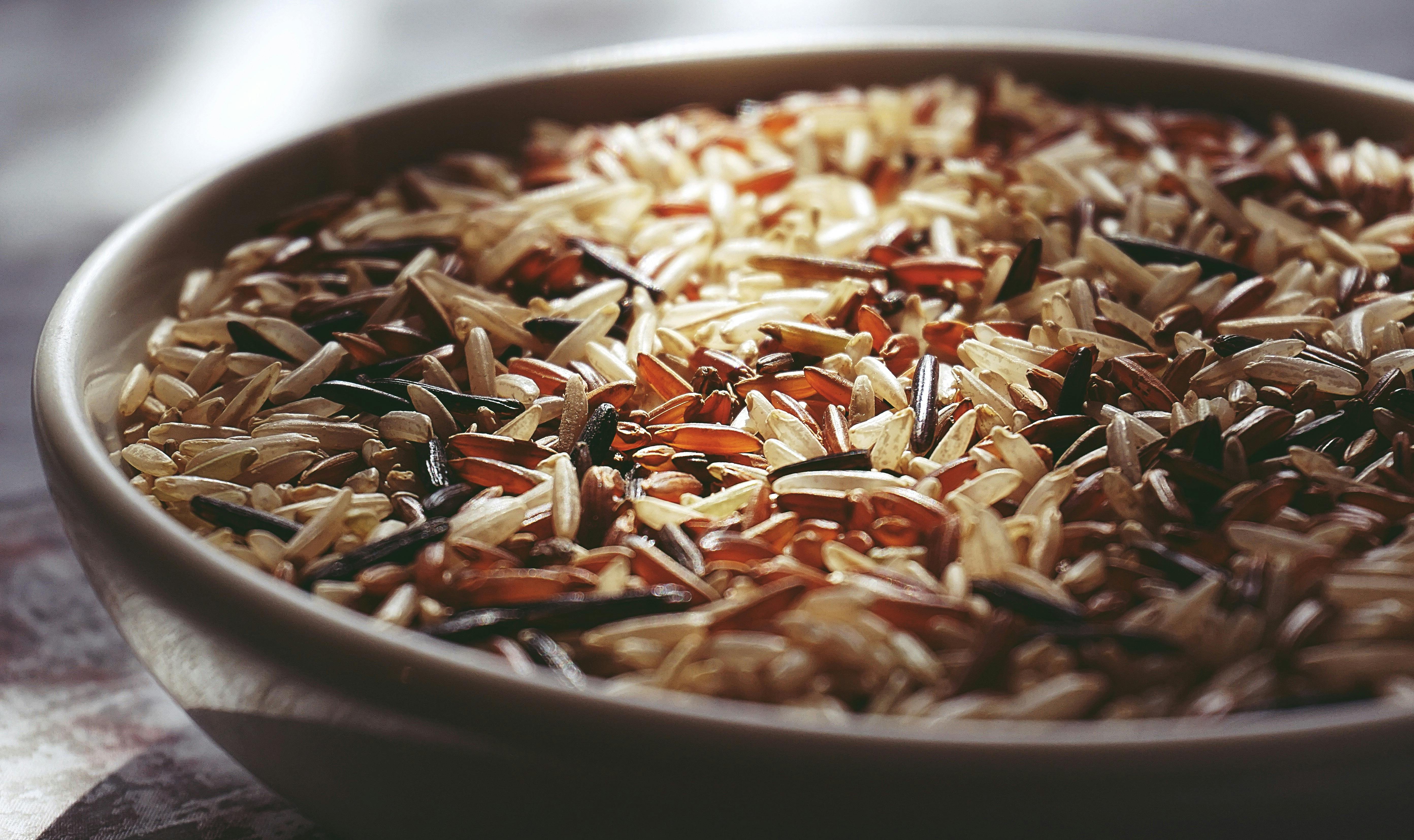
Wild rice
The lakeshore harvest of the North American Anishinaabe — botanically not rice but Zizania grass: a fiber-, phenolic-acid-,
Wild rice in 1 minute
What does it provide? Wild rice is botanically not rice, but the seed of an aquatic grass in the Zizania genus — native to lakeside and riverside habitats of North America: Z. palustris (lake variety) and Z. aquatica (river variety). High insoluble fiber (6.2–7.5 g/100 g cooked, nearly twice brown rice), high phenolic acid (ferulic, p-coumaric, vanillic), manganese (1.3 mg/100 g — RDI ≈ 65%), small amounts of lutein and quercetin. Gluten-free, with a glycemic index of 35 it is among the lowest of grain-like foods. Total phenolic antioxidant capacity is 30× white rice (Qiu 2009).
How much? Cooked wild rice 80–150 g/serving (≈ 35–60 g dry), 1–2 servings/day. Long cooking required (40–60 min), or 4-hour soaking. On its own or mixed with long-grain rice; a classic North American turkey-stuffing base.
When to avoid? Acute bowel obstruction, severe stricture (high fiber), chemotherapy + neutropenia (ergot sensitivity — wild rice can rarely be infected with Claviceps), infant under 1 year (whole-grain aspiration risk), severe kidney disease with potassium restriction.
Wild rice (Zizania palustris) is a native aquatic grass of the North American Great Lakes region — mainly today's Minnesota, Wisconsin, Michigan, and Ontario — a centuries-old sacred food of the Anishinaabe (Ojibwe, Chippewa) peoples. The plant's name in Ojibwe is manoomin, "the good food given by water." Traditional harvesting is done from a canoe: between two harvest partners, one steers along the shallow lakeshore while the other bends the ear-bearing wild rice over the canoe with a wooden stick so the grains fall in. Grains are dried in the sun or by light roasting (parching), then threshed by hand or with moccasined foot-trampling to detach the chaff. According to 17th-century records of white settlers, French coureurs des bois (forest fur trappers) and the British Hudson Bay Company purchased wild rice from the Ojibwe for centuries.
Modern "wild rice" market prices began to rise from the mid-20th century with consumer discovery, and from the 1960s industrial agricultural production began — mainly in artificial lakes in California and Idaho, where varietal breeding and mechanical harvest make the product significantly cheaper than the traditional Ojibwe source. Distinguishing the two market categories is important: cultivated wild rice is a longer, smooth black grain; natural wild rice / true wild rice (Anishinaabe-harvested) is shorter, thinner, pale-brown with a characteristic parched aroma. In the 21st century, wild rice has grown into an international pseudo-grain and "superfood"; the Slow Food Ark of Taste officially recognizes Anishinaabe-harvested manoomin as a tradition to be protected, and it is a key symbol of the Canadian indigenous food sovereignty movement.
Scientific Background
Wild rice (Zizania palustris and Z. aquatica) is an aquatic grass in the Poaceae family — botanically not rice (distant relation to Oryza sativa), but a pseudo-grain like a perennial-annual grass akin to maize. Insoluble fiber content is 6.2–7.5 g/100 g cooked (USDA NDB) — nearly twice brown rice (3.5 g/100 g) and many times white rice (0.4 g/100 g). High insoluble fiber significantly shortens colon transit time and adds bulk to stool, contributing to colorectal cancer prevention per epidemiological and prevention studies.
The phenolic antioxidant profile is outstanding: in Qiu 2009, wild rice's total phenolic antioxidant capacity was ≈ 30× white rice and ≈ 3–5× brown rice. The main components are ferulic acid, p-coumaric acid, vanillic acid, caffeic acid, with smaller amounts of quercetin and lutein (Bunzel 2001, Qiu 2010). Ferulic acid is released from covalent binding by colonic bacterial ferulic-acid esterase (Bifidobacterium, F. prausnitzii) and converted to dihydroferulic acid, which has systemic anti-inflammatory effect.
Wild rice protein content is 4 g/100 g cooked — higher than white rice (2.7 g/100 g), and the amino acid profile is also more favorable (more lysine and methionine, better biological value protein). Manganese (1.3 mg/100 g) and zinc (1.3 mg/100 g) make significant micronutrient contributions. Glycemic index is ≈ 35 (low) — due to the high fiber matrix and relatively slow digestion, postprandial glycemia is moderate (USDA / international GI tables).
Gluten-free status is certain (botanical family distant from wheat), so safe in celiac disease — but cross-contamination is possible in commercial dried products, certified GF labeling is recommended. Note that wild rice can rarely be infected with Claviceps purpurea (ergot fungus) — commercial quality control screens for this, but traditional small lots can rarely have occurrence. Species note: North American Z. palustris and Z. aquatica are the traditional "wild rice," while the Asian Z. latifolia is used partly for a different purpose (its swollen stem, infected with a smut fungus, as the Chinese vegetable "jiaobai"); the Han 2018 anti-obesity / anti-inflammatory finding comes from a Z. palustris L. extract in a mouse model.
- + Legumes (chickpea, black bean, lentil): complementary amino acid profile, high manganese + zinc combination.
- + Game meat, poultry, fish (classic North American turkey stuffing): traditional pairing, high protein + complex carbohydrate.
- + Roasted-steamed vegetables (squash, mushroom, Brussels sprout): carotenoid × phenolic-acid synergy, classic stuffing combinations.
- + Olive oil, walnut: fat aids lutein and carotenoid absorption.
- + Mixed with long-grain brown rice: classic "wild rice blend," reduces cooking time and cost.
- + 4-hour soaking: reduces cooking time and improves texture.
- High-dose fast carbohydrates (sugar, white rice): glycemic spike, polyphenol benefit disappears.
- Iron supplementation in the same meal: phytate and tannin chelate Fe — temporal separation.
- Prolonged high-heat cooking (≥ 90 min): phenolic-acid breakdown, lutein loss.
- Too short cooking (< 30 min): the hard grain doesn't open up, remains indigestible — minimum 40–45 min.
- "Wild rice instant" products (pre-cooked, fast): the benefit of wild rice comes from the hard grain and long digestion — lost in instant form.
- Calcium supplementation in the same meal: phytate chelates Ca.
- Acute bowel obstruction, severe stricture: high insoluble fiber — risky.
- Chemotherapy + neutropenia: theoretical Claviceps / ergot infection risk — only traced, certified product.
- Severe kidney disease (CKD 4–5): potassium content is high (≈ 100 mg/100 g cooked) — moderate the serving under restriction.
- IBS elimination phase: low FODMAP, generally well tolerated — start with small portions due to high fiber.
- Infant (under 1 year): whole-grain aspiration risk — puréed, small portion.
- Celiac disease: safe (certified GF product).
- Diabetes: low GI (≈ 35) — favorable choice with portion control.
- Pregnancy, lactation: varied grain consumption recommended; wild rice arsenic content is lower than whole-grain rice.
References
[1] Qiu Y et al. Antioxidant properties of commercial wild rice and analysis of soluble and insoluble phenolic acids. Food Chem 2010;121(1):140–147. Link
[2] Bunzel M et al. Diferulates as structural components in soluble and insoluble cereal dietary fibre. J Sci Food Agric 2001;81(7):653–660.
[3] Surendiran G et al. Wild rice (Zizania palustris L.) prevents atherogenesis in LDL receptor knockout mice. Atherosclerosis 2013;230(2):284–292. Link
[4] Han S et al. Wild rice (Zizania palustris L.) extract attenuates obesity and inflammation in high-fat-diet-fed mice. J Food Sci 2018;83(3):834–841. (Note: result based on Z. palustris L. extract — North American species, not the Asian Z. latifolia.).
[5] USDA. National Nutrient Database for Standard Reference — wild rice, cooked. USDA Agricultural Research Service. Link
[6] Anishinaabe Manoomin (Wild Rice) — Slow Food Ark of Taste. Slow Food Foundation for Biodiversity. Link
[7] Monash University. High and Low FODMAP foods — wild rice. Monash FODMAP database. Link