


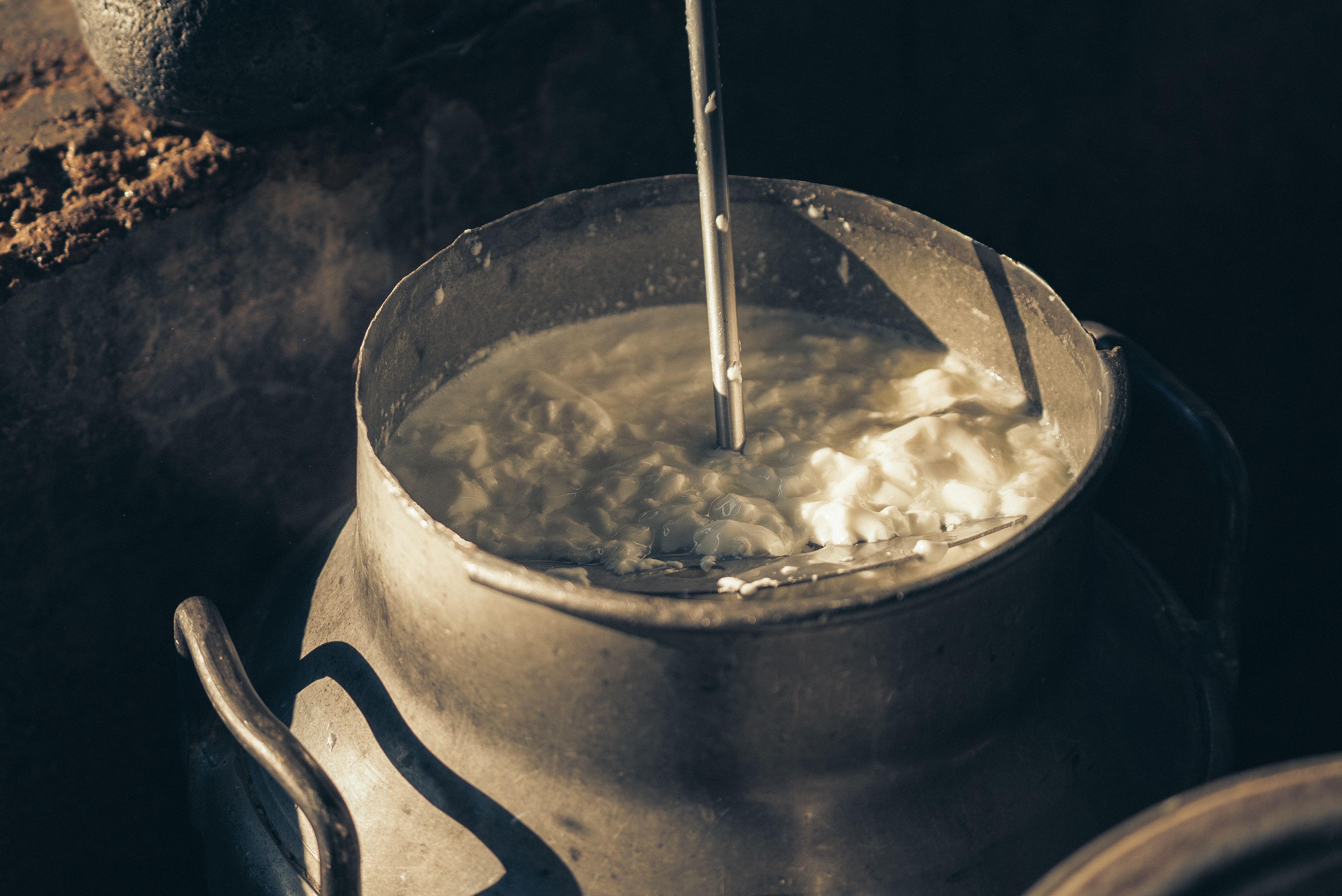
Goat Milk Ferments (yogurt, kefir)
A2-like casein profile + high MFGM — an allergen matrix different from cow milk, better tolerance for milk-sensitive
Goat Milk Ferments in 1 minute
What does it provide? Goat milk has a different casein profile than cow milk: predominantly A2-like β-casein (little A1 variant), smaller average fat-globule size (better digestibility), higher MFGM (milk fat globule membrane) — a phospholipid prebiotic matrix. In fermented forms (yogurt, kefir): live LAB + B-complex + lower lactose (30—50% reduction).
How much? 150—250 ml/day of goat-milk yogurt or kefir.
When to avoid? Severe IgE-mediated cow milk allergy (frequent cross-reactivity ~ 60—80%). Galactosemia. Infants under 1 year: not suitable as a primary food (iron-poor, folate-deficient).
Goat milk is one of humanity's oldest dairy sources — domestication of the goat began 10,000 years ago in the Fertile Crescent, before the domestication of the cow. According to Greek mythology, the infant Zeus was raised on Amalthea's goat milk. The modern "A2 milk" movement (Australia in the 2000s) — starting from the negative cardiometabolic hypothesis of A1 milk — placed goat and sheep back at the center of attention. The traditional southern European and Balkan cuisines, however, used them continuously (Greek yogurt, French chèvre).
Scientific Background
The casein fraction of goat milk is predominantly A2-like β-casein — as opposed to cow milk's dominant A1 variant. The A1 → A2 difference manifests in the formation of β-casomorphin-7 (BCM-7) peptide: A1 digestion releases BCM-7, which some authors (Pal 2015 Nutrients review) suggest may cause GI symptoms. Clinical evidence is mixed — Jianqin 2015 Nutr J human RCT showed GI symptom improvement and reduced inflammatory markers with cow-milk A1 → A2 switch.
The smaller fat-globule size (3.5 µm in goat-milk fat vs. 4.5 µm in cow) improves enzymatic hydrolysis and lipid absorption. The medium-chain fatty acid (C6-C12 — caprylate, caprate, lauric acid) proportion is higher — the cholesterol matrix profile is different.
Goat-milk yogurt (Streptococcus thermophilus + Lactobacillus delbrueckii ssp. bulgaricus) falls under the classic EFSA-approved lactose-digestion claim (as does cow-milk yogurt — IX.1). Goat-milk kefir is equivalent to the classic kefir grain (IX.2) complex microbiome matrix.
Clinical human evidence: small pilots document mild GI tolerance improvement and reduced inflammation markers with goat-milk consumption (Caroli 2009 J Dairy Sci review). Evidence is ★★ — more robust than average but does not reach the EFSA claim level available for cow-milk yogurt.
- + Berries (blueberry, raspberry): classic anthocyanin + LAB.
- + Honey (small amount): classic Greek yogurt-honey pairing.
- + Fresh mint or cucumber (Greek "tzatziki"): classic Mediterranean.
- + Nuts (almond, walnut): fat + protein + LAB.
- + Inulin powder or psyllium: synbiotic principle.
- + Fresh fig or pomegranate: classic Mediterranean-Balkan combination.
- High-dose antibiotic treatment: live LAB is ineffective; 2—4 hour separation.
- High-dose iron supplement at the same meal: calcium interference.
- Heat treatment > 60 °C for yogurt: live LAB dies.
- Severe IgE-mediated cow milk allergy: cross-reactivity 60—80% — absolute caution, allergist consultation.
- Galactosemia (inherited metabolic disorder): absolutely forbidden.
- Severe lactose intolerance: the ferment has reduced lactose content (50—70% reduction), but sensitive individuals may still experience symptoms.
- Infants under 1 year: to be avoided as a primary food (iron-poor, folate-deficient, high in salt) — breast milk or special formula required.
- Kidney stones (calcium-oxalate + oxalate intake): the calcium matrix is generally protective, but monitor.
- Jianqin S et al. Effects of milk containing only A2 β-casein versus milk containing both A1 and A2 β-casein on gastrointestinal physiology, symptoms of discomfort, and cognitive behavior of people with self-reported intolerance to traditional cows' milk. Nutr J 2015;15:35. https://doi.org/10.1186/s12937-016-0147-z
- Pal S et al. Milk intolerance, beta-casein and lactose. Nutrients 2015;7(9):7285—7297. https://doi.org/10.3390/nu7095339
- Caroli AM et al. Invited review: dairy intake and bone health: a viewpoint from the state of the art. J Dairy Sci 2009;92(11):5251—5275. https://doi.org/10.3168/jds.2011-4578
- Hodgkinson AJ et al. Comparative effects of beta-casein variants on intestinal physiology — review. Nutrients 2018;10(12):1939.
- Park YW et al. Physico-chemical characteristics of goat and sheep milk — review. Small Rumin Res 2007;68(1-2):88—113. https://doi.org/10.1016/j.smallrumres.2006.09.013
- Ceballos LS et al. Composition of goat and cow milk produced under similar conditions and analyzed by identical methodology. J Food Compos Anal 2009;22(4):322—329. https://doi.org/10.1016/j.jfca.2008.10.020
- EFSA Panel on Dietetic Products. Scientific Opinion on live yoghurt cultures and improved lactose digestion. EFSA Journal 2010;8(10):1763 (cow-milk yogurt EFSA claim — extrapolated to goat milk). https://doi.org/10.2903/j.efsa.2010.1763