


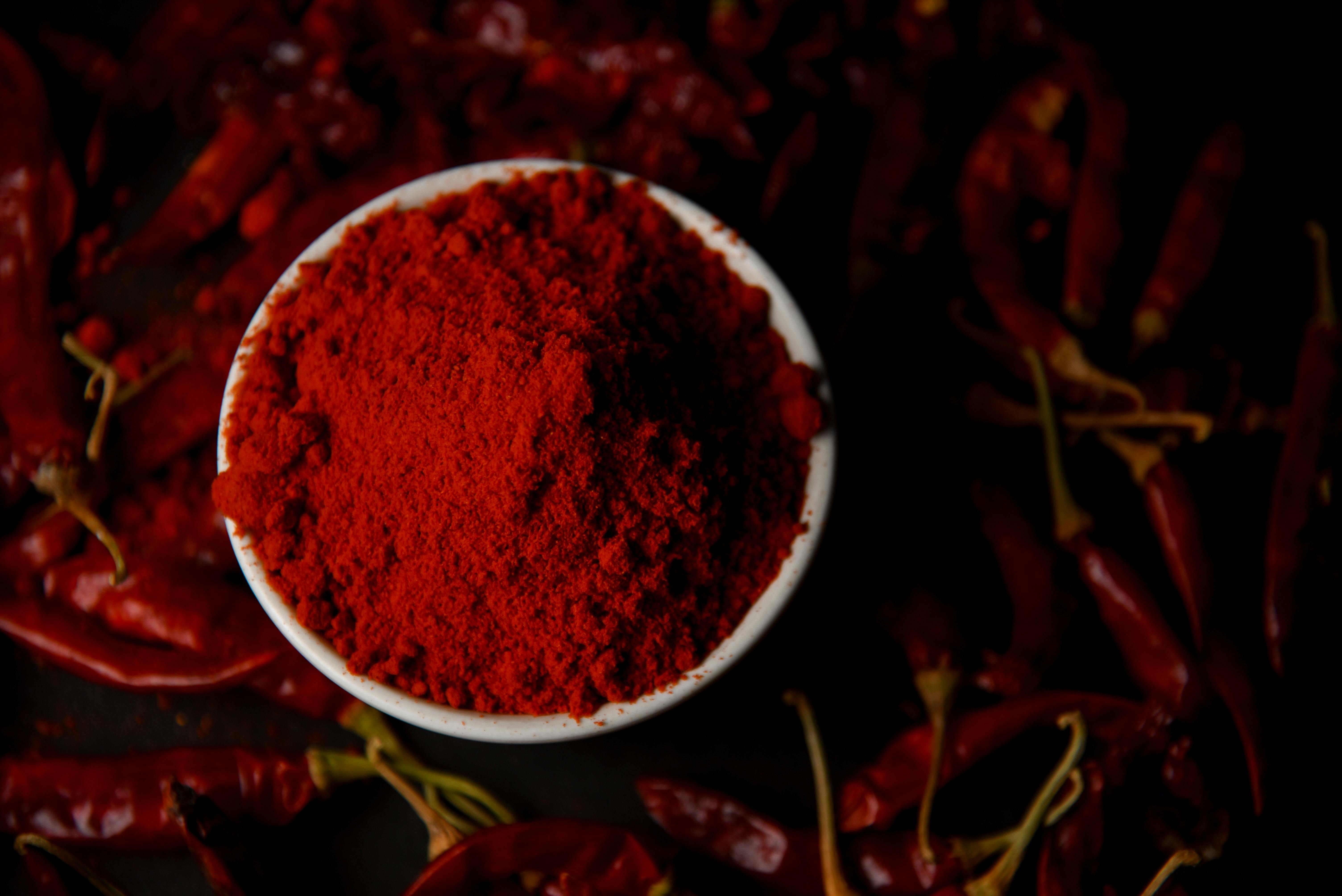
Paprika (Hungarian Spice)
A Hungarian gastronomy icon — capsanthin, capsorubin, and a carotenoid matrix from sweet to mildly hot rose paprika.
Paprika in 1 minute
What does it provide? Hungarian paprika spice is the ripened, dried, and ground fruit of red Capsicum annuum. The red color comes from capsanthin and capsorubin xanthophyll carotenoids (a distinctive feature of Hungarian paprika — other national paprika varieties differ in carotenoid profile). Rich in β-carotene (provitamin A), trace vitamin C (mostly lost during drying), and minimal capsaicin in the sweet/edesnemes ("delicate") variety. Maoka (2020) and Jang/Sahebkar et al. (2020) data show antioxidant, visual-health (macula), and metabolic-syndrome marker effects.
How much? In the kitchen, 1–2 tsp (≈ 3–6 g) of sweet paprika per 4-person serving. Essential to Hungarian goulash, paprikash, fish soup, and lecsó. A few grams of daily intake in the traditional Hungarian diet — safe and offering antioxidant benefit.
When to avoid? Capsicum allergy (rare); active GERD/reflux disease (rose/hot varieties — capsaicin can trigger flares); active gastric ulcer; Solanaceae sensitivity. Rose paprika and hot varieties have significant capsaicin content — detailed contraindications in the condition-specific section. NOT equivalent to chili pepper (XV.6) — lower capsaicin, higher carotenoid profile.
Hungarian paprika is an icon of Hungarian identity and a culinary product with Hungaricum status. Capsicum annuum originally came from Central America, reaching Europe after Columbus's 1492 expedition. By the late 16th century it arrived in Hungary via Ottoman mediation (during the Turkish occupation). Initial experimental cultivation began around Kalocsa and Szeged — these two cities remain the heart of Hungarian paprika production, both protected by EU Protected Designation of Origin (PDO).
Until the mid-19th century, paprika had only a secondary role in Hungarian cooking — the Hungarian goulash-pörkölt-paprikash tradition crystallized in the second half of the 19th century, when drainage of marshes industrialized paprika production. A major development came in the early 20th century (Albert Szent-Györgyi's Szeged studies, 1930–1932): he isolated hexuronic acid / vitamin C in large quantities from Hungarian paprika, leading to his 1937 Nobel Prize. Modern paprika research (Kalocsa and Szeged Universities, from the 1960s) focused on maximizing capsanthin and capsorubin content — these are the principal colorants of Hungarian paprika, with antioxidant potential placing them among the top-tier carotenoids. Maoka (2020) and Jang/Sahebkar et al. (2020) Sci Rep meta-analysis explore the carotenoid- and capsaicinoid-matrix functional-food role in detail. Hungarian paprika classification: special (sweetest), delicacy (sweet), edesnemes (most common), semi-sweet, rose (mildly hot), hot (sharp). (Szent-Györgyi 1937 Nobel; Maoka 2020)
Scientific Background
Hungarian paprika spice has one of the world's most concentrated red-paprika carotenoid matrices. Total carotenoid content is 200–800 mg/100 g dry weight (upper end for premium PDO lots) — of which 30–60% is capsanthin (the distinctive red xanthophyll of Hungarian paprika, present in smaller proportion in other-origin paprikas), 10–20% capsorubin, 8–15% β-carotene (provitamin A), with smaller amounts of cryptocapsin, zeaxanthin, and lutein. Xanthophylls are lipophilic polyphenols — brief heating in fat (5–10 min, 60–80 °C) — the classic Hungarian "roasted pörkölt base" technique — optimizes extraction.
Capsanthin is in vitro one of the strongest natural antioxidants (with DPPH and ORAC values higher than β-carotene). Maoka (2020) natural-carotenoid-pigment review and Jang/Sahebkar et al. (2020 Sci Rep) Capsicum annuum supplementation meta-analysis highlighted multiple aspects of carotenoid and capsaicinoid metabolism: (1) free-radical scavenging, (2) NF-κB and COX modulation reducing inflammation, (3) macular-pigment (lutein, zeaxanthin) contribution to visual health, (4) LDL-cholesterol reduction in metabolic-syndrome patients.
Human data are limited — small studies (Pérez-Gálvez 2003 on Spanish red paprika, Hornero-Méndez 2001) confirmed carotenoid absorption and pigment profile, but clinical endpoints remained largely at the preclinical level. In the Hungarian population, paprika consumption is already part of average diet — robust prospective clinical trials are lacking.
Vitamin C content drops significantly during drying — compared to fresh green pepper, dried red paprika contains 1/10 to 1/5 (≈ 50–100 mg/100 g). Despite this, regular consumption of small amounts is a useful vitamin C source.
Capsaicin content depends on type: special/delicacy/edesnemes (< 0.005% capsaicin, practically undetectable), semi-sweet (≈ 0.01%), rose (0.02–0.05%, mildly hot), hot (> 0.05%, distinctly hot). The rose and hot variants exert similar TRPV1-receptor-mediated effects as chili pepper — inflammation, blood pressure, and metabolic modulation.
At the microbiome level, paprika's carotenoid-fiber matrix has moderate prebiotic effect — animal data show selective growth of Bifidobacterium and Lactobacillus, and a decrease in Enterobacteriaceae. Human data are preliminary.
- + Fat (olive, lard, butter, ghee): capsanthin and β-carotene are fat-soluble — the Hungarian "roasted pörkölt base" (onion + fat → remove from heat → swirl in paprika → add stock/water) optimizes exactly this.
- + Onion (foundation): classic Hungarian base: quercetin (onion) + carotenoid (paprika) yields a synergistic antioxidant profile.
- + High-quality protein (beef, pork, chicken, fish): classic pörkölt-paprikash-fish soup matrix.
- + Potato, sauerkraut, tarhonya (Hungarian egg-barley): matrix maintaining stable glycemia + paprika antioxidant.
- + Vitamin-C-rich acidic items (sauerkraut, fresh tomato): synergistic antioxidant capacity.
- + Sour cream/yogurt: carotenoid absorption is increased by fatty dairy — classic creamy paprikash exploits this.
- Hot (≥ 150 °C) oil + long heating of paprika: carotenoids degrade ("burnt paprika" — bitter taste, antioxidant loss, acrylamide formation). The classic Hungarian technique: sauté onion, REMOVE FAT FROM HEAT, only then add paprika + immediately add water/stock.
- Rose/hot paprika + active GERD or gastric ulcer: capsaicin content is a flare trigger — switch to delicacy/sweet variety.
- Rose/hot paprika + anticoagulant (warfarin) at high doses: capsaicin is mildly antiplatelet — additive bleeding risk at chronic high doses. Culinary amounts are safe.
- ACE inhibitor therapy + large amounts of hot paprika long-term: cough risk (capsaicin can amplify it via TRPV1).
- Aspirin-sensitive asthma + Solanaceae sensitivity: rare, but salicylate content may add up.
- Counterfeit "paprika" products (powders, dyed): paprika adulterated with industrial dyes (Sudan dyes) — there was a scandal in 2003. EU strict monitoring, but caution with cheap sources.
- Active GERD, reflux disease flare: avoid rose/hot variety; delicacy/sweet at low dose is OK.
- Active gastric ulcer, erosive gastritis: avoid hot varieties; sweet variety also at low dose.
- Capsicum or Solanaceae allergy: cross-reactivity with tomato, eggplant, potato.
- IBS hot-trigger variant: rose/hot variety may be a trigger.
- Active hemorrhoid flare: hot variety may worsen symptoms.
- Infants and small children (< 2 years): avoid hot variety; sweet variety in moderation.
- Pregnancy and breastfeeding: culinary delicacy/sweet is safe; large amounts of rose/hot to be avoided (may worsen reflux, infant symptoms).
- Iron-deficiency anemia under treatment: paprika in large amounts may chelate iron slightly via polyphenols — separate from iron supplement.
- Adulteration risk (industrial dyes, Sudan-I): avoid cheap, unverified sources. EU PDO labeling or a trusted domestic producer recommended.
- Moldy paprika suspicion: aflatoxin risk (Aspergillus) — do NOT use musty-smelling, discolored, or moldy product.
Daily serving (culinary): 1–2 tsp (≈ 3–6 g) delicacy/sweet paprika for a 4-person serving.
The Hungarian pörkölt base protocol (KEY):
- Onion + fat (lard classic; ghee alternative) slowly sautéed to translucent (8–10 min, 80 °C).
- REMOVE FAT FROM HEAT (critical step).
- Whirl in delicacy/sweet paprika + quick stir (5–10 sec — the hot fat releases capsanthin).
- IMMEDIATELY add 100–150 ml water/stock/wine.
- Return to heat, add meat and further liquid.
Classic patterns:
- Goulash: classic beef + onion + paprika + potato + vegetables.
- Pörkölt (pork/beef/veal): thicker matrix with less liquid.
- Chicken paprikash: classic sour cream finishing.
- Fish soup (halászlé): carp/catfish + lots of paprika (up to 50 g per 4 people).
- Lecsó: fresh pepper + tomato + onion + ground paprika seasoning.
- Stuffed pepper: fresh pepper + meat-rice filling + tomato sauce.
Storage: in an airtight glass jar, dark and cool place (NOT in fridge — humidity degrades, mold risk). High-quality delicacy paprika retains aroma for 6 months, declines significantly after 1 year. Frozen, stable up to 1 year. PDO-labeled (Kalocsai or Szegedi) source recommended.
What not to do: don't put paprika into hot (≥ 150 °C) oil — bitter taste, acrylamide. Don't buy from unverified cheap sources (Sudan dye risk). Don't store in open packaging (oxidation). Don't cook for 100+ minutes — carotenoids slowly lose their color.