
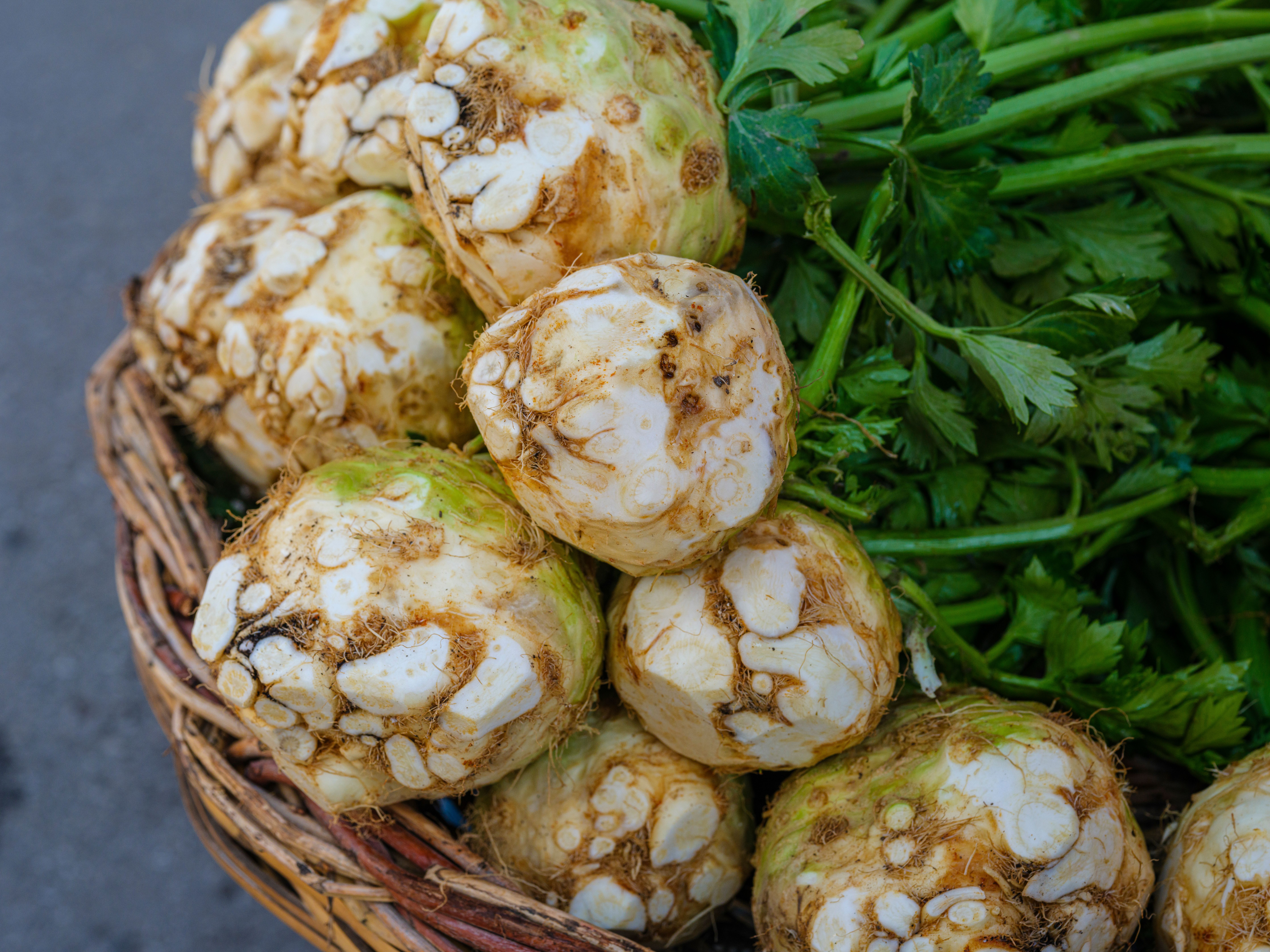
Celery
A quiet ally of blood pressure — apigenin flavonoid, phthalide compounds, and moderate nitrate in one crunchy stalk.
Celery in 1 minute
What does it provide? Apigenin (flavone — ≈ 19 mg/100 g, one of the highest apigenin sources), 3-n-butylphthalide (3nB, aroma component and vasodilator) — the latter at about 6–28 mg/100 g fresh stalk. Vitamin K1 (≈ 29 μg/100 g), potassium (≈ 260 mg/100 g), and moderate inorganic nitrate (≈ 250 mg/kg).
How much? Fresh as salad or snack 30–80 g stalk/serving (≈ 2–4 stalks), in soup 100–150 g celeriac/serving, weekly 3–5×. In preclinical (animal) lipid studies, celery extract reduced serum cholesterol and triglycerides (Tsi 1995 Planta Med, rat); human antihypertensive evidence is weak to moderate.
When to avoid? Celery allergy (Apiaceae cross-reaction: carrot, parsley, mugwort — "birch–mugwort–celery syndrome"), psoralen photodermatosis (celery's psoralen content is phototoxic, especially from diseased stalk), warfarin at long-term dose in large amounts (K1 + coumarin synergy), pregnancy in large amounts (apiol theoretical uterotonic effect), active IBS flare with celeriac (FODMAP-high mannitol).
Celery originates from the marshy shores of the Mediterranean and Western Asia, where its wild form — bitter and aromatic — was noticed even by ancient Egyptians: a wreath of celery leaves was found in Tutankhamun's burial chamber, dated around the 12th century BCE. Greeks knew it as selinon and considered it a mourning plant of the dead — in Homer's Iliad, Patroclus's horse grazes in a celery-decorated meadow. The Romans used it as both medicinal herb and digestive stimulant. The domesticated, swollen-stalked forms appeared in the 16th–17th century in Italy; the bulbous (celeriac) variety was matured to its present thickness by French horticulture. (Britannica)
Scientific Background
Celery offers three well-documented bioactive families. (1) Flavones: apigenin and its glycoside, apiin (≈ 19 mg/100 g apigenin equivalent) — apigenin per the Shukla & Gupta (2010) Pharm Res review is a broad-spectrum antioxidant, anti-inflammatory, and anxiolytic molecule that also acts on the GABA-A receptor. Its clinical relevance is partial: bioavailability is low (≈ 5%), but the colonic microbiota deglycosylates apigenin and converts it into kaempferol-like metabolites.
(2) Phthalides: 3-n-butylphthalide (3nB) and sedanolide compounds give celery its characteristic aroma, and in preclinical studies (in vitro and animal lipid models — Tsi 1995 Planta Med, high-fat-fed rat) they showed systolic blood-pressure-lowering and vascular smooth muscle-relaxing effects. The proposed mechanism: calcium channel modulation + sympathetic tone reduction. Clinical evidence is still weak-to-moderate, but the pharmacological pathway is validated.
(3) Mannitol and fiber: celeriac has significant mannitol content (FODMAP-high, osmotically active polyol), which triggers bloating and a mild laxative effect in sensitive individuals, but is a prebiotic-equivalent substrate for healthy microbiomes (Bifidobacterium fermentation).
Celery is high in water (≈ 95%), low in calories (≈ 16 kcal/100 g) — the "negative-calorie food" myth doesn't hold, but it is a carbohydrate-sparse carbohydrate source.
- + Olive oil / peanut butter snack: K1 and β-carotene absorption needs fat; the classic "peanut butter on celery stalk" is not just a kids' snack but a fat-vitamin synergy.
- + Onion, garlic: the coumarin and quercetin matrix is cardiovascularly synergistic.
- + Carrot, parsley: Apiaceae-related vegetables for polyphenol pool expansion (mixed soup, mirepoix).
- + Lemon juice + fish dish: apiol and phthalides stabilize in acidic medium, and the fish omega-3 + celery polyphenol matrix is anti-inflammatory.
- + Salad greens + walnut: Mediterranean pattern, ALA + apigenin synergy.
- Antihypertensive drug + large celery juice amount: additive hypotension risk. Culinary amounts are safe, therapeutic-dose celery juice (> 250 ml/day) requires supervision.
- Warfarin at long-term dose: K1 + coumarin together affect INR — stable weekly pattern needed.
- Levothyroxine simultaneous intake: fiber may reduce hormone absorption — keep > 2 hours apart.
- Celery allergy (Apiaceae): strict avoidance, anaphylaxis risk. In birch–mugwort–celery syndrome there are cross-reactions with stone fruits and spices.
- Psoralen photodermatosis: diseased or fungus-infected celery's psoralen content is phototoxic — healthy, fresh celery is safe.
- IBS flare: celeriac is to be avoided due to high mannitol — stalk is low FODMAP, tolerable.
- Kidney stones, CKD 3–5: moderate potassium and oxalate content — dose control.
- Pregnancy in large amounts: apiol theoretical uterotonic effect — culinary amounts are safe, therapeutic celery oil should be avoided.
- Shukla S, Gupta S. Apigenin: a promising molecule for cancer prevention. Pharm Res 2010;27(6):962–978. https://pubmed.ncbi.nlm.nih.gov/20306120/
- Tsi D, Das NP, Tan BKH. Effects of aqueous celery (Apium graveolens) extract on lipid parameters of rats fed a high fat diet. Planta Med 1995;61:18–21. (preclinical, rat) https://pubmed.ncbi.nlm.nih.gov/7700983/
- Kooti W, Daraei N. A review of the antioxidant activity of celery (Apium graveolens L). J Evid Based Complement Altern Med 2017;22(4):1029–1034. https://pubmed.ncbi.nlm.nih.gov/28701046/
- USDA FoodData Central — Celery, raw. https://fdc.nal.usda.gov/
- Monash University. Celery — FODMAP serving guidance. https://www.monashfodmap.com/about-fodmap-and-ibs/high-and-low-fodmap-foods/