

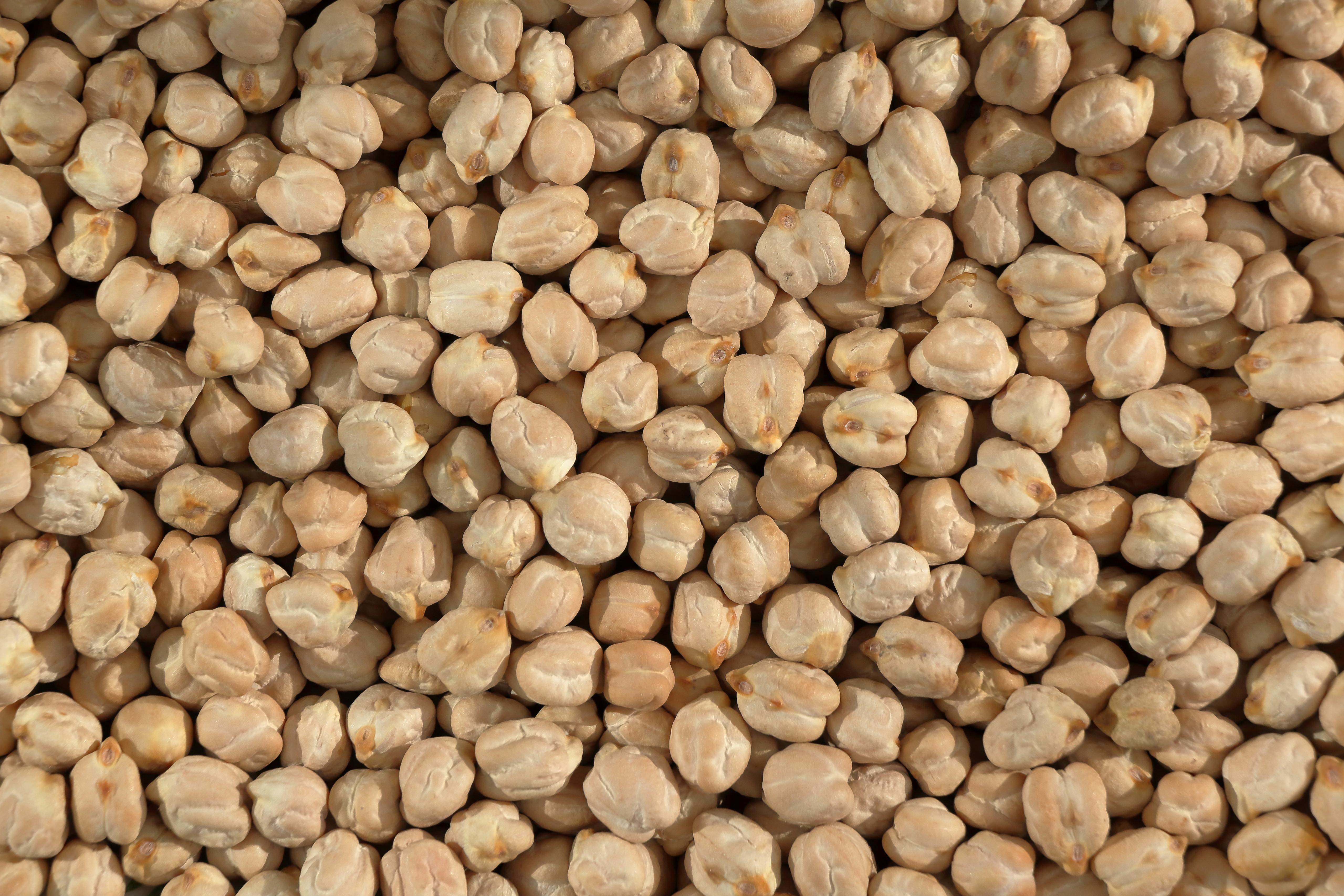
Chickpea
The foundation of hummus — GOS prebiotic, cold-retrograded RS3, and Mediterranean tradition.
In 1 minute
What does it provide? Galacto-oligosaccharides (GOS: raffinose, stachyose, verbascose — legume prebiotics that ferment only in the colon), resistant starch (RS3 — retrograded after cook-and-cool, digestion-resistant starch with butyrate-positive fermentation), plant protein, folate, manganese, and polyphenols.
How much? In RCTs, 200 g/day of canned chickpeas (≈ 1 cup) for 3 weeks produced a microbiome-positive response. 3–4×/week of ½–1 cup cooked or canned servings is a good starting point.
When to avoid? IBS elimination phase, chickpea/legume allergy, acute diverticulitis flare, sprout allergy in sprouted forms.
The chickpea's history also unfolds along the edge of the Fertile Crescent: archaeobotanical and genomic data indicate it was domesticated about 10,000–12,000 years ago, and the species is still considered one of the "founder crops." Moving from the Near East to South Asia, the Mediterranean, and Europe, it took particular root in India, where the still-popular chana and the besan flour ground from it are an obvious legacy. The Latin origin of its name — cicer — even produced a Roman politician: Marcus Tullius Cicero's family name comes from this word, traditionally because of a chickpea-shaped wart on an ancestor's nose.
In classical and medieval kitchens, chickpea joined millet and barley on the table: thanks to its long shelf life, it was eaten as dry stores, porridge, or flatbread — the remnants of this tradition give us today's hummus, the Moroccan harira soup, and the Italian farinata. The agricultural-historical diversity between the "desi" (small, dark, hulled Indian type) and "kabuli" (larger, cream-colored Mediterranean line named after Kabul in the 18th century) is still well documented and recognizable in markets around the world. (OUP Academic)
🔬 Scientific Background
The two main microbiome substrates of chickpea are the GOS/RFO fraction (raffinose, stachyose, verbascose) and resistant starch, mainly RS3 after cook→cool. GOS is not broken down in the small intestine (no human α-galactosidase) and ferments to SCFAs in the colon (acetate, propionate, butyrate). RS3 is a slowly, distally utilized "fiber-like" substrate.
In a randomized, crossover human study, 3 weeks of 200 g/day canned chickpeas or 5 g raffinose modified the stool microbiome: Faecalibacterium prausnitzii ratio ↑, some putrefactive groups ↓. The functional SCFA increase is not always significant in the short term — the response is time- and dose-dependent, and depends on the individual microbiome profile.
The 2024 reviews discuss chickpea as a "functional food" from the standpoint of gut barrier support and microbiota nutrition. In vitro human studies suggest that peptides derived from chickpea protein promote Bifidobacterium growth and lactobacillus strengthening. With chickpea pasta, cooling produces an RS increase and lower glycemic response — the classic "cook → cool" retrogradation pattern works here too.
In the polyphenol fraction, the kabuli type primarily contains quercetin and kaempferol, while the desi type also contains catechins and proanthocyanidins — the dark-hulled desi carries greater antioxidant potential.
- + Tahini (sesame paste): classic hummus combination — complementary amino acid profile (lysine × methionine) and calcium-sesamol synergy.
- + Olive oil + lemon juice: fat increases polyphenol bioavailability, and vitamin C raises iron absorption 2–4×.
- + Cumin seed, ground cumin, dill: traditional "wind-dispelling" spices — they ease gas formation from GOS fermentation.
- + Live culture (yogurt, kefir, sauerkraut): synbiotic synergy, stronger Bifidobacterium growth.
- + Whole grain (bulgur, brown rice, toasted wheat): broader fermentable fiber spectrum, more stable SCFA profile.
- + Cook → cool → eat next day: RS3 formation, lower glycemic response.
- + Sprouting or long soaking (12+ hours): reduces α-GOS for sensitive individuals (but also lowers prebiotic yield).
- Iron tablets / iron supplementation: the phytate content (≈ 0.3–0.9 g/100 g) is chelating — separate by ≥ 2 hours.
- Tea, coffee with meals: tannin-iron interaction — wait 30–60 minutes.
- Levodopa (Parkinson's): high plant protein impairs absorption — time separation (≥ 30 minutes).
- Raw or undercooked chickpeas: lectins and trypsin inhibitors cause GI irritation — minimum 45–60 minutes boiling (15–20 minutes in a pressure cooker).
- "Overcooked" chickpeas at very high heat: protein quality degrades, RS is lost — aim for the "al dente, then cool" pattern.
- Empty stomach large serving in IBS-sensitive individuals: start with 2–3 tablespoons of rinsed canned chickpeas.
- IBS elimination phase (first 4–6 weeks of FODMAP protocol): high α-GOS. For reintroduction, ¼ cup canned, rinsed (≈ 42 g) is the Monash "green" serving.
- Chickpea allergy (rare but exists): more often with sprouted or raw forms; milder with cooked forms. History of legume cross-reactivity matters.
- Active diverticulitis flare: temporarily low-fiber diet; protective in stable phases.
- Severe kidney disease (CKD, dialysis): high potassium and phosphorus — dose control.
- Acute gout flare: moderate purine content — limit during flare.
- Active IBD (UC, Crohn's) flare: temporarily low-fiber; can be reintroduced in remission.
- Infant (under 6 months): fibrous texture inappropriate; after 6 months, pureed (e.g., as hummus).
- Sprouted + immunosuppression: Salmonella/E. coli risk — heat through.
Daily/weekly serving
3–4×/week of ½–1 cup cooked or canned chickpeas (≈ 80–160 g) per occasion. RCT dose: 200 g/day for 3 weeks was tolerable. IBS-sensitive: ¼ cup canned, rinsed.
Preparation pattern
- Dry: overnight soak (8–12 hours) in plenty of water, changed several times.
- Boil in fresh water for 45–60 minutes covered (15–20 minutes in pressure cooker).
- Salt only in the last 5 minutes.
- RS3 trick: chill cooked chickpeas 12–24 hours, eat the next day cold as salad or hummus.
Classic patterns
Hummus (Lebanese): cooked chickpeas + tahini + olive oil + lemon juice + garlic + ground cumin + salt. Classic prebiotic + polyphenol + healthy fat matrix.
Indian chana masala: chickpeas + tomato + onion + ginger + chili + garam masala + turmeric — spice synergy + plant iron + vitamin C from tomato.
Moroccan harira: chickpeas + lentil + tomato + parsley + cilantro + ground cumin + cinnamon — Ramadan-fast classic, even better when cold-retrograded.
Italian farinata: chickpea flour + water + olive oil + rosemary baked as a flatbread — gluten-free, high protein.
Chickpea salad: pre-cooked, chilled chickpeas + cucumber + tomato + parsley + lemon juice + olive oil — RS3-maximizing pattern.
Storage
Dry: airtight, in a dark place 1–2 years. Cooked: in fridge 4 days, frozen 6 months. Opened canned: in fridge 3–4 days. Hummus: in fridge 5–7 days.
What not to do
Don't overcook (falls apart, RS lost). Don't salt at the start of cooking (stays hard). Don't eat raw. Don't jump to extreme servings without ramp-up in IBS-sensitive individuals.
References
[1] Fernando WMU et al. Diets supplemented with chickpea or its main oligosaccharide component raffinose modify faecal microbial composition in healthy adults. Br J Nutr 2010;106(8):1217–1224.
[2] Wallace TC et al. The nutritional value and health benefits of chickpeas and hummus. Nutrients 2016;8(12):766.
[3] Murty CM et al. Chickpea supplementation in an Australian diet affects food choice, satiety and bowel health. Appetite 2010;54(2):282–288.
[4] Singh B et al. Chickpea (Cicer arietinum L.) as a functional food: a comprehensive review. Front Nutr 2024;11:1370450.
[5] EFSA NDA Panel. Scientific opinion on dietary reference values for protein. EFSA Journal 2012.
[6] Costa GT et al. Pulse-based diets in microbiome-mediated metabolic improvements. Nature Communications 2025.
[7] Lazarte CE et al. Effect of cooking and cooling on resistant starch and in vitro digestibility of chickpea-based pasta. Foods 2023;12(7):1442.
[8] Monash University. High and Low FODMAP foods: chickpeas. Monash FODMAP database.
[9] Roy F et al. Bioactive proteins and peptides in pulse crops: nutritional, functional and cardiometabolic properties. Food Research International 2010.
[10] Sonnante G, Hammer K, Pignone D. From the cradle of agriculture a handful of lentils: history of domestication. Rendiconti Lincei 2009;20(1):21–37.