


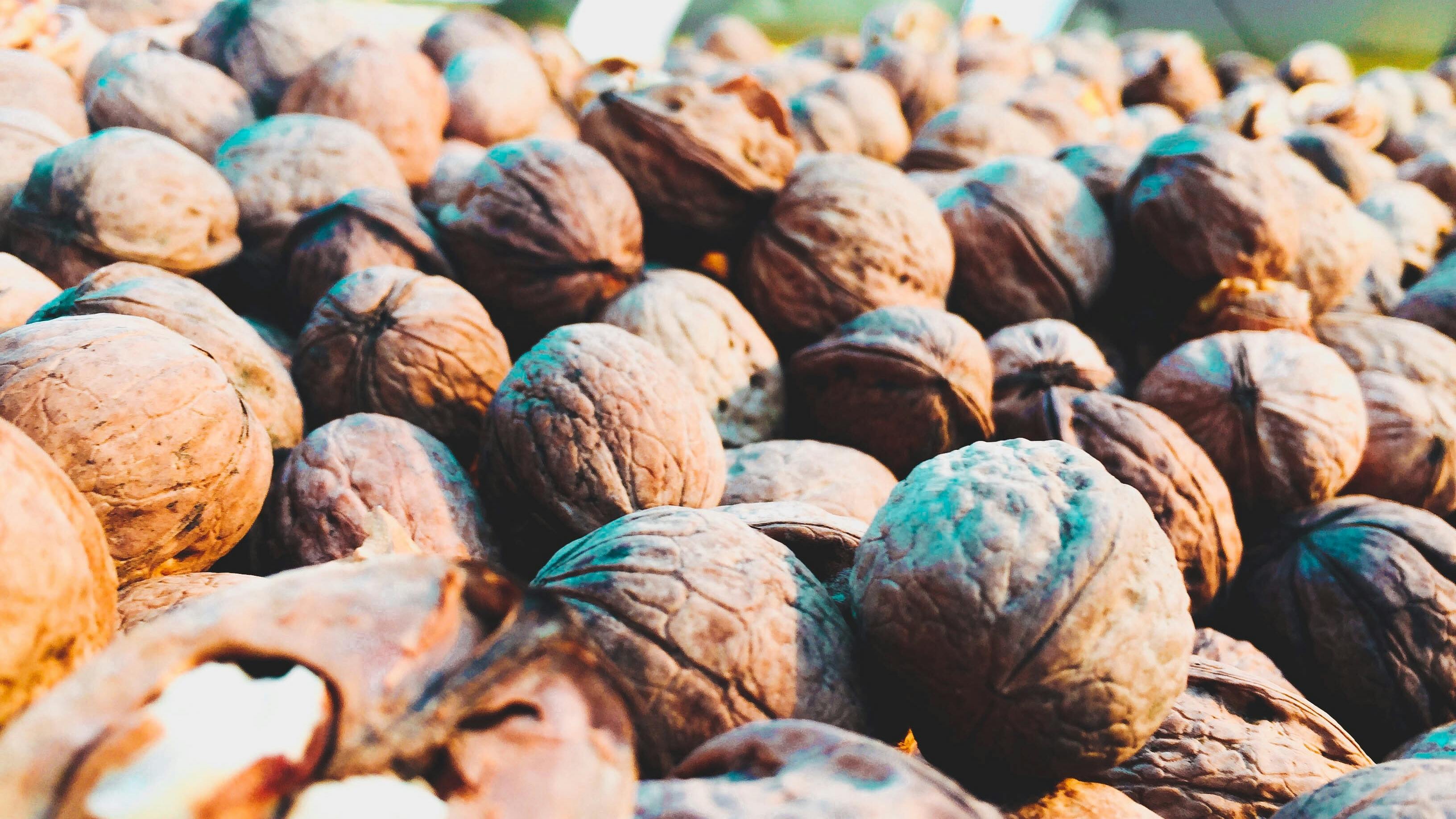
Walnut
The Silk Road''s "royal acorn" — plant omega-3, ellagitannins, and microbiome-mediated urolithins.
In 1 minute
What does it provide? Plant omega-3 (α-linolenic acid / ALA, ≈ 9 g/100 g — anti-inflammatory fatty acid), insoluble fiber (≈ 7 g/100 g, adds stool volume), and ellagitannins (polyphenols concentrated in the brown skin beneath the shell — the pellicle — which gut bacteria convert into urolithins, supporting mitochondria). It also contains natural melatonin (≈ 3.5 ng/g), which may aid sleep preparation.
How much? A handful per day (≈ 30 g, about 7–8 walnut halves) with pellicle intact. In the Walnuts and Healthy Aging (WAHA) RCT, 43–56 g/day for 6–24 months lowered LDL cholesterol (≈ −5–7%) and increased the share of Faecalibacterium and Roseburia.
When to avoid? Tree-nut allergy (severe anaphylaxis risk, cross-reaction with pecan and Brazil nut), rancid or moldy nuts (aflatoxin hazard, especially for liver patients and children), nickel-contact allergy (SNAS), active IBD flare or peptic ulcer (insoluble fiber + tannin can irritate), child under 4 with whole walnuts (choking), warfarin therapy with chronic daily > 60 g (weak bleeding risk).
The familiar "English" or "Persian" walnut's homeland traces back to South-Central Asia and around today's Iranian mountain ranges: from here it set off toward the Mediterranean, where Silk Road caravans carried it onward in small sacks to Roman markets, and from the 17th century it traveled into the hands of Spanish missionaries to the soils of California. The Romans honored it as Juglans regia, "Jupiter's royal acorn," and according to one favored imperial wedding custom, walnuts were scattered after the newlyweds leaving the ceremony — as a symbol of fertility and good fortune. Pliny devotes long pages of the Naturalis Historia to the walnut, specifically noting that its green hull dyes the skin and its oil also serves as lamp oil.
Medieval sources treated walnut as both food and medicine: the leaves, green hull, and oil were used for diarrhea, as a black hull dye, or for wound-washing. According to the medieval "signatura rerum" doctrine, the walnut kernel looks just like a mini brain — therefore physicians of the era recommended it as a "brain tonic," a folk tradition that has since been carried into the modern language of 21st-century omega-3 and cognitive research. The name "Persian walnut" also points to its Iranian–Central Asian origin, and some of the Hungarian walnut varieties still bearing fruit today are descendants of this multi-millennia journey. **(Britannica, PMC)
🔬 Scientific Background
Walnut's bioactive matrix rests on three components: ALA (≈ 9 g/100 g, outstanding among oilseeds), insoluble fiber (≈ 7 g/100 g), and ellagitannins (mainly pedunculagin, with smaller amounts of castalagin) — the latter concentrated in the pellicle (brown skin). Ellagitannins themselves are barely absorbed; in the small intestine they hydrolyze to ellagic acid, then the colonic microbiota (especially Gordonibacter urolithinfaciens and Ellagibacter isourolithinifaciens) convert this into urolithins (UA, UB, UC, UD). This explains why the clinical effect is individual-dependent: about 10–40% of the population are "urolithin-A producer" metabotype, 40–60% are UA+UB producers, and 10–20% don't produce urolithin.
The most robust human data come from the Walnuts and Healthy Aging (WAHA) study and related RCTs: 43–56 g of walnut/day for 6–24 months significantly lowered LDL cholesterol (≈ −5–7%) and increased the share of Faecalibacterium prausnitzii, Roseburia, and Lachnospiraceae, while reducing colonic secondary bile acids (deoxycholate, lithocholate). Rising urolithin-A levels induce mitochondrial biogenesis and mitophagy (Andreux 2019), linked to muscle and brain aging modulation.
Walnut is also the highest-melatonin nut (≈ 3.5 ng/g), which may contribute to circadian microbiota rhythm.
- + Retain pellicle (brown skin beneath the shell): 70–90% of polyphenols are here. NEVER peel off, don't blanch.
- + Fiber-diverse matrix (oats, flaxseed, legumes, whole grains): the microbial community needed for urolithin formation is stabilized by complex fibers → more sustained urolithin-A levels.
- + Fermented dairy (kefir, yogurt, aged cheese): synbiotic synergy, supporting microbiome diversity for urolithin-converting taxa.
- + Polyphenol matrix (red berries, pomegranate, red wine): shared ellagitannin pool → higher and more sustained urolithin levels.
- + Salad greens + olive oil: Mediterranean matrix; the ALA + MUFA + polyphenol combination is the best-documented cardiometabolic pattern.
- + Evening snack: walnut's melatonin content raises plasma level within 30–60 minutes (small effect, but measurable) — sleep support.
- Iron supplementation + large amount of walnut: ellagitannins chelate iron — time separation (≥ 2 hours) recommended.
- High heat, long roasting (≥ 180 °C, 20+ minutes): ALA oxidation + polyphenol loss. Maximum 150 °C, 10–12 minutes gentle toasting.
- Heavy degreasing/blanching: strips off the pellicle → ellagitannin intake drops by up to 80%.
- Anticoagulants (warfarin) + very high ALA intake: theoretical, weak bleeding-risk increase. Culinary amounts (30–60 g/day) are safe, no drug-level risk.
- Empty stomach + large serving (> 60 g): GI irritation, bloating (insoluble fiber + tannin).
- Rancid/off-smelling oil: ROS load. Walnut oil is among the most oxidizable.
- Tree-nut allergy: strict total avoidance (anaphylaxis risk). Walnut's cross-reactivity with other tree nuts (pecan, Brazil nut) is common, but NOT with peanut (that's a legume).
- Nickel-contact allergy / systemic nickel syndrome (SNAS): walnut has moderate nickel content — flare possible during strict diet.
- Aflatoxin-sensitive populations (liver patients, children): discard rancid/moldy walnuts immediately. Airtight packaging + refrigerated storage.
- Active peptic ulcer / active IBD flare: insoluble fiber + tannin may worsen symptoms. Safe in remission.
- Kidney stones (calcium-oxalate stone tendency): walnut has moderate oxalate content; 30 g/day is safe, more + low calcium intake is risky.
- Severe calorie-restricted diet: 30 g walnut ≈ 200 kcal — portion control.
- Infant, child under 4: whole walnut is a choking hazard; can be given ground, in butter (after allergy history check).
Daily serving
30 g (≈ 7–8 walnut halves) with pellicle. In RCT protocol, 43–56 g/day for targeted microbiome effect.
Preparation pattern
- Raw, with pellicle: the gentlest form. Soaking (4–8 hours in cold water) softens the tannic aftertaste, reduces phytate content.
- Gentle toasting: maximum 150 °C, 8–12 minutes — flavor deepening with minimal polyphenol loss.
- Grind fresh: never store ground for days — ALA oxidizes in minutes.
Classic patterns
Mediterranean salad: arugula + pear + walnut + balsamic + olive oil — classic ALA + polyphenol matrix.
Pesto (basil + walnut instead of pine nut): cheaper, more ALA-rich variation. Olive oil + Parmesan + garlic.
Breakfast oatmeal: oats + walnut + berries + kefir drizzle — synbiotic breakfast, grain fiber + ellagitannin.
Nocino (green walnut liqueur): green walnuts picked in late July + high-proof spirit + sugar + spices, 40-day maturation — traditional Italian digestif, enjoyed in moderation.
Evening walnut-kefir snack: ½ handful walnut + 200 ml kefir 1 hour before bed — melatonin + synbiotic.
Storage
In an airtight jar, in the fridge (4 °C) — in-shell walnut 6 months, shelled 2–3 months, frozen 1 year. Walnut oil in a dark bottle, refrigerated, maximum 3 months.
What not to do
Don't store ground walnuts at room temperature for days. Don't peel off the pellicle. Don't roast above 180 °C. Don't eat rancid (bitter, biting) walnuts.
References
[1] Holscher HD et al. Walnut consumption alters the gastrointestinal microbiota, microbially derived secondary bile acids, and health markers in healthy adults: a randomized controlled trial. J Nutr 2018;148(6):861–867.
[2] Bamberger C et al. A walnut-enriched diet affects gut microbiome in healthy Caucasian subjects: a randomized, controlled trial. Nutrients 2018;10(2):244.
[3] Sala-Vila A et al. Effect of a 2-year diet intervention with walnuts on cognitive decline: the Walnuts and Healthy Aging (WAHA) Study. Am J Clin Nutr 2020;111(3):590–600.
[4] Andreux PA et al. The mitophagy activator urolithin A is safe and induces a molecular signature of improved mitochondrial and cellular health in humans. Nat Metab 2019;1:595–603.
[5] Tomás-Barberán FA et al. Urolithins, the rescue of "old" metabolites to understand a "new" concept: metabotypes as a nexus among diet, microbiota, and health. Mol Nutr Food Res 2017;61(1).
[6] Reiter RJ et al. Melatonin in walnuts: influence on levels of melatonin and total antioxidant capacity of blood. Nutrition 2005;21(9):920–924.
[7] Bolling BW et al. Tree nut phytochemicals: composition, antioxidant capacity, bioactivity, impact factors. Nutr Res Rev 2011;24(2):244–275.
[8] Monash University. High and Low FODMAP foods. Monash FODMAP database.