

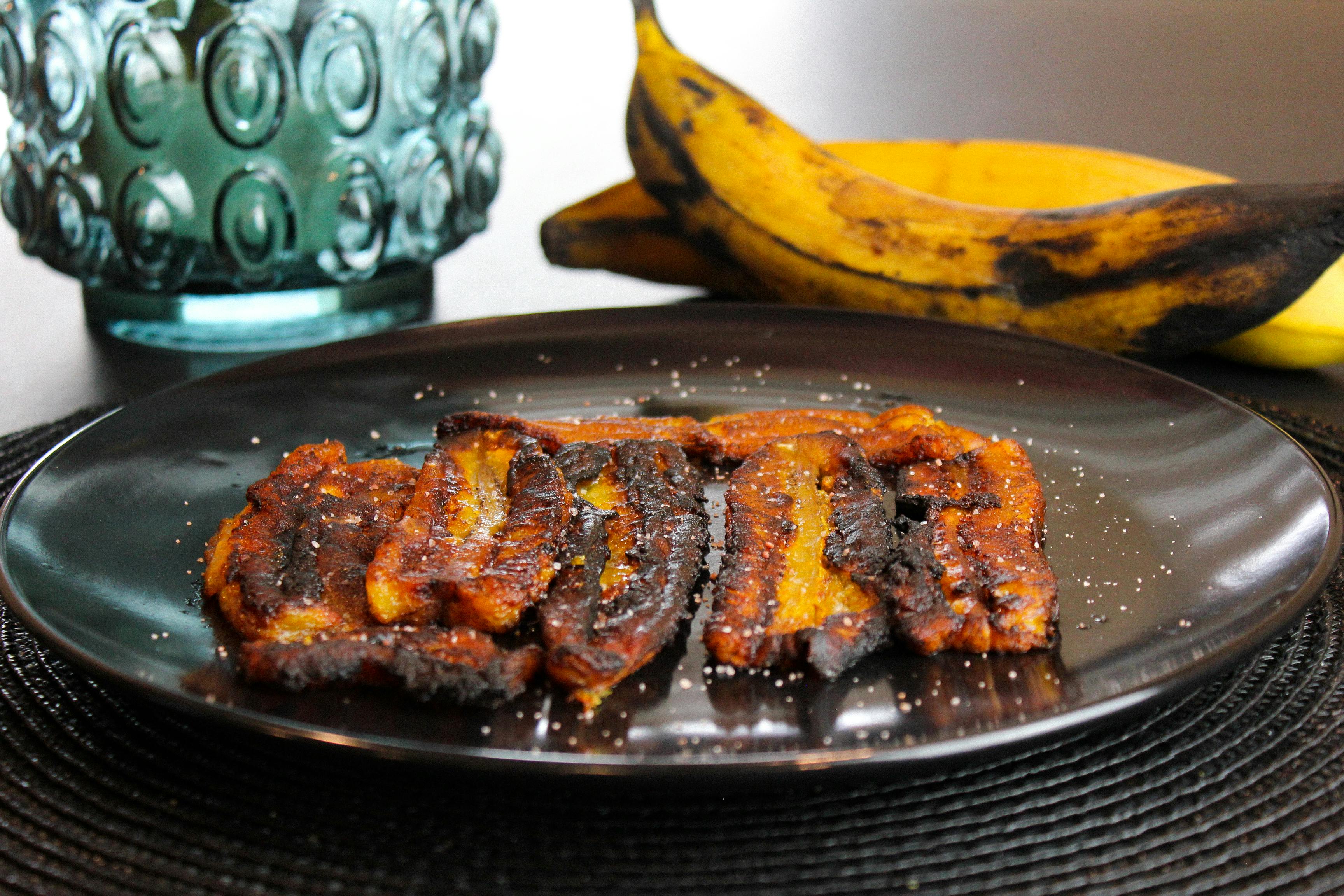
Plantain (cooking banana)
The big sibling of the green banana — RS2-starch concentrate, butyrate substrate, ancient tropical staple.
Plantain in 1 minute
What does it provide? In the green (unripe) state, outstanding RS2 content (40—50% on dry-weight basis — even higher than green banana!), high potassium (499 mg/100 g — heart-kidney support), vitamin B6, manganese. During ripening, the starch converts to sugar, but when cooked (fried, boiled, chips) partial RS3 conversion is preserved.
How much? 100—150 g green plantain cooked, daily — clinical pilots (Falcomer 2019, Bhattacharyya 2016) used this dose.
When to avoid? Diabetes with insulin-pump therapy (ripe form has a high glycemic index). Latex allergy (banana-latex cross-reactivity ~ 30—50%). Potassium-overload risk in severe kidney disease.
Plantain (cooking banana) is an ancient West African, Central American, and Caribbean staple. Despite its Southeast Asian origins, the 16th-century slave trade spread it across Caribbean plantations, where it took on a role similar to maize and root crops. In Ghana, Nigeria, Uganda, and Congo, it remains a daily staple today — boiled, fried (tostones, mofongo), or as dried flour. Modern microbiome science integrated the clinical RS2 evidence in Falcomer 2019 Nutrients review.
Scientific Background
Green plantain is one of the most concentrated natural RS2 sources. It differs from the ripe banana (IV.7 green banana) by a higher starch-to-sugar ratio: 100 g green plantain ≈ 32 g starch, 40—50% of which is resistant. The keystone bacterium Ruminococcus bromii and Bifidobacterium adolescentis are the main fermenters — with high individual variability (responder vs. non-responder phenotype).
Falcomer 2019 Nutrients review synthesizes the green-banana/plantain evidence: in human pilots (Bhattacharyya 2016), green banana flour at 30 g/day reduced postprandial glucose and increased fecal butyrate. The plantain evidence is analogous but partly extrapolated.
The cook-cool protocol (as with potato) yields RS3 conversion — producing a combined RS2+RS3 matrix. The classic Caribbean tostones (twice-fried plantain) interestingly preserve part of the RS matrix through the frying process.
- + Bean + tomato (African stew): classic "red red" — legume fiber + plantain RS.
- + Avocado + lime: Caribbean-Mexican matrix.
- + Roasted meat (chicken, fish): classic "mofongo."
- + Coconut milk (small amount) + turmeric: Caribbean "curry plantain."
- + Olive oil + garlic + parsley: Mediterranean adaptation.
- + Fermented vegetables (sauerkraut): RS + live LAB synbiotic.
- Raw consumption: extremely hard, almost inedible — cooking or frying is mandatory.
- Deep-frying in industrial oils: acrylamide formation at high temperatures + saturated fat.
- Overripe plantain in a high-glycemic context: the starch has converted to sugar.
- High-dose potassium supplement with diuretic: cumulative potassium overload.
- Severe kidney disease (CKD 4—5): high-potassium risk.
- Latex allergy: banana-latex cross-reactivity 30—50% — first use a small dose.
- Diabetes with insulin-pump treatment: ripe form is high-glycemic — green preferred.
- IBS mature phase: ripe form (yellow-spotted) is more FODMAP-positive; green is safe.
- Infant: as purée from 6 months, but cooked.
- Falcomer AL et al. Health benefits of green banana consumption: a systematic review. Nutrients 2019;11(6):1222. https://www.mdpi.com/2072-6643/11/6/1222
- Bhattacharyya R et al. Resistant starch from green banana improves insulin sensitivity — pilot RCT. Indian J Clin Biochem 2016.
- Mota da Silva A et al. Nutritional composition and bioactive compounds of green and ripe Musa species — review. Food Res Int 2020;132:108963.
- USDA FoodData Central — Plantains, green, raw (NDB #09277). https://fdc.nal.usda.gov/
- Monash University. Plantain — Low FODMAP serving guidance (green zone). https://www.monashfodmap.com/
- Bouhnik Y et al. Short-chain fatty acid production by colonic fermentation — review. Eur J Clin Nutr 1999.
- Walker AW et al. Dominant and diet-responsive groups of bacteria within the human colonic microbiota. ISME J 2011;5(2):220—230. https://pubmed.ncbi.nlm.nih.gov/20686513/