


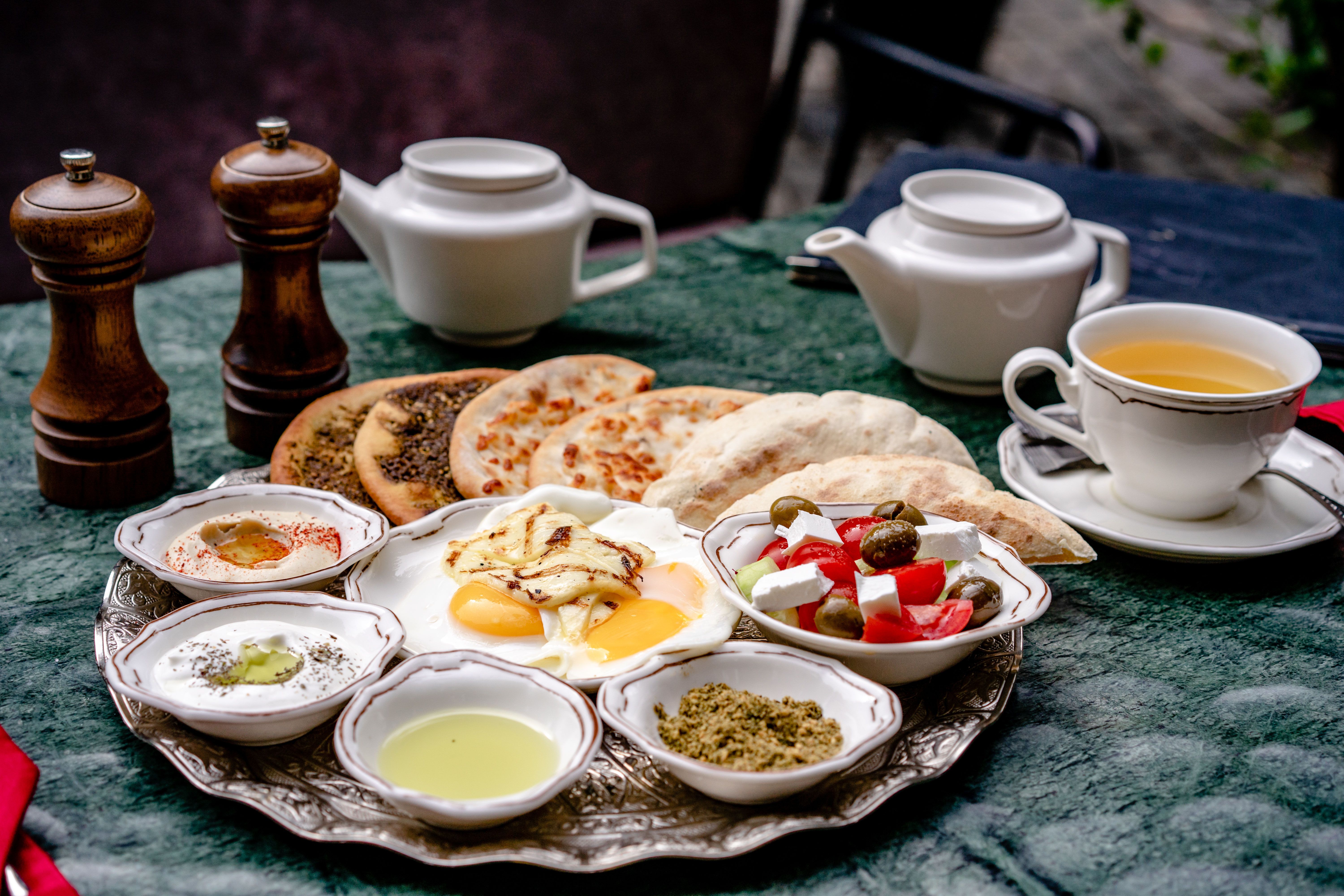
Labneh
The Middle Eastern strained yogurt — creamy-textured live dairy with Mediterranean herbs, in density between cheese and Greek yogurt.
- Latin név
- Bos taurus / Capra aegagrus / Ovis aries (cow, goat, or sheep milk) + Streptococcus thermophilus + Lactobacillus delbrueckii + long whey straining
- FODMAP
- 🟡 moderate plain / 🟢 low lactose-free
- Evidence
- ★ ★ (live LAB EFSA + Middle Eastern population data)
- Microbiota
- Live LAB + dense casein matrix + postbiotic
- What does it provide?
- "Labneh" (لبنة, Arabic "small milk," "curd-like" content) is the classic Middle Eastern strained yogurt — made with several-hour-to-day whey straining, in density between Greek yogurt and fresh cheese. High protein (8–11 g/100 g), casein-dominant. Live LAB (10⁶–10⁸ CFU/g), active β-galactosidase (EFSA claim lactose digestion). Classic serving: with olive oil, za'atar spice blend, and fresh pita bread.
- How much?
- 50–150 g plain labneh daily (in Mediterranean-Middle Eastern diet).
- When to avoid?
- Cow's milk protein allergy (strictly); galactosemia (absolute); severe lactose intolerance (lower lactose, but sensitive individuals may still react — choose lactose-free or sheep/goat base); pasteurized shelf-stable versions (low LAB); ≥ 2 hours separation from levothyroxine, iron supplements; infant < 6 months.
Labneh is a several-thousand-year-old cornerstone of Middle Eastern and North African cuisines — the whey-strained fermented milk form of ancient Mesopotamian and Levantine shepherds. Both Arabic "labneh" ("لبنة") and Hebrew "lebene" ("לבנה") derive from "leben" ("yogurt"). The classic Middle Eastern breakfast — labneh + olive oil + za'atar + pita — is a centuries-old Lebanese, Palestinian, Syrian, Jordanian tradition. "Labneh balls" (small balls of dense labneh stored in oil) are a traditional winter preservation method in Lebanon.
During modern globalization, labneh entered the Western "superfood" market in the 2010s. Clinical microbiome research (Sanlier 2019, Marco 2017) discusses Middle Eastern strained ferments — labneh, ayran, kefir — in the "Mediterranean-LAB matrix" category. In Middle Eastern populations, average daily strained ferment consumption is high and is associated with favorable bone health and metabolic profile — as the dairy component of the "Mediterranean diet."
🔬 Scientific Background
Labneh production process: 1. Yogurt base: classic yogurt starter (Streptococcus thermophilus + Lactobacillus delbrueckii subsp. bulgaricus), 42 °C for 6–8 hours. 2. Salting: ½–1% salt added to assist whey straining. 3. Whey straining: on cheesecloth, gravitational, 12–48 hours (in refrigerator). Longer straining → denser labneh. Classic: 24 hours. 4. Packaging: refrigerated, or as labneh balls in oil (winter preservation).
Per Codex Alimentarius, labneh is in the "concentrated fermented milks" category — similar to Greek yogurt but traditionally with longer whey straining and higher salting.
Nutrient matrix: 8–11 g protein/100 g, 6–10 g fat/100 g (depending on the milk-base fat content), 100–150 mg calcium/100 g. Casein-whey ratio is milk-typical (80:20).
Live LAB: in fresh traditional version 10⁶–10⁸ CFU/g — EFSA claim valid (lactose digestion). Industrial long-shelf-life versions are pasteurized.
Clinical studies: small Middle Eastern pilots (Othman 2010, Halawa 2018) showed favorable effects of labneh consumption on glycemic profile and blood pressure. Middle Eastern population data show that high labneh + olive diet (Lebanese-Mediterranean) is associated with low cardiovascular disease incidence.
Microbiome effect: Wallace (2018 J Food Sci) and Marco (2017 Curr Opin Biotechnol) report that traditional strained ferments (labneh, Greek yogurt, skyr) increase Bifidobacterium and Lactobacillus levels, providing a favorable SCFA matrix.
Goat/sheep labneh (Lebanese tradition): labneh made from goat milk has an A2-like casein profile (better tolerance for cow-milk-sensitive individuals — see IX.5 goat milk ferments), higher MFGM content.
- + Olive oil, za'atar (thyme + sesame + sumac): classic Lebanese breakfast.
- + Fresh pita, manakish: traditional.
- + Fresh greens (tomato, cucumber, radish, mint): Mediterranean salad.
- + Olives, capers, lemon zest: flavor deepening.
- + Sumac + sesame: spice symbol.
- + Berries (strawberry, blueberry): dessert variation.
- Added sugar: worsens metabolic profile.
- High-Na foods (cheese, sausage): labneh + added salt → Na overload.
- Levothyroxine (T4): calcium chelation — separate by ≥ 4 hours.
- Tetracycline, ciprofloxacin: calcium interference — ≥ 2 hours.
- Iron supplements: ≥ 2 hours.
- Heating to high temperatures (≥ 70 °C): LAB loss.
- Cow's milk protein allergy: strictly avoid (or try goat/sheep labneh).
- Galactosemia: absolute.
- Severe lactose intolerance: lower lactose, but sensitive individuals may still react.
- Severe kidney disease (CKD 4–5): high protein + phosphorus — moderate.
- Hypertension + Na restriction: labneh is traditionally salted — choose "low-salt" version.
- Severe immunosuppression: live LAB avoided.
- Infant < 6 months: avoid.
- Histamine intolerance: moderate.
- Hashimoto + iodine sensitivity: dietary amounts OK, levothyroxine separation.
- Chronic hypercalcemia: avoid.
"Labneh and Greek yogurt are the same." Partly a myth. Both are strained yogurt, BUT: labneh is traditionally made with longer whey straining (24–48 hours vs. Greek yogurt 12–24 hours), and often salted — denser, more cheese-like. Greek yogurt is unsweetened, unsalted. Clinically similar categories.
"Labneh is the same as cream cheese." Myth. Cream cheese (Philadelphia, ricotta) is rennet- or coagulant-clotted + often not fermented; labneh is purely LAB ferment + whey straining. Cream cheese is high-fat, low-LAB; labneh is medium-fat, high-LAB.
"All labneh is live-culture." Partly a myth. Industrial long-shelf-life versions are pasteurized — low LAB. Check label: "live active cultures."
"Labneh is the powerful Mediterranean super-healthy food." Partly true. The classic Lebanese breakfast — labneh + olive oil + vegetables + za'atar — has a favorable lipid and microbiome profile. BUT: traditional salting makes moderate portions advised from a Na standpoint.
"Goat labneh is healthier than cow." Partly true. Goat milk has A2-like casein profile, higher MFGM, better tolerance for cow-milk-sensitive individuals. BUT: not "absolutely better" — clinical studies show positive effects from cow labneh too.
"0% fat labneh is ideal." Partly a myth. Full-fat labneh (6–10%) contains MFGM matrix and fat-soluble vitamins (D, K). Calorie target or diabetes = lower fat; general health = full fat.
"Vegan labneh alternative (almond, coconut) is equivalent." Partly a myth. Vegan labneh alternatives are similar in flavor, but protein, calcium, live-LAB content differ. Soy labneh with live culture comes closer, but the animal milk matrix is unique.
🍳 Kitchen Protocol
Daily serving: 50–150 g plain labneh.
Preparation pattern — homemade labneh: 1. 1 liter whole milk + 2 tbsp live yogurt → yogurt starter at 42 °C for 6–8 hours. 2. Add ½ tsp salt. 3. Drain on cheesecloth for 24 hours (in refrigerator). 4. Store in refrigerator.
Classic patterns:
Classic Lebanese breakfast: labneh + extra virgin olive oil + za'atar + fresh pita + olives + tomato + cucumber.
Manakish bil za'atar: flatbread with labneh + za'atar + olive — baked.
Mezzeh platter (Mediterranean appetizer): labneh + hummus + baba ganoush + tabouli + pita.
Labneh balls (labneh kerat): dense labneh formed into small balls, olive + dried herbs (thyme, oregano), in glass with olive oil — winter preservation 3–6 months.
Salad dressing: labneh + Dijon + lemon + olive.
Storage: refrigerated airtight for 7–14 days. Labneh balls in oil 3–6 months.
What not to do: don't boil (LAB loss). Don't leave at room temperature. Don't add too much salt (traditional ½ tsp/liter is enough).
📚 References (selected)
1. EFSA NDA Panel. Scientific opinion on live yoghurt cultures and improved lactose digestion. EFSA Journal 2010;8(10):1763. 2. Wallace TC. Health effects of fermented dairy. J Food Sci 2018. 3. Sanlier N et al. Health benefits of fermented foods. Crit Rev Food Sci Nutr 2019;59(3):506–527. 4. Marco ML et al. Health benefits of fermented foods: microbiota and beyond. Curr Opin Biotechnol 2017;44:94–102. 5. Othman SK et al. Concentrated fermented milks (labneh) — production, composition and health benefits. Int Dairy J 2010. 6. Halawa MM et al. Microbiological quality and health benefits of traditional Middle Eastern labneh: a review. J Food Sci Technol 2018. 7. Codex Alimentarius. Standard for Fermented Milks (CXS 243-2003, Rev. 2025). 8. Hill C et al. ISAPP consensus on the term "probiotic". Nat Rev Gastroenterol Hepatol 2014;11(8):506–514.