

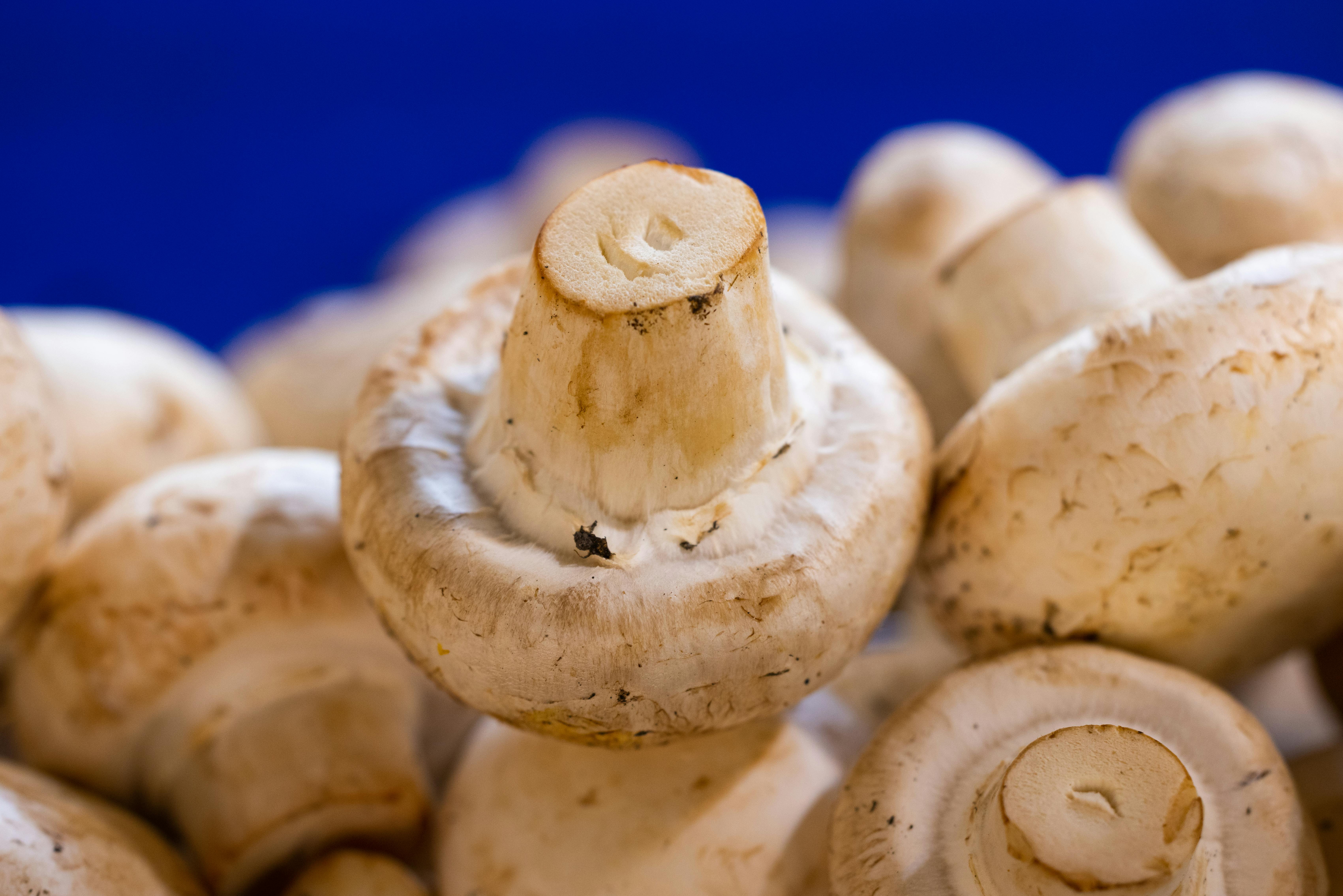
White Button Mushroom
The trick of the champignon cellars beneath Paris — ergosterol → vitamin D₂ in the glow of a UV lamp.
In 1 minute
What does it provide? Mushroom β-glucans (β-(1→3)/(1→6)), chitin/chitin-glucan complex, ergosterol (converts to vitamin D₂ under UV light), ergothioneine (a rare, dietary antioxidant amino acid), small amounts of protein, and B vitamins (especially B2 — riboflavin, B3 — niacin, B5 — pantothenic acid).
How much? Fresh/sautéed: 80–100 g/meal. Hess 2018 human RCT used 84 g/day (≈ 1 cup) for 10 days. The UV-treated form dramatically increases D₂ content.
When to avoid? IBS-mannitol sensitivity (fresh mushroom); raw in large quantities (agaritine — a natural hydrazine compound, weakly mutagenic in vitro; largely degrades with cooking); mushroom allergy; canned with brine (lower in FODMAPs for sensitive individuals but may contain preservatives).
The European cradle of button mushroom cultivation is 17th-century France: according to accounts, Louis XIV's famous head gardener Jean-Baptiste de La Quintinie first experimented with it in the dark greenhouses of Versailles's Potager du Roi, where they began growing the button mushroom alongside overflowing melons. In 1707, Joseph Pitton de Tournefort wrote a separate dissertation for the Académie des Sciences in what was the first known scientific cultivation description. The 18th–19th century Parisian breakthrough was the discovery of the city's vast underground catacombs and abandoned quarries as "champignon" cellars: the constant 12–14 °C temperature and 90% humidity proved ideal — hence the world-famous "champignon de Paris" name.
By the mid-19th century, mushrooms were being produced by the ton in the Parisian catacombs across some 300 km of tunnels, and city kitchens received fresh produce daily by cart. In 1893, at the Pasteur Institute, Constantin and Matruchot developed the controlled, sterile "spawn" (mushroom seed) production process, which eliminated random contamination — this turning point shaped 20th-century industrial cultivation. A fun fact: the American birthplace of mushroom cultivation is Kennett Square, Pennsylvania, where in the 1880s Eberhardt William Swayne began growing the French hardy button mushroom strain — today the town supplies more than half of the US mushroom crop and proudly bears the name "Mushroom Capital of the World." The button mushroom is today the world's most widely consumed cultivated mushroom.
🔬 Scientific Background
The white button mushroom (Agaricus bisporus) bioactive matrix: (1) cell-wall polysaccharides — mainly β-glucans (with β-(1→3)/(1→6) branching) and chitin; mushroom-derived, structurally distinct from cereal β-glucan; (2) ergosterol — converts to vitamin D₂ (ergocalciferol) under UV light; (3) ergothioneine — a rare, diet-derived antioxidant amino acid; (4) small amounts of polyphenols and volatile compounds. The mature, darker varieties (cremini, portobello) share a similar profile with a more mature umami flavor.
Clinical human evidence: (1) Hess 2018 randomized crossover trial in healthy adults (32 subjects, 10 days, mushroom-based diet vs. meat control) — stool mass increase, Bacteroidetes rise, Firmicutes decline, but SCFA averages unchanged. (2) Outila 1999 human pilot — UV-treated mushrooms (sun-exposed) produced a 25(OH)D increase as D₂ supplementation. (3) Beelman 2020 human RCT — ergothioneine intake modulated cognitive markers in older adults (weak effect). (4) Calvo 2024 human RCT — UV-treated mushrooms over 12 weeks vs. D₃ supplementation → similar 25(OH)D rise.
Culinary technology keys: - Boiling may modify the measurable β-glucan fraction and bile-acid binding capacity — the effect is temperature- and time-dependent. - Sautéing may reduce ergosterol and some components. - Grilling/microwaving favorably preserves antioxidant capacity. - UV-B treatment (sun exposure 30–60 minutes or industrial UV-B lamp) dramatically converts ergosterol to vitamin D₂ — up to 10–25 µg/100 g.
Fresh button mushrooms contain mannitol (a mushroom sugar alcohol), which can cause bloating in IBS-sensitive individuals. In canned button mushrooms, mannitol partially leaches into the brine — which is why they are often better tolerated.
- + UV exposure (sun exposure 30–60 minutes): dramatic vitamin D₂ increase.
- + Olive oil, butter (cooked with fat): improves D₂ and carotenoid absorption.
- + Onion-garlic sauté (if FODMAP-tolerated): classic synergy.
- + Whole-grain side dish (AXOS): broader fermentation profile.
- + Yogurt, kefir: synbiotic synergy.
- + Parsley, thyme: essential-oil synergy, polyphenol amplification.
- Raw in large quantities: agaritine (a hydrazine derivative) is mushroom-derived and moderately carcinogenic in animal models; heat degrades it.
- Canned brine in larger amounts for FODMAP-sensitive individuals: osmotically burdensome.
- Prolonged high-heat deep frying: β-glucan loss.
- Salted, preservative-laden canned product: sodium load.
- Discarding the soaking liquid for dried mushrooms: water-soluble β-glucans are lost.
- With sugary sauces: no synergy.
- IBS-mannitol sensitivity: portion control with fresh button mushrooms (Monash: 75 g fresh low), rinsed canned often better.
- Gout flare: moderate purine content.
- Mushroom allergy: avoid.
- Infant under 1 year: mushroom introduction not recommended.
- Severe renal failure: moderate purine and potassium.
- Pregnancy: safe in dietary amounts when well cooked; raw/raw-like to be avoided (Listeria risk).
- Active Crohn's flare: caution due to β-glucan content.
- Sodium-restricted diet: for canned products, read the label.
Daily serving
Fresh 80–100 g/meal (Hess 2018 RCT: 84 g/day). For D₂ purposes, UV-treated approximately 100 g.
Preparation pattern
- Cleaning: wipe with a damp cloth; don't soak (becomes spongy).
- Slicing or halving: cut into small pieces.
- UV activation (for D₂ purposes): 30–60 minutes in the sun, sliced.
- Heat treatment: at least 5–7 minutes at high heat — breaks down agaritine.
Classic patterns
Classic French "champignons à la grecque": olive oil + lemon juice + coriander + bay leaf + pepper.
Mushroom paprikash (Central European style): button mushrooms + onion + paprika + sour cream.
Italian risotto ai funghi: rice + stock + button mushrooms + parmesan.
Stuffed portobello "burger": filled with parmesan, roasted as a "meat substitute."
Roasted button mushroom salad: roasted mushrooms + arugula + walnuts + balsamic vinegar.
Chinese stir-fry: button mushrooms + scallion + soy + sesame oil.
Canned button mushrooms (rinsed) for FODMAP-sensitive: small amounts in salads.
Storage
Fresh refrigerated 5–7 days (in paper, not plastic). UV-treated and frozen (D₂ retained) 6 months. Opened canned in fridge 3–4 days. Dried: 12 months.
What not to do
Don't eat raw in large quantities (agaritine). Don't soak in water (becomes spongy). Don't put behind glass for "D₂ activation" (UV-B doesn't pass through glass). Don't push it if mannitol-sensitive.
References
[1] Hess J et al. Effects of Agaricus bisporus consumption on gut microbiota in healthy adults: a randomized crossover trial. J Acad Nutr Diet 2018;118(8):1503–1512.
[2] Urbain P et al. Bioavailability of vitamin D2 from UV-B-irradiated button mushrooms (Agaricus bisporus) in healthy adults deficient in serum 25-hydroxyvitamin D: a randomized controlled trial. Eur J Clin Nutr 2011;65(8):965–971.
[3] Beelman RB et al. Health consequences of improving the content of ergothioneine in the food supply. FEBS Lett 2020;594(20):3262–3268.
[4] Calvo MS et al. Vitamin D2 from UV-exposed mushrooms — efficacy review. Nutrients 2024;16(11):1623.
[5] Yu S et al. Agaricus bisporus and antiobesity effects on gut microbiota and inflammation: animal and human studies. Foods 2022;11(18):2890.
[6] Cardwell G et al. A review of mushrooms as a potential source of dietary vitamin D. Nutrients 2018;10(10):1498.
[7] EFSA NDA Panel. Safety of UV-treated mushroom powder as a novel food. EFSA Journal 2020;18(7):6190.
[8] Smith JE et al. Medicinal mushrooms: their therapeutic properties and current medical usage with special emphasis on cancer treatments. Cancer Research UK report 2002.
[9] Monash University. Mushrooms (button, fresh) — high FODMAP; canned drained — low FODMAP.