


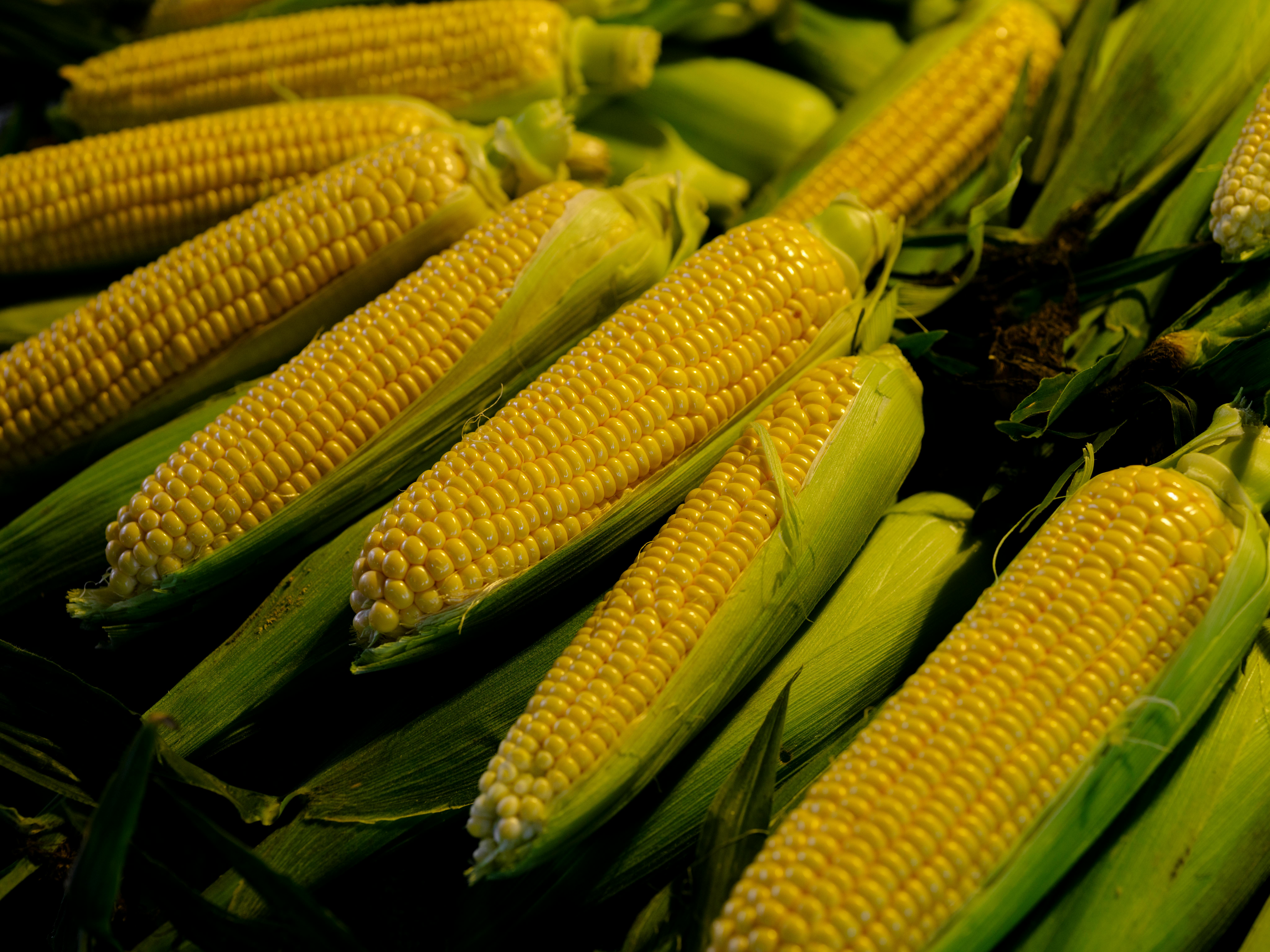
Corn
The Mesoamerican invention — nixtamalization, niacin release, and the conquest of pellagra.
In 1 minute
What does it provide? Bran arabinoxylans (soluble-insoluble mixed fiber, fermented by Bifidobacterium and Prevotella), resistant starch (the small intestine doesn't digest it, colon bacteria convert it to butyrate — especially after cook-and-chill polenta, RS3 fraction), ferulates (ferulic acid-polyphenol esters, antioxidants), lutein-zeaxanthin (the yellow macular pigment, eye protection documented in the AREDS2 RCT). After nixtamalization (lime-water pre-cooking), niacin (B3) is converted to a free, usable form.
How much? 1 cup cooked sweet corn (≈ 165 g) daily, or 1–2 nixtamalized tortillas, or 60–80 g polenta. In a clinical trial (Van den Abbeele 2018), 25–35 g/day corn AX over 6 weeks produced Bifidobacterium adolescentis enrichment and SCFA increase. Whisner 2016 (J Nutr, dose-response RCT): soluble corn fiber (10–20 g/day) in pubertal girls increased Ca absorption by ~12%, with Parabacteroides and Clostridium family shifts.
When to avoid? Corn allergy (rare IgE-mediated), active diverticulitis flare (whole grain and popcorn husk can irritate), in celiac disease cross-contaminated flour (only certified gluten-free), in IBS elimination phase sweet corn (high fructan/polyol FODMAP), in controlled diabetes industrial corn flakes and HFCS-containing products (empty carbohydrate), exclusively corn-based diet without nixtamalization (pellagra risk).
The history of corn is one of human selection's boldest success stories. The wild ancestor, teosinte (Zea mays subsp. parviglumis), grew in today's Mexico's Balsas River valley — with such a tiny, two-finger-sized cob and only a few fingernail-sized seeds — that for a long time archaeologists did not believe it became today's sweet corn. Only recently, by comparing genetic and micromolecular evidence, has it been shown that domestication began here about 9,000–10,000 years ago, and changes in a few key genes (especially the tb1 and tga1 genes) created the enlarged, multi-rowed, compact cob. From there, corn became the sacred grain of the Mesoamerican civilizations — the Olmec, Maya, Aztec: according to the Popol Vuh, the K'iche' Maya creation myth, the human body was kneaded by the gods themselves from corn paste, after experiments from mud and wood failed.
The revolutionary invention of Mesoamerican cuisine is nixtamalization — the technology of lime-alkali boiling, soaking, and hull removal, from which masa and then tortilla and tamales are made. This method has been known for more than three thousand years, and it not only made corn tasty: under the action of lime, the cell wall matrix broke down, and the previously bound niacin (vitamin B3) was released — and with this, pellagra disappeared, the disease that raged in 18th–19th century Europe and the American South when corn was adopted without this technique. Through Columbus's second voyage, corn reached Europe from the 1490s, and by the 16th–18th centuries became a staple of Italy (polenta), Romania (mămăligă), and Transylvania (puliszka) — Central European cuisine also deeply absorbed it. Today corn is a world citizen: modern food technology is rediscovering the whole grain, the bran, and the arabinoxylan fibers and resistant starches derived from it.
🔬 Scientific Background
At the center of corn's microbiome-active fractions are the bran arabinoxylans (AX) — in a human controlled trial, corn-bran AX (long-chain fraction) caused microbiota composition change and SCFA profile shift in overweight adults (Van den Abbeele 2018). A 6-week randomized trial (at 25–35 g/day dose) identified the taxa involved in AX fermentation (Prevotella copri, Bifidobacterium adolescentis).
On the resistant starch line, corn provides a double advantage: - RS2 — high-amylose corn starch (Hi-Maize®, > 50% amylose, vs. normal 25–30%) is granular, compact in structure, arrives undigested in the colon → butyrate fermentation. Human RCTs have documented butyrate increase and insulin sensitivity improvement. - RS3 — cook-and-chill polenta or corn pasta forms RS3 through retrogradation.
Nixtamalization is of milestone clinical significance: under the action of lime water (Ca(OH)₂), the corn cell wall matrix breaks down, and bound niacin (B3) is converted to a free, biologically usable form. Pre-nixtamalization corn-based diets in 18th–19th century Europe and the American South caused pellagra (niacin deficiency: dermatitis, dementia, diarrhea, death) — that is why today's puliszka, mămăligă, and Italian polenta are in a better form with lime pretreatment. Modern processed masa-harina is nixtamalized.
Lutein and zeaxanthin — high in yellow corn, documented effective in eye macula protection (AREDS2 study).
Ferulates (ferulic acid-arabinoxylan ester) — the phenolic acid fraction of corn bran, released by microbial metabolism, antioxidant + anti-inflammatory.
According to a comprehensive 2024 review (NIH-PMC) of corn-RS, corn-derived RS2 and RS3 boost butyrate production; the individual response depends on baseline microbiome. Soluble corn fiber produced calcium absorption increase in pubertal girls (Whisner 2016, J Nutr) — with broader physiological relevance of corn fibers.
- + Nixtamalization (lime-water pretreatment): niacin release, cell wall breakdown, improved digestibility.
- + "Cook-and-chill" RS3 protocol: chilled, sliced polenta or corn pasta → reheated the next day.
- + Legumes (beans, lentils): classic Mexican-American pattern, complete amino acid profile + lysine supplementation (corn's lysine is limited).
- + Avocado or fatty fish: carotenoids (lutein/zeaxanthin) are fat-soluble — 2–3× absorption with fat.
- + Sweet corn + tomato: classic salsa, vitamin + polyphenol synergy.
- + Fresh herbs (oregano, cilantro, cumin): Mexican pattern, antimicrobial + antioxidant.
- Corn-only diet: pellagra risk (B3 deficiency), especially in non-nixtamalized form. Niacin-containing complementary foods are required (meat, milk, legumes).
- High-fructose corn syrup (HFCS) as "corn": this is not whole corn but industrial sweetener — avoid, no prebiotic advantage at all.
- Popcorn for a diverticulosis patient: the hard husk can irritate in the diverticulum (newer evidence suggests this risk relevance is declining, but caution).
- Over-processed "corn flakes" + sugar: empty carbohydrate, high GI, no prebiotic advantage.
- Hulled, polished corn flour + B3-deficient diet: pellagra risk.
- Corn allergy (rare but IgE-mediated exists): strictly avoid.
- Celiac disease: naturally gluten-free, BUT processing cross-contamination risk (corn flour in the same mill as wheat) → certified product.
- Severe active phase diverticulitis: whole-grain corn/popcorn with caution.
- Diabetes mellitus, under glycemic control: avoid high-sugar corn derivatives (HFCS); choose the whole grain or nixtamalized tortilla.
- IBS elimination phase: sweet corn high FODMAP (polyol, fructan) — avoid; cooked whole grain low FODMAP.
- B3-vitamin niacin-flush supplementation + large amounts of nixtamalized corn: overdose risk (rare).
Daily serving
1 cup cooked whole-grain sweet corn, or 1–2 nixtamalized tortillas, or 60–80 g polenta.
Preparation pattern
- Nixtamalization (home): 500 g dried corn + 2 l water + 1 tsp lime (calcium hydroxide) → boil 20 minutes, soak 8 hours, wash → masa.
- Polenta (cook-and-chill RS3): 100 g cornmeal + 400 ml water/broth → 25 minutes stirring → pour into a mold, chill 12 hours → slice, sauté in a pan.
- Fresh sweet corn: 5–7 minutes in boiling water, with butter-salt.
- Tortilla: masa-harina + water → press → on a hot pan 30 seconds per side.
Classic patterns
Central European puliszka: cornmeal + water + salt → thick porridge, with sour cream, curd cheese, sausage.
Italian polenta: slowly cooked cornmeal, parmesan + mushroom + truffle.
Mexican tortilla: from nixtamalized masa, with legumes and avocado.
Romanian mămăligă: thick polenta, with brânză cheese, bacon.
Mexican esquites: cooked sweet corn + lime + chili + cotija cheese.
Storage and avoidances
Storage: Dry corn/cornmeal in an airtight jar 12 months. Fresh sweet corn in the fridge 3 days; cooked 4 days.
What not to do: Don't consume exclusively non-nixtamalized corn (pellagra risk). Don't toast at too high a temperature (acrylamide). Don't buy HFCS-containing products under the "corn" label.
References
[1] Van den Abbeele P et al. Arabinoxylans from corn bran modulate gut microbiota composition and SCFA profile in vivo. Br J Nutr 2018.
[2] Maki KC et al. Resistant starch from high-amylose maize increases insulin sensitivity in overweight and obese men. J Nutr 2012;142(4):717–723.
[3] Whisner CM et al. Soluble corn fiber increases calcium absorption associated with shifts in the gut microbiome: a randomized dose-response trial. J Nutr 2016;146(7):1298–1306.
[4] Bouis HE, Saltzman A. Improving nutrition through biofortification: a review of evidence from HarvestPlus, 2003–2016. Glob Food Sec 2017;12:49–58.
[5] Bressani R, Scrimshaw NS. The history of corn and pellagra. Annu Rev Nutr 1986.
[6] Mora-Avilés A et al. Nixtamalization processes for maize: nutritional, sensorial and structural impact. Food Chem 2017.
[7] Chiremba C et al. Determinants of polyphenols in maize. Cereal Chem 2012.
[8] Bingham SA et al. Whole grain intake and cancer risk: epidemiological evidence. Br J Cancer 2003.
[9] Monash University. High and Low FODMAP foods — sweetcorn vs. whole-grain corn. Monash FODMAP database.