


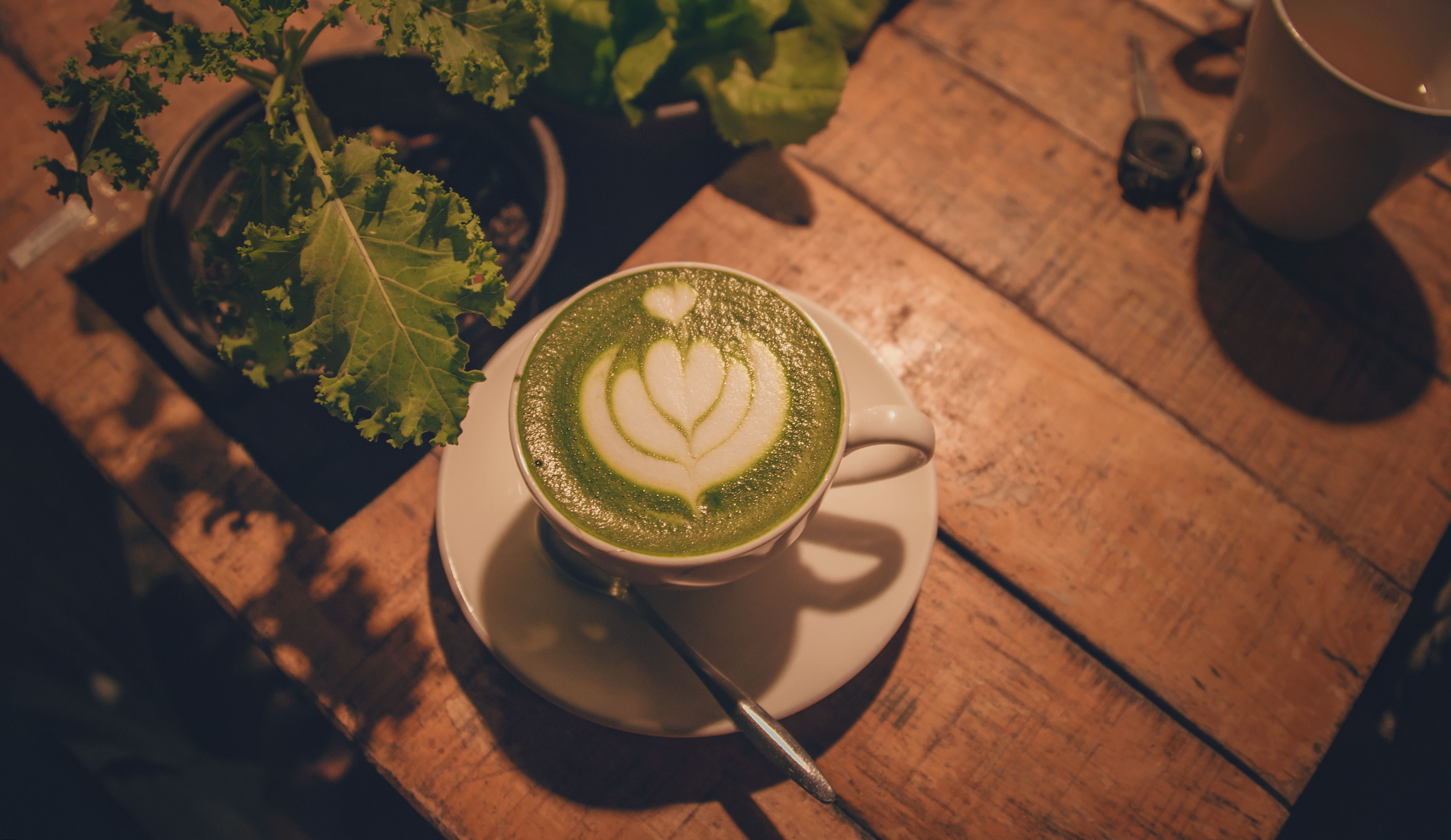
Green tea / Matcha
EGCG catechins and L-theanine in a concentrated polyphenol matrix — matcha as the 21st-century microbiota beverage.
In 1 minute
What does it provide? Catechins — EGCG (epigallocatechin gallate, the most powerful polyphenol antioxidant), EGC, EC, ECG (flavan-3-ols, inflammation- and LDL-reducing microbiota substrates), L-theanine (the amino acid characteristic of tea, α-brain-wave-increasing, "calm focus" feeling), small amount of caffeine, and in matcha the whole leaf content (fiber, chlorophyll).
How much? Infusion: 2–4 cups/day (≈ 500–1000 ml; ≈ 240–320 mg catechin). Matcha: 1–2 g/day (1 cup ≈ 60–80 mg EGCG). Microbiome shift in matcha RCT (2024): 2 g matcha/day for 4 weeks → Coprococcus↑, Fusobacterium↓. Postprandial glucose benefit: Auvichayapat 2008 GTE RCT with ~750 mg catechin/day for 12 weeks.
When to avoid? With iron supplementation (time separation), high-dose EGCG supplement (≥ 800 mg/day — hepatotoxicity), nighttime caffeine sensitivity, pregnancy (moderate).
The history of green tea begins in the mountains of southwestern China, where genetic studies show that Camellia sinensis was domesticated — with multiple partly independent domestication centers, in Chinese and Assam lineages. Legend attributes tea to Emperor Shen Nong around 2737 BCE, when the emperor's boiled water accidentally encountered tea leaves that had fallen in. The first written "tea monograph," the Cha Jing (Tea Classic), was written by the Tang-era poet Lu Yu around 760 CE: this three-part work details the entire process from selecting tea lands to the boiled-water tea ceremony, and became the founding document of Chinese tea culture. At the Tang court, tea took root as the meditation drink of Buddhist monks, and the powdered "matcha predecessor" was still transported in the form of pressed bricks along the Silk Road.
In the 12th century, the Zen monk Eisai brought the tea leaf to Japan, and there developed the culture of powdered green tea — matcha — which by the 15th–16th century evolved into the chanoyu tea ceremony codified by Sen no Rikyū. In the 17th–18th centuries, Dutch and English traders brought green tea to Europe, first as a luxury medicine, then as an everyday drink. Modern chemistry discovered the role of catechins — particularly EGCG — in the final third of the 20th century, and in the 2020s microbiome research has particularly embraced matcha, because with its whole-leaf content it offers a unique polyphenol and fiber-like matrix to the colonic bacterial community.
🔬 Scientific Background
Green tea's main bioactive substances are the catechins (flavan-3-ols): EGCG (epigallocatechin gallate), EGC, EC, ECG. Total catechin content is about 30–40% of the dry leaf mass. Catechins are hydrophobic polyphenols with poor plasma absorption (< 5%); most of the intake reaches the colon, where the microbiota breaks it down into phenolic metabolites (e.g., phenyl-γ-valerolactones) — this is the "coffee/tea → microbe → postbiotic" pathway.
L-theanine: an amino acid, present in significant amounts only in Camellia. Anxiolytic, α-brain-wave-increasing, and "softens" the caffeine stimulus — this is the classic "calm focus" feeling after tea drinking.
Matcha vs. strained infusion: - Matcha: powdered whole leaf → full catechin + fiber + chlorophyll + higher L-theanine (shaded growing). - Strained green tea: only the dissolved fraction — less catechin amount in the consumed drink.
Clinical human evidence:
- Matcha microbiome RCT (2024): Healthy adults, 2 g matcha/day for 4 weeks — Coprococcus↑, Fusobacterium↓ — significant microbiome shift vs. placebo. - Standard green tea supplementation (12 weeks, PLOS): No major compositional change found — heterogeneous evidence base. - Gut barrier: Catechin-rich GTE (green tea extract) reduces endotoxin (LPS) and zonulin signaling in RCTs → permeability improvement. - Cardiometabolic: Several meta-analyses indicate mild LDL, BP, and body-fat reduction with 3–6 cups/day.
Safety (EFSA): Green tea consumed as an infusion is generally safe. ≥ 800 mg EGCG/day in supplement form has produced (transient, reversible) liver-enzyme elevations in reported cases. The supplement ≠ the infusion.
Tannin + iron chelation: Green tea tannins bind non-heme iron — for vegetarians or in iron-deficient states, time separation (≥ 1–2 hours).
- + Lemon (vitamin C): stabilizes the catechins in the digestive tract → better bioavailability.
- + With a meal (NOT on an empty stomach): reduces iron chelation and GI irritation.
- + Matcha smoothie (avocado, banana, walnut): fat aids transport of catechins.
- + Fiber-rich breakfast: microbiota-substrate combination.
- + Morning / early afternoon consumption: OK from a caffeine standpoint, doesn't disturb sleep.
- + Honey (small amount, gentle sweetener): smooths the flavor, in moderation.
- Iron supplementation: time separation (≥ 1–2 hours).
- Milk + green tea: debated — some studies show milk reduces catechin bioavailability; if polyphenol effect is the goal, drink it without milk.
- MAO inhibitor therapy: even a small amount of caffeine can interact.
- Boiling-temperature brewing (≥ 90 °C): bitter, partly degraded catechin.
- Anticoagulant (warfarin): green tea's vitamin K content is negligible (small), but in large amounts a theoretical interaction.
- Diuretic + large amounts of green tea: dehydration (caffeine).
- Iron-deficiency anemia under treatment: separate from iron supplements by ≥ 2 hours, or consume moderately.
- Active hepatitis, unexplained liver enzyme elevation: the supplement (≥ 800 mg EGCG/day) is to be avoided. Infusion OK.
- Pregnancy, lactation: max. 2 cups/day (caffeine limit ≈ 200 mg/day); the supplement not recommended.
- Severe anxiety, insomnia: moderate consumption, not after 4 pm.
- Active reflux disease, gastric ulcer flare: don't drink on an empty stomach.
- Severe kidney failure: moderate (oxalate content).
- Kidney stones (oxalate-type): moderate-to-high oxalate — portion control.
- Infant, young child < 6 years: to be avoided due to caffeine.
- Anticoagulant + high-dose EGCG supplement: medical supervision.
Daily serving
Green tea infusion: 2–4 cups (500–1000 ml) per day.
Matcha: 1–2 g (≈ 1 cup) per day.
Preparation pattern — strained green tea
- 2 g good-quality green tea (sencha, gyokuro, or bancha) in a sieve.
- 200 ml water at 80–85 °C (NOT boiling).
- 2–3 min steep.
- Strain. Optionally 1 drop of lemon.
Preparation pattern — matcha
- 1 g (≈ ½ tsp) matcha powder into a cup.
- 80 ml water at 75–80 °C.
- Chasen (bamboo whisk) in a W motion for 30 sec → foamy surface.
- Sip in one go.
Classic patterns
Japanese tea ceremony (chanoyu): with ceremonial matcha quality.
Cold brew: 5 g green tea + 1 liter cold water + 8 hr in refrigerator → high L-theanine, low tannin.
Matcha latte: matcha + milk base + small honey.
Smoothie: matcha + banana + spinach + flaxseed — afternoon boost.
Green-tea rice (chazuke): traditional Japanese, lukewarm green tea over cooked rice with pickled plum.
Storage
In an airtight, light-protected container, refrigerated (matcha) or at room temperature (dry leaf). Fresh matcha 1–2 months (oxidation is fast), dry leaf 6–12 months.
What not to do
Don't brew boiling (bitter). Don't steep 5+ minutes (tannin over-extraction). Don't drink on an empty stomach (GI irritation). Don't combine with a high-dose EGCG supplement.
References
[1] Yang CS et al. Cancer prevention by tea: animal studies, molecular mechanisms and human relevance. Nat Rev Cancer 2009.
[2] Ohishi T et al. Anti-inflammatory action of green tea. Antiinflamm Antiallergy Agents Med Chem 2016.
[3] EFSA Panel. Scientific opinion on the safety of green tea catechins. EFSA Journal 2018.
[4] Morita Y et al. A randomized, double-blinded study evaluating effect of matcha green tea on human fecal microbiota. J Clin Biochem Nutr 2023;72(2):165–171.
[5] Auvichayapat P et al. Effectiveness of green tea on weight reduction in obese Thais. Physiol Behav 2008.
[6] Shoji T et al. Bioavailability of tea catechins after consumption of green tea — review. Curr Pharm Biotechnol 2014.
[7] EMA/HMPC. Camellia sinensis monograph. 2018.
[8] Liu Z et al. Tea polyphenols and gut microbiota: review. Crit Rev Food Sci Nutr 2022.