


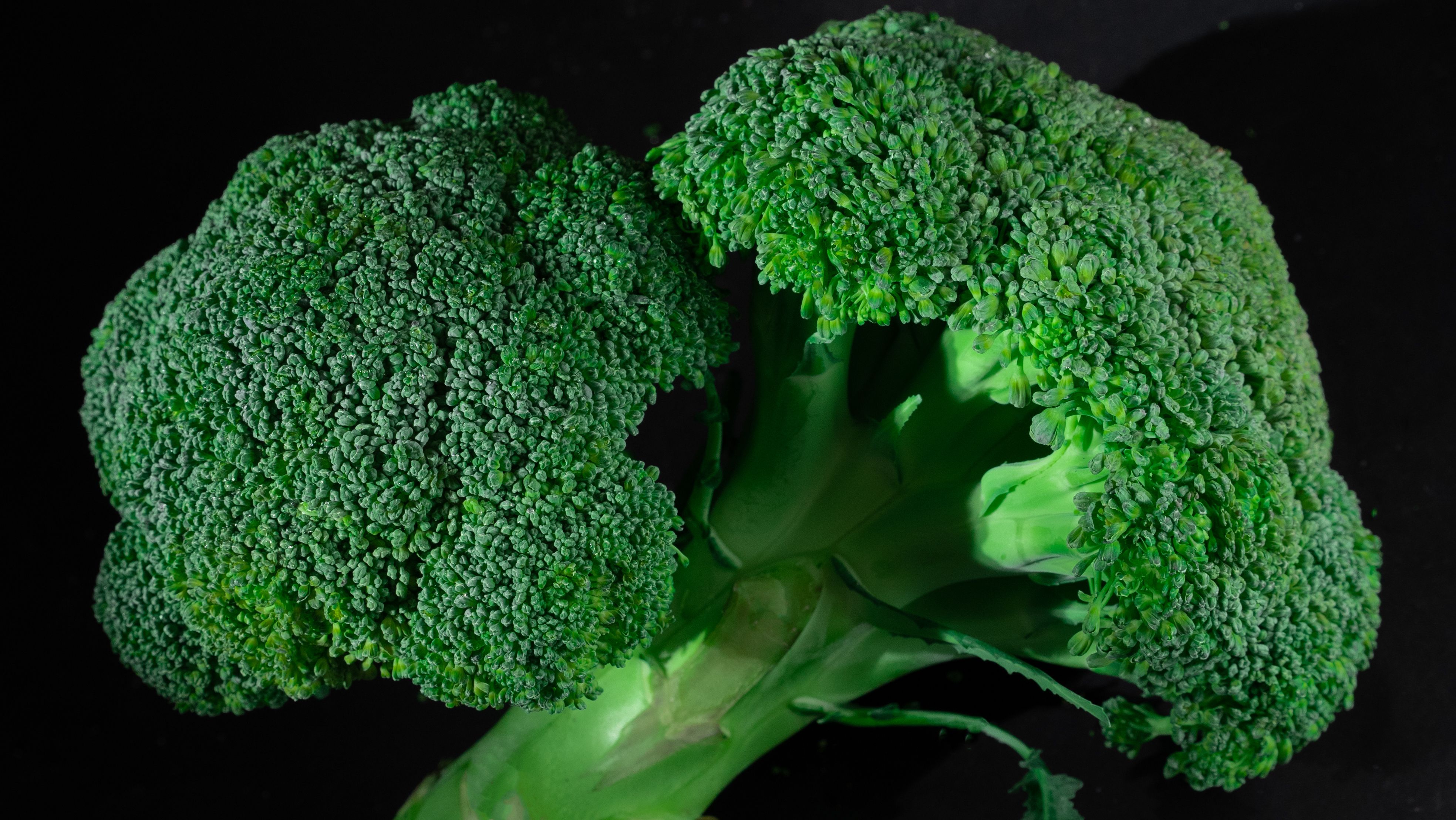
Cruciferous vegetables (broccoli, kale)
The sulforaphane school — glucosinolate, myrosinase, and the mustard-seed trick for cooked broccoli.
In 1 minute
What does it provide? Glucosinolates (glucoraphanin), from which the myrosinase enzyme generates sulforaphane (SFN) — anti-inflammatory, Nrf2-activating (Nrf2 = nuclear transcription factor that triggers the body's own antioxidant and detoxifying enzyme system), microbiota-modulating effect. Plus soluble fiber and quercetin.
How much? 1 cup (≈ 80–100 g) fresh or lightly steamed broccoli/kale 4-5×/week; broccoli sprouts 1-2 tbsp/day for concentrated SFN precursor.
When to avoid? Thyroid disease (hypothyroidism) in symptomatic flare with extreme large amounts raw, large quantities of vitamin K with anticoagulant, large amounts during IBS flare.
Broccoli's history begins with the wild forms of wild cabbage (Brassica oleracea) in the Mediterranean and Asia: the domestication of B. oleracea and its astonishing form diversity — cabbage, kale, cauliflower, broccoli, Brussels sprouts, kohlrabi — is rooted in the ancient Mediterranean, and is a rare example of how many entirely different vegetables can be bred from a single species. Classical authors such as Theophrastus and Pliny describe cabbage relatives in detail, and the Romans particularly favored varieties cultivated for their flower heads. The broccoli-like types grown for their inflorescence emerged in Southern Italy and Sicily — the name itself comes from the Italian diminutive "broccolo," meaning "cabbage flower" or "shoot." (PMC)
Broccoli spread further in Europe in the early modern era: from 16th-century Italian cuisine it arrived in France along with Catherine de' Medici's 1533 marriage, where the Italian entourage brought their favorite Mediterranean vegetables. In England in the 1720s it appeared as "Italian asparagus," and reached America substantially only in the 1920s, when the D'Arrigo brothers in Northern California (San Jose / Santa Clara Valley) launched commercial cultivation (1925-26) — from there it began its explosive North American journey. Modern botanical and genetic literature classifies broccoli among the "inflorescence" type varieties of B. oleracea, emphasizing Mediterranean origin and the Italian breeding center. (Wikipedia)
🔬 Scientific Background
Cruciferous vegetables (Brassicaceae family: broccoli, kale, cauliflower, Brussels sprouts, cabbage, radish, watercress) share a common biochemical signature: the glucosinolate–myrosinase system. Broccoli's main glucosinolate is glucoraphanin (4-methylthio-3-butenyl-glucosinolate), which through plant myrosinase converts to sulforaphane (SFN). SFN is one of the most potent natural Nrf2 activators, inducing the cells' antioxidant and Phase II detoxifying enzyme system.
The clinical challenge: SFN bioavailability dramatically depends on enzyme activity. From freshly chewed or chopped broccoli ≈ 35–40% bioavailability (active plant myrosinase). From cooked broccoli (≥ 6 min boiling) the plant myrosinase is inactivated, and only partial digestion by gut flora remains — ≈ 10% bioavailability (Vermeulen 2008). The "mustard-seed trick": ½ tsp brown mustard powder (active myrosinase source) added at serving to cooked broccoli increases SFN uptake 3-4× (Okunade 2018 human biomarker study).
In the H. pylori literature, broccoli sprout SFN is documented to reduce colonization and moderate gastritis markers. Cruciferous-microbiota human RCTs (Li 2009, Kellingray 2017) demonstrate significant compositional shift, the effect is individual-specific and tied to baseline microbiome. The thyroid myth: dietary amounts of crucifers have no clinically relevant goitrogenic effect with adequate iodine intake — except in extreme cases of 1+ kg raw consumption per day.
- + Brown mustard powder / mustard seed (Brassica juncea): "enzyme replacement" for cooked broccoli — 3-4× SFN increase (human biomarker).
- + Broccoli sprouts (1-2 tbsp/day): concentrated glucoraphanin source with active myrosinase.
- + Grated radish or daikon: another active myrosinase source.
- + Extra-virgin olive oil: fat helps SFN cross biological membranes.
- + Lemon (brief contact): acid preserves chlorophyll and color, polyphenol stabilization.
- + Live cultures (yogurt): microbiome support for partial glucosinolate breakdown.
- + Resistant starch / β-glucan: broader SCFA profile.
- Warfarin in large amounts: high vitamin K (≈ 100 μg/100 g) — INR fluctuation, consistent daily intake.
- Thyroid hormone (levothyroxine) within ~¼ hour + large dose: can moderately reduce absorption — time separation.
- Long boiling (≥ 10 min) + water discard: minimal SFN yield, glucosinolate loss.
- Microwave 5+ min on high: myrosinase inactivation.
- Large amount of raw broccoli on empty stomach for IBS-sensitive: mannitol-FODMAP bloating.
- Atorvastatin/simvastatin + extremely large dose (3+ cups/day raw): theoretical CYP interaction.
- Thyroid disease with iodine deficiency + large raw dose: avoid large amounts raw; cooked + adequate iodine is safe.
- IBS flare: moderate dose due to mannitol content.
- Warfarin therapy: consistent daily amount (max 1 cup/day).
- Infant under 8 months: avoid (texture, choking).
- Severe kidney disease with potassium restriction: moderate potassium — portion control.
- Brassica allergy (very rare): avoidance.
- Acute gout attack: moderate purine — restraint.
- Active scheduled surgery 1 week: reduce (vitamin K).
Daily/weekly serving
1 cup (≈ 80–100 g) fresh or steamed broccoli/kale 4-5×/week. Broccoli sprouts: 1-2 tbsp/day (≈ 5–10 g) on salads, sandwiches, in smoothies.
Preparation pattern
- Cut into florets (smaller pieces = more enzyme activation), use the stem too (peeled).
- Chop or chew well — cellular breakdown activates myrosinase.
- Steam 3-4 min (still crisp, vibrant green), OR pan sauté 4-5 min.
- For hot serving, sprinkle ½ tsp brown mustard powder — SFN boost.
Classic patterns
Steamed broccoli + lemon-olive oil: basic Mediterranean side.
Stir-fry (Chinese): quick wok cooking with ginger + sesame oil + soy sauce.
Broccoli soup with miso: steamed broccoli + miso paste + stock — synbiotic.
Roasted broccoli + tahini: roasted at 220 °C for 15 min, with tahini-lemon sauce.
Broccoli sprout sandwich: whole-grain bread + avocado + tomato + broccoli sprouts.
Storage
Fresh: refrigerated in ventilated bag 5-7 days. Steamed: refrigerated 2-3 days. Frozen (blanched): 8-10 months. Broccoli sprouts: refrigerated 5-7 days, rinsed under tap water daily.
What not to do
Don't boil 10+ min in large water (glucoraphanin leaches out). Don't microwave 5+ min on high. Don't let cool at room temperature longer than 2 hours (rapid microbial growth). Don't discard the stem (delicious peeled, fiber-rich).
Bok choy (also known as pak choi) is a Chinese-origin cruciferous leafy vegetable — a loose-rosette subspecies of the Brassica rapa genus. A classic East Asian kitchen staple, ideal for quick stir-frying and soup.
Differences from the classic broccoli/kale portfolio:
| Parameter | Broccoli | Bok choy |
|---|---|---|
| Glucoraphanin (sulforaphane precursor) | high | moderate |
| Glucobrassicin | high | high |
| Vitamin C | 89 mg/100 g | 45 mg/100 g |
| Carotenoids (β-carotene, lutein) | moderate | higher (in green leaves) |
| Vitamin K | 100 µg/100 g | 45 µg/100 g (moderate) |
| Calcium | 47 mg/100 g | 105 mg/100 g (high!) |
| Nitrate | moderate | high (≈ 200—300 mg/100 g) |
The high calcium content (105 mg/100 g) is clinically relevant — it's the cornerstone of calcium supplementation for dairy-free diets in East Asian populations. The nitrate content also makes it fit into Bondonno's "nitrate-rich vegetables" portfolio.
Clinical relevance: the cruciferous-typical glucosinolate-sulforaphane matrix is moderate; the green leaves' carotenoid content supports eye health (lutein + zeaxanthin) and antioxidant matrix. Quick stir-fry maximizes polyphenol preservation — long boiling should be avoided.
Microbiome perspective: same as broccoli — sulforaphane-mediated Akkermansia + intestinal barrier strengthening (analogous human RCT evidence ★★).
Other parameters (Hashimoto + high-dose raw restriction, FODMAP green, contraindications) are the same as other cruciferous vegetables.
References
[1] Fahey JW et al. Broccoli sprouts: an exceptionally rich source of inducers of enzymes that protect against chemical carcinogens. Proc Natl Acad Sci USA 1997;94(19):10367–10372.
[2] Vermeulen M et al. Bioavailability and kinetics of sulforaphane in humans after consumption of cooked versus raw broccoli. J Agric Food Chem 2008;56(22):10505–10509.
[3] Okunade O et al. Supplementation of the diet by exogenous myrosinase via mustard seeds to increase the bioavailability of sulforaphane in healthy human subjects after the consumption of cooked broccoli. Mol Nutr Food Res 2018;62(18):e1700980.
[4] Yanaka A et al. Dietary sulforaphane-rich broccoli sprouts reduce colonization and attenuate gastritis in Helicobacter pylori-infected mice and humans. Cancer Prev Res 2009;2(4):353–360.
[5] Kellingray L et al. Consumption of a diet rich in Brassica vegetables is associated with a reduced abundance of sulphate-reducing bacteria: a randomised crossover study. Mol Nutr Food Res 2017;61(9):1600992.
[6] Li F et al. Variation of glucoraphanin metabolism in vivo and ex vivo by human gut bacteria. Br J Nutr 2011;106(3):408–416.
[7] Felker P et al. Concentrations of thiocyanate and goitrin in human plasma, their precursor concentrations in Brassica vegetables. Nutr Rev 2016;74(4):248–258.
[8] Monash University. Broccoli FODMAP content. Monash FODMAP database.