


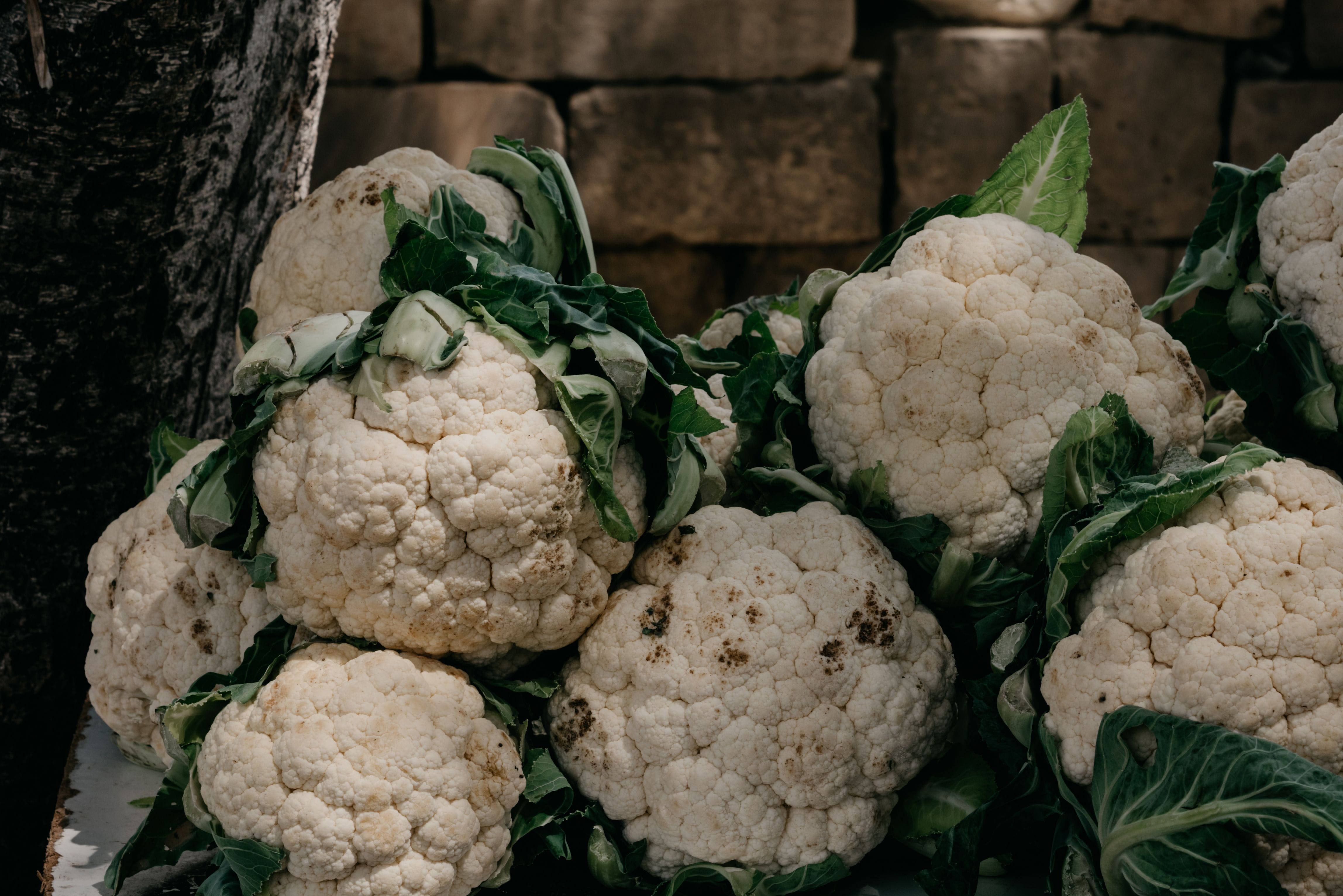
Cauliflower
The white 'college-educated cabbage' — indole glucosinolates and vitamin C in a low-FODMAP package.
In 1 minute
What does it provide? Indole-type glucosinolates (glucobrassicin, from which I3C and DIM form — estrogen metabolism modulators), vitamin C (≈ 48 mg/100 g, antioxidant), vitamin K (clotting), and soluble fiber that ferments to SCFA in the colon. The glucosinolate–myrosinase reaction triggers the Nrf2 activation pathway as an anti-inflammatory mechanism.
How much? ¾–1 cup (≈ 75–100 g) fresh or steamed cauliflower 3-4×/week; in human crossover feeding trials (Kellingray 2017, Li 2009), daily ≈ 100–250 g cruciferous intake produced significant microbiota shift over 2 weeks. Sprinkle ½ tsp brown mustard powder at serving = external myrosinase, multifold isothiocyanate formation.
When to avoid? IBS flare (mannitol-FODMAP, bloating above ¾ cup), thyroid disease with iodine deficiency + large raw dose (goitrogenic glucosinolates), warfarin therapy with fluctuating dose (vitamin K fluctuation), levothyroxine intake (≥ 1 hour separation), Brassica allergy, infant < 8 months.
Cauliflower is the bred "cultivated for inflorescence" type of wild cabbage (B. oleracea); Mediterranean in origin, it belongs along with broccoli to the forms selected for the flower head. Pliny the Elder in Naturalis Historia mentions "cyma" — cabbage relatives harvested for the flower head, often associated by scholars with cauliflower and broccoli precursors — these may have been early "flowering cabbages" of Roman gastronomy. In the Middle Ages cauliflower was linked to Cyprus: according to Arab botanists' descriptions, the island was an important center of early cauliflower cultivation, and from there it traveled through Syria, Egypt, into Europe. Mark Twain later jokingly called it "cabbage with a college education," reflecting the Western view of the species' peculiar, refined character.
In the 15th–16th centuries it spread through Italy into Europe; French sources recorded it as "chou-fleur," Italian sources as "cavolfiore," and it soon appeared at the French court: the classic "choux à la Du Barry" — cauliflower with potato purée — became one of the elegant dishes of 18th-century gastronomy, a favorite composition during Louis XV's era. England and the Low Countries learned of it in the mid-17th century, while British colonizers brought it to India in the 19th century, where cauliflower became a constant element of Indian cuisine (e.g., aloo gobi). Modern reviews record the Eastern-Mediterranean domestication and the late-medieval to early-modern spread. (Wikipedia, cabidigitallibrary.org)
🔬 Scientific Background
Cauliflower's main glucosinolate profile differs from broccoli's: broccoli is dominated by glucoraphanin (aliphatic), while cauliflower is dominated by indole glucosinolates — particularly glucobrassicin and neoglucobrassicin. These convert via myrosinase to indole-3-carbinol (I3C), which rapidly condenses to diindolylmethane (DIM) in stomach acid. DIM is a documented estrogen metabolism modulator (raising the 2-hydroxyestrone / 16α-hydroxyestrone ratio), and an Nrf2 activator.
The glucosinolate–myrosinase dynamic works the same as in broccoli: plant myrosinase is inactivated by long heat treatment, and gut flora partially compensates. The "mustard-seed trick" works here too: an external myrosinase source multiplies isothiocyanate/indole formation from cooked cauliflower.
Cauliflower's vitamin C content is outstanding (≈ 48 mg/100 g fresh), and the full anti-inflammatory package (vitamin C + glucosinolates + fiber) explains the results of controlled, crossover human feeding studies, where cruciferous vegetables induced significant microbiota shift (Li 2009, Kellingray 2017).
The "rice-substitute cauliflower rice" trend is a calorie-poor, low-carb alternative that preserves glucosinolates and vitamin C, but home preparation (microwave 2-3 min) causes greater losses than fresh grating and raw consumption.
- + Brown mustard powder / mustard seed / grated daikon: "enzyme replacement" for cooked cauliflower — multifold isothiocyanate increase.
- + Extra-virgin olive oil + nutmeg: Indian/French classic, polyphenol stabilization.
- + Legumes (chickpea-aloo-gobi-curry): fiber + GOS + glucosinolate.
- + Tahini-lemon sauce: calcium + fat + acid.
- + Live cultures (yogurt): microbiome support.
- + Brief roasting (220 °C, 15-20 min): caramelized surface, preserved glucosinolate fraction.
- Long boiling (≥ 10 min) with water discard: glucosinolate + vitamin C loss → reincorporation (cream soup).
- IBS flare large dose (≥ 1 cup at once): mannitol-FODMAP bloating.
- Warfarin with fluctuating large amounts: vitamin K fluctuation.
- Thyroid hormone simultaneous + large raw dose: time separation (≥ 1 hour).
- Raw on empty stomach: GI irritation, gas.
- Excessively rapid microwave cooking: myrosinase inactivation → enzyme replacement needed.
- IBS flare: moderate dose (≤ ¾ cup), with low-FODMAP testing.
- Thyroid disease with iodine deficiency + large raw dose: avoid large amounts raw.
- Warfarin therapy: consistent daily amount.
- Infant under 8 months: avoid.
- Severe kidney disease with potassium restriction: moderate potassium — portion control.
- Brassica allergy (rare): avoidance.
- Active gout flare: moderate purine — restraint.
- 1 week before scheduled surgery + large dose: reduce due to vitamin K.
Daily/weekly serving
¾–1 cup (≈ 75–100 g) fresh or steamed cauliflower 3-4×/week. As cauliflower rice substitute, even more is fine.
Preparation pattern
- Cut into florets, use the hard stem part too (peeled).
- Chop or grate (cellular breakdown = enzyme activation).
- Steam 4-5 min, or roast at 220 °C for 15-20 min, or grate raw as "rice."
- At serving sprinkle ½ tsp brown mustard powder — isothiocyanate boost.
Classic patterns
Aloo gobi (Indian): cauliflower + potato + turmeric + ginger + garam masala + tomato.
Roasted cauliflower + tahini: roasted at 220 °C for 20 min caramelized, with tahini-lemon-garlic sauce.
Cauliflower rice stir-fry: grated cauliflower in wok + egg + green peas + soy sauce.
Choux à la Du Barry (French): cauliflower + potato purée + béchamel + cheese + gratinéed in oven.
Cauliflower soup with nutmeg: classic French, with little cream + nutmeg.
Storage
Fresh: refrigerated in ventilated bag 5-7 days. Steamed: refrigerated 2-3 days. Cauliflower rice (fresh grated): refrigerated 3 days. Frozen (florets, blanched): 8-10 months.
What not to do
Don't boil uncovered 15+ min (sulfur smell, glucosinolate loss, soft tissue). Don't microwave 5+ min on high. Don't discard the green leaves — they have a dill-soup-like flavor, can be cooked.
References
[1] Verkerk R et al. Glucosinolates in Brassica vegetables: the influence of the food supply chain on intake, bioavailability and human health. Mol Nutr Food Res 2009;53 Suppl 2:S219–S265.
[2] Bradlow HL et al. 2-hydroxyestrone: the 'good' estrogen. J Endocrinol 1996;150 Suppl:S259–S265.
[3] Reed GA et al. Single-dose pharmacokinetics and tolerability of absorption-enhanced 3,3'-diindolylmethane in healthy subjects. Cancer Epidemiol Biomarkers Prev 2008;17(10):2619–2624.
[4] Kellingray L et al. Consumption of a diet rich in Brassica vegetables is associated with a reduced abundance of sulphate-reducing bacteria: a randomised crossover study. Mol Nutr Food Res 2017;61(9):1600992.
[5] Li F et al. Human gut bacterial communities are altered by addition of cruciferous vegetables to a controlled fruit- and vegetable-free diet. J Nutr 2009;139(9):1685–1691.
[6] Volden J et al. Effect of thermal treatment on glucosinolates and antioxidant-related parameters in different cultivars of cauliflower. Food Chem 2009;113:1100–1107.
[7] Picchi V et al. Phytochemical characterization of cauliflower (Brassica oleracea L. var. botrytis) byproducts. Foods 2020;9(4):451.
[8] Monash University. Cauliflower FODMAP content. Monash FODMAP database.