
Green Pea and Pea Fiber
Mendel's legacy — lower FODMAP, pectin fiber, and the pea-fiber supplement.
In 1 minute
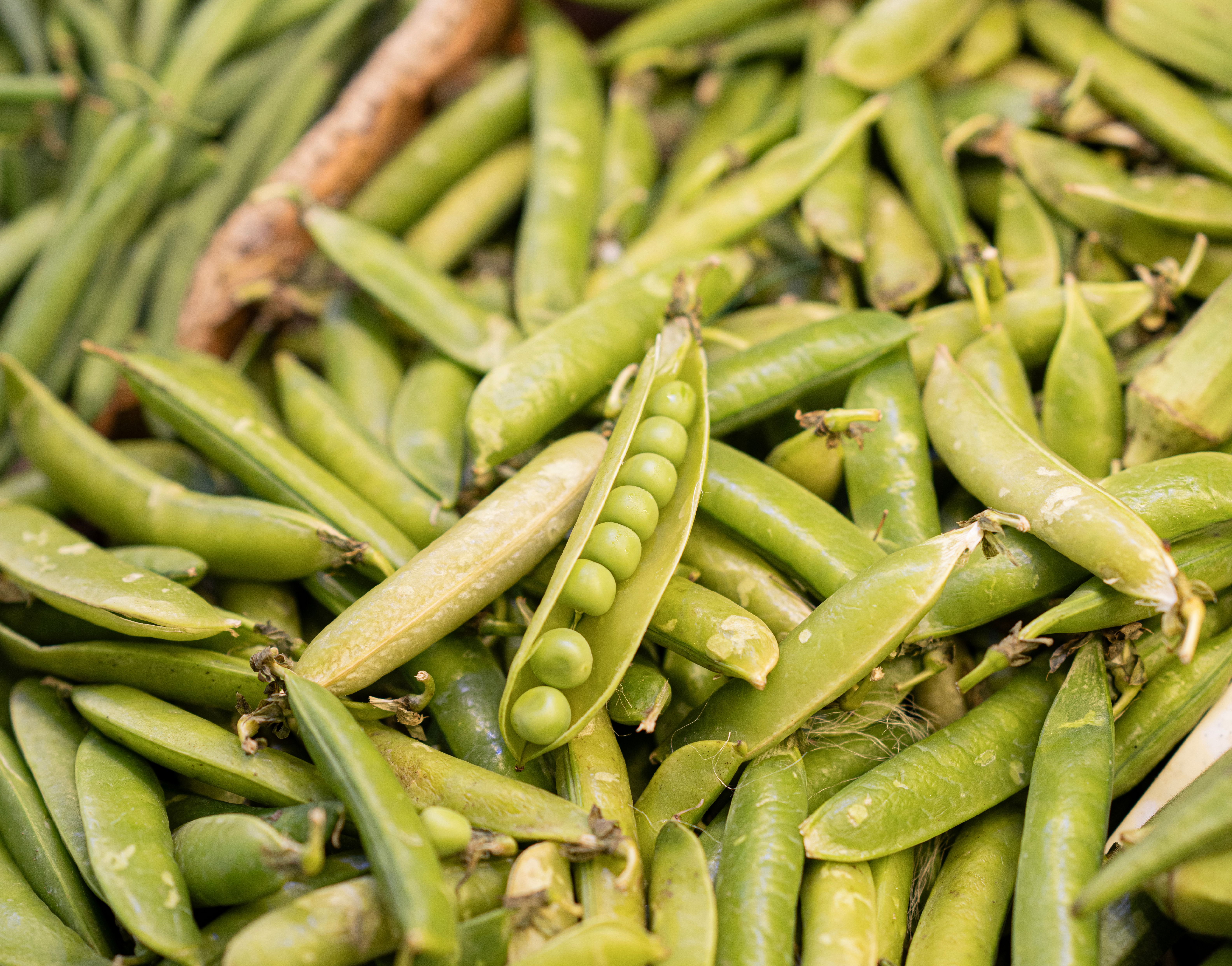
What does it provide? Insoluble fiber (in the hull: cellulose, hemicellulose, lignin — bulking, slowly or non-fermentable), soluble fiber (pectin and arabinogalactan — fermenting faster, SCFA-positive), α-GOS prebiotic, resistant starch (RS), protein, and vitamin C.
How much? Fresh/frozen green pea: ½–1 cup (≈ 80–160 g) 3–5×/week. Pea fiber supplement (pea kernel fiber, PHF): 12–30 g/day built into foods.
When to avoid? Large serving during IBS elimination phase, pea/legume allergy, acute diverticulitis, small child (≤ 2 years) with high amounts of dried pea flour.
The pea is among the early "founder crops" of the Fertile Crescent; archaeobotanical and genetic syntheses indicate that wild Pisum populations were domesticated about 10,000–11,000 years ago, at the beginning of the Neolithic. The early seeds were small, dark, and hard — they weren't eaten green but cooked dry as a porridge ingredient in Roman pulmentum or the everyday bowls of Greek home kitchens. Cultivation spread west to Europe along the Danube line and east through Iran and India to China.
Fresh, green-shelled pea became fashionable only in 16th–17th-century French gardens: at Louis XIV's court, "petits pois" turned into a true craze, and Madame de Maintenon's diary complains about the court ladies' excessive green-pea worship. Gregor Mendel worked out the laws of inheritance from 1856 using thousands of Pisum sativum plants in the Brno monastery garden — the birth of modern genetics is tied to the same species that also fed peasant porridges. From the 17th–18th centuries onward, garden green pea spread on an industrial scale, and today the pea has taken on another functional-food role in the form of frozen pea and pea fiber (PHF). (Global.oup.com, PMC)
🔬 Scientific Background
Green pea's fiber fractions feed the microbiota from several directions. The typical composition of pea hull fibre (PHF) is ~65% cellulose, ~16% pectin (with smaller hemicellulose/lignin fractions) — a low-viscosity, more bulking, moderately fermentable fiber. In interventions in care homes, finely ground PHF increased stool frequency and reduced laxative needs; in a 10-week crossover RCT in healthy older adults, group-level microbiome change was not seen, although an individual "fermenter" subgroup may have been signaled.
The inner soluble fiber fractions (pectin/arabinogalactan) are more fermentable — they are the main SCFA sources in pea. Green/yellow pea's RS content is 2–7% in the seed (variety- and technology-dependent), and its α-GOS content carries prebiotic potential. The cook → cool technique can strengthen RS3 formation, supporting further SCFA production.
Clinically, a short-term human pilot of yellow-pea pasta showed favorable microbiota composition changes in healthy subjects. Animal and in vitro work has shown SCFA increase and improvement of gut barrier markers with pea fiber and pea RS.
From the FODMAP standpoint, green pea has lower α-GOS content than lentil, chickpea, or bean — the Monash green serving is ¼ cup (≈ 38 g), which is significantly more tolerable for IBS-sensitive individuals. This makes the green pea the "gateway legume" in IBS reintroduction.
"Pea fiber" as an isolated supplement (PHF) has become a functional-food ingredient in the past decade: it goes into gluten-free baked goods, meat products, and protein drinks because it's tasteless, white, and has high water/fat binding capacity.
- + Live culture (yogurt, kefir): synbiotic synergy — pea α-GOS + live Bifidobacterium.
- + Mint leaf, fresh mint, lemon balm: classic "pea soup + mint" pairing — mint menthol eases fermentation gas.
- + Olive oil, ghee, coconut fat: fat increases polyphenol absorption.
- + Whole grain (couscous, bulgur, brown rice): complementary amino acid profile + broader fiber spectrum.
- + Carrot, parsnip: classic vegetable base, β-carotene + vitamin C synergy.
- + Cook → cool → eat next day (RS3 strategy): butyrate substrate reaching the colon ↑.
- + Other prebiotics (inulin/FOS, AXOS): broader SCFA profile, more stable fermentation.
- + Pea fiber supplement (PHF): mixed into gluten-free bread or protein drink, invisibly raises daily fiber intake.
- Long high-heat puréeing in aluminum cookware: in more alkaline pH, chlorophyll browns, fiber structure breaks down — color change and texture loss.
- Iron tablets + large serving of pea: moderate phytate content, time separation (≥ 2 hours).
- Tea, coffee with meals: tannin-iron interaction.
- Levodopa (Parkinson's): plant protein impairs absorption — time separation.
- PHF supplement + fluid deficit: concentrated fiber — minimum 250 ml water per 5 g fiber, otherwise constipation.
- "Old" yellow pea flour + high heat for prolonged baking: RS loss, dextrinization.
- Raw, hulled dried pea in large quantities: trypsin inhibitors cause GI irritation.
- Large serving during IBS elimination phase: ¼ cup (≈ 38 g) canned or frozen green pea is the Monash green serving — among legumes, best tolerated in small amounts.
- Acute diverticulitis flare: temporarily low-fiber diet.
- Active IBD flare: temporarily low-fiber, can be reintroduced in remission.
- Severe kidney disease (CKD, dialysis): potassium restriction — dose control.
- Pea/legume allergy: rare, but cross-reactivity possible (peanut, soy).
- Small child (≤ 2 years) with PHF supplement: fiber too concentrated, constipation risk.
- PHF + severe dysphagia, swallowing difficulty: supplement risk — mix well with water before dosing.
- Infant (under 6 months): whole pea is a choking/aspiration risk; after 6 months, pureed.
- Acute gout flare: moderate purine — limit during flare.
Daily/weekly serving
Fresh/frozen green pea: ½–1 cup (≈ 80–160 g) 3–5×/week. Dry yellow/green pea: ¼–½ cup cooked. PHF supplement: 5–15 g fiber/day built into foods, with fluid.
Preparation pattern
Fresh/frozen pea:
1. Frozen: in boiling salted water 2–3 minutes (al dente).
2. Fresh (shelled): in hot water 3–5 minutes.
3. Before serving: pat of butter or olive oil + pepper + dried or fresh mint.
Dry pea:
1. Soak 8–12 hours (or quick soak: 1 minute boil + 1 hour rest).
2. DISCARD soaking liquid, use fresh water for cooking.
3. After boiling, 30–45 minutes covered (10–15 minutes in pressure cooker).
4. RS3 trick: chill cooked pea 12–24 hours, eat the next day as salad or moderately reheated.
Classic patterns
English mushy peas (mint pea soup): frozen green pea + vegetable stock + fresh mint + crème fraîche — quick, vibrant green classic.
Dutch erwtensoep (snert): dry yellow pea + vegetables + smoked meat + bay leaf — traditional, thick soup, RS3-maximized next day.
Indian matar paneer: green pea + paneer + tomato + garam masala — complementary protein + vitamin C.
Risi e bisi (Venetian): rice + green pea + butter + Parmesan — simple, classic fiber-starch matrix.
PHF-enriched bread: wheat flour 80% + PHF 20% + water + yeast + salt — invisible fiber boost (≈ 8 g fiber/slice).
Storage
Frozen: at -18 °C for 12 months. Fresh in pod: in fridge 5–7 days. Cooked: in fridge 4 days, frozen 6 months. PHF supplement: airtight, in a dark place 12–18 months.
What not to do
Don't overcook fresh green pea (turns gray, vitamin loss). Don't add dry pea to salted water (stays hard). Don't dose PHF supplement without fluid. Don't eat pea raw in large quantities.
References
[1] Dahl WJ et al. Effects of pea hull fiber on bowel function in elderly people. Br J Nutr 2003.
[2] Lambert JE et al. Consuming yellow pea fiber reduces voluntary energy intake: a randomized trial. Nutrients 2017.
[3] Tosh SM, Yada S. Dietary fibres in pulse seeds and fractions: characterization, functional attributes, and applications. Food Res Int 2010.
[4] Vidal-Valverde C et al. Galacto-oligosaccharides and effects on gut microbiota in pea-based diets. J Sci Food Agric 2019.
[5] Marinangeli CPF et al. The effect of pulse-based pasta on gut microbiota composition: a randomized pilot. Frontiers in Nutrition 2023.
[6] Petropoulou K et al. A high-protein high-fibre breakfast promotes ileal appetite-relevant peptide release and modulates short-chain fatty acid production. Br J Nutr 2024;131(8):1346–1358.
[7] EFSA NDA Panel. Scientific opinion on dietary fibre. EFSA Journal 2010.
[8] Monash University. High and Low FODMAP foods: peas. Monash FODMAP database.
[9] Pavanello A et al. Pea hull fibre as a functional food ingredient: technological and clinical perspectives. Trends Food Sci Technol 2022.
[10] Smýkal P et al. The role of the testa during development and in establishment of dormancy of the legume seed. Front Plant Sci 2014;5:351.