
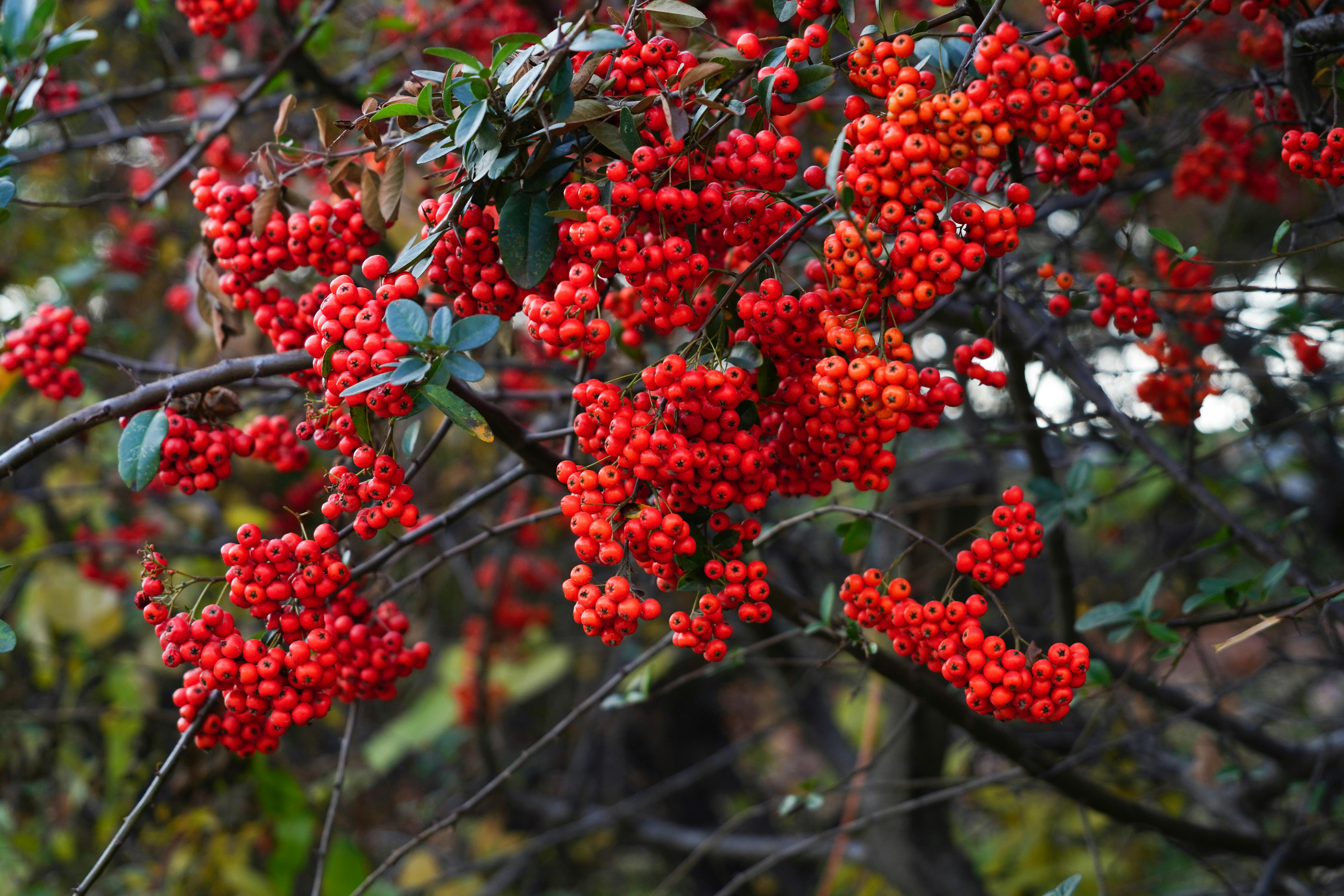
Black chokeberry (aronia)
The "polyphenol peak depth" — among berries, aronia delivers the highest anthocyanin and PAC levels.
In 1 minute
What does it provide? The highest anthocyanin (cyanidin-3-galactoside, -arabinoside) and proanthocyanidin (PAC) content among berries (≈ 600–1500 mg anthocyanin/100 g — three times that of blueberry!), chlorogenic acids, fiber, moderate vitamin C.
How much? Fresh/frozen: 30–60 g/day (modest amount, because very acidic-astringent); 100% juice: 50–100 ml/day; dried powder: 5–10 g/day.
When to avoid? Kidney stones (calcium-oxalate tendency), larger doses alongside chronic warfarin, peptic ulcer flare (acidic), dental sensitivity.
Black chokeberry, or aronia, was a traditional medicinal and overwintering fruit of North American indigenous communities — particularly the Potawatomi and Iroquois — who brewed the berries for colds, fevers, and digestive complaints and also mixed them into pemmican. The origin of the English name "chokeberry" is that raw, it is so astringent it almost makes the eater choke — hence its notorious tartness. In the early 20th century, the Russian nutrition scientist Ivan Michurin recognized it as a cold-tolerant "huge vitamin C source" and naturalized it in Siberia — today's European cultivated aronia varieties are descendants of this Soviet breeding program.
Soviet and Polish agriculture put the species into large-scale cultivation in the 1950s–60s, from where it spread across Eastern Europe; Poland is today the world's largest aronia producer. From the 2000s it spread worldwide as a "functional berry" due to its high anthocyanin and proanthocyanidin content — aronia is one of the world's most polyphenol-rich fruits, containing up to three times as much anthocyanin as blueberry. In modern processing, juice, concentrate, freeze-dried powder, and pressing-residue cake (pomace) all reach the market as functional ingredients. Interesting note: the Hungarian word "berkenye" is borrowed from the Turkish "berek," and was originally used for several Sorbus species — while aronia (by its current botanical name) only became officially established in Hungary from the late 1990s.
🔬 Scientific Background
In comparative analyses (USDA Database for the Flavonoid Content of Selected Foods), aronia berries are mostly listed among the highest anthocyanin (≈ 1480 mg/100 g, cf. Wu 2006), proanthocyanidin (≈ 660 mg/100 g) and total-polyphenol sources. Chlorogenic acid content (5-CQA, 3-CQA, neochlorogenic acid) is also substantial — a complex caffeic-acid-ester matrix. This concentrated polyphenol stronghold explains why it became a "functional berry."
Clinical human evidence: Loo 2024 double-blind RCT in healthy men → 12 weeks of aronia poly(phenols) → improvement in vascular function (FMD), increase in microbiome gene richness, elevation of butyrate-producing species (Roseburia, Faecalibacterium). A 2024 systematic review (Sidor 2024) shows that aronia moderates inflammation and oxidative stress markers, but effect sizes are heterogeneous. At ≥ 12 weeks with high polyphenol-dose interventions, microbiome modulation is more pronounced.
Clinical pitfalls: - Commercial "aronia drinks" are often sweetened — compromising the polyphenol-benefit picture. - Large compositional shifts are not always visible in humans — often only measurable at metabolite level (urolithin, propionate). - Freeze-dried powder and HPP-treated juice carry sensitive stability questions.
- + Yogurt, kefir: synbiotic synergy, softens the acidity.
- + Nuts, honey: classic polyphenol × fat × sugar matrix.
- + Inulin/FOS (Jerusalem artichoke, chicory): prebiotic × polyphenol synergy.
- + Oat β-glucan: dual fiber matrix.
- + Banana, apple (sweeter fruits): in smoothie combinations balances the tartness.
- + Red wine matrix (non-alcoholic): classic "European polyphenol tradition" in small servings.
- Sweetened "aronia syrup": marketing — concentrated added sugar, polyphenol benefit disappears.
- Large doses alongside chronic warfarin: theoretical INR disturbance — medical consultation.
- High-heat, prolonged cooking: anthocyanin loss.
- Iron supplementation immediately together: ≥ 2-hour separation.
- Aspirin/NSAID + high-dose aronia: salicylate additivity (minor clinical significance).
- Sugary juice concentrate "as a cure": carbohydrate bomb, not ideal.
- Kidney stones, calcium-oxalate tendency: moderate-to-high oxalate content — moderate the serving.
- Chronic warfarin use: theoretical interaction, monitor.
- Active peptic ulcer, gastritis flare: acid content (pH ≈ 3) may provoke.
- Active aphthous stomatitis: acid may sting.
- Dental sensitivity: acid-eroding to thin enamel — don't brush teeth for 30 minutes afterward.
- Aspirin sensitivity: moderate salicylate.
- Infant (under 1 year): allergen risk, can be tested in small portions.
- Active diverticulitis flare: small seeds are a concern.
- In diabetes, sweetened aronia juice prohibited: glycemic bomb; unsweetened is fine.
- Severe hypotension tendency: blood-pressure-lowering effect may be additive.
Daily serving
Fresh/frozen 30–60 g (small amount due to tartness). 100% juice 50–100 ml. Freeze-dried powder 5–10 g (in smoothie).
Preparation pattern
- Fresh berry is rare — mainly on Polish/Scandinavian markets. Wash.
- Raw: small amounts in a smoothie (with other sweeter fruits).
- Compote/jam brief heat: sweetened with honey or a little sugar.
- Frozen: in smoothies, baked goods.
- Powder: in yogurt, smoothie — flavorless, acidic, but polyphenol-concentrated.
Classic patterns
Polish "aronia syrup": brief-heat berry + honey + water — a vitality booster/drizzled into tea.
Smoothie: ½ tbsp aronia powder + apple + spinach + banana + water.
Breakfast yogurt bowl: plain yogurt + aronia powder + walnut + oats.
"Polish dessert": cottage cheese + honey + small aronia puree + walnut.
Combo-berry compote: aronia + apple + plum → brief heat, with a little sugar.
Salad dressing: aronia syrup + balsamic vinegar + olive oil — anthocyanin sheen.
Storage
Fresh refrigerated 1–2 weeks (stores well). Frozen 12–24 months. Powder in sealed packaging 12–24 months. 100% juice refrigerated 7–14 days, frozen 6 months.
What not to do
Don't cook for a long time at high heat. Don't choose sweetened syrup. Don't overdo it if prone to kidney stones. Don't brush teeth immediately afterward (acidic).
References
[1] Loo BM et al. Cardiovascular and metabolic effects of Aronia melanocarpa polyphenols: a double-blind RCT. Br J Nutr 2024;131(7):1198-1212.
[2] Sidor A et al. Aronia melanocarpa L. — a comprehensive review on health-promoting effects. Crit Rev Food Sci Nutr 2024;64(15):4880-4901.
[3] Kulling SE, Rawel HM. Chokeberry (Aronia melanocarpa) — a review on the characteristic components and potential health effects. Planta Med 2008;74(13):1625-1634.
[4] Wu X et al. Concentrations of anthocyanins in common foods. J Agric Food Chem 2006;54(11):4069-4075.
[5] Park S et al. Effects of black chokeberry on the gut microbiota of healthy subjects. Nutrients 2023;15(8):1854.
[6] Sosnowska D et al. Bioactive components of chokeberry (Aronia melanocarpa) berries and their effects on gut microbiota. J Funct Foods 2022;88:104897.
[7] Borowska S, Brzóska MM. Chokeberries (Aronia melanocarpa) and their products as a possible means for the prevention and treatment of noncommunicable diseases. Compr Rev Food Sci Food Saf 2016;15(6):982-1017.
[8] Tian Y et al. High-pressure processing of chokeberry juice: bioactive compound retention and microbiological quality. Foods 2022;11(15):2280.
[9] USDA Database for the Flavonoid Content of Selected Foods, Release 3.3.