
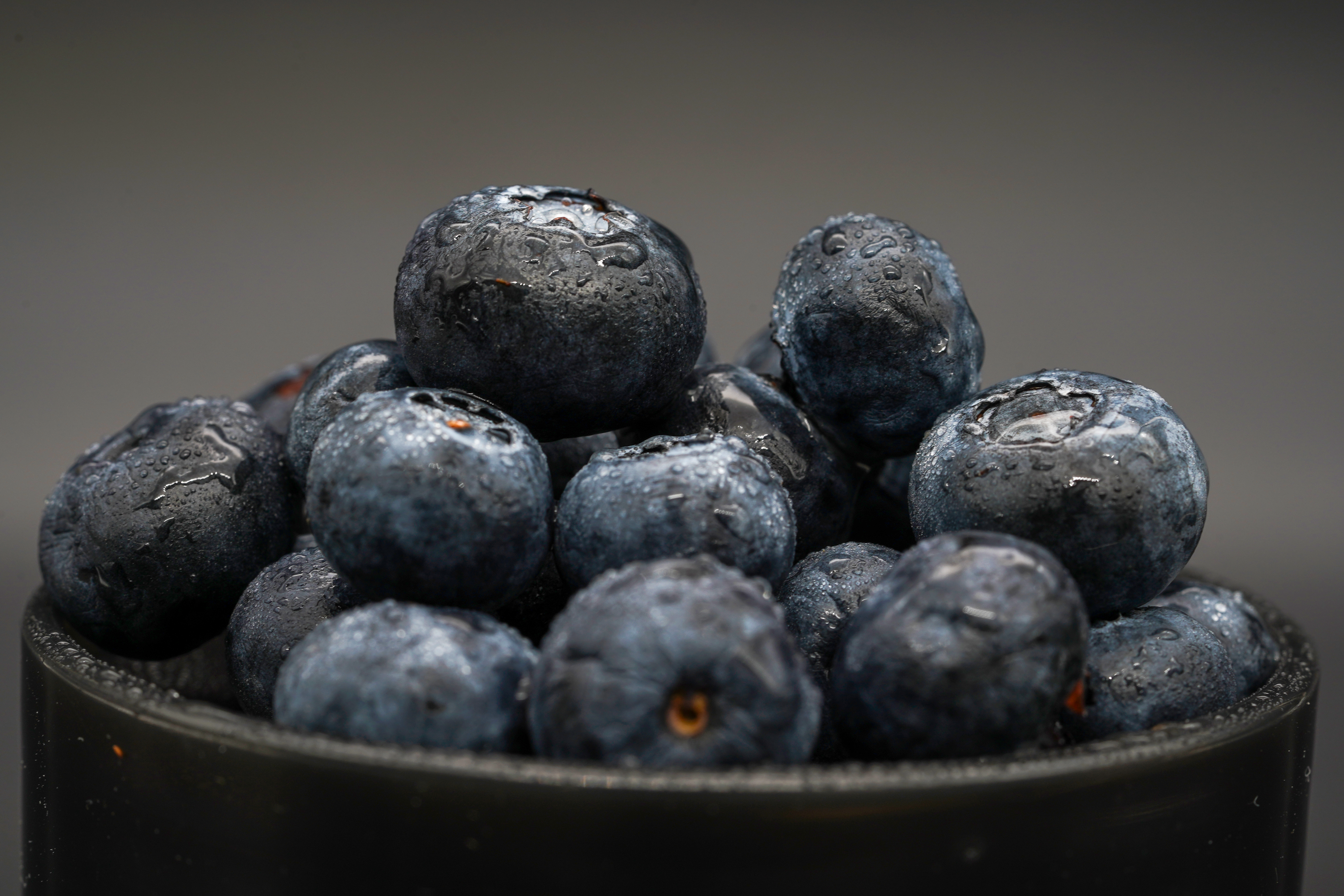
Blueberry
The anthocyanin gold standard — pterostilbene, blood-brain-barrier-friendly flavonoids, and Mayo-Clinic-grade cognitive evidence.
In 1 minute
What does it provide? Anthocyanins (the blue-purple pigment — vascular-protective polyphenols broken down by colonic bacteria into small phenolic acids), pterostilbene (the more stable and more bioavailable cousin of resveratrol), soluble fiber (pectin), and vitamin C. In human crossover RCTs, 1 cup daily for 4–6 weeks produced Akkermansia muciniphila and Bifidobacterium increases (see Scientific Background).
How much? 1 cup (≈ 150 g) daily, fresh or frozen. In the King's College London RCT (Rodriguez-Mateos 2019), 200 g/day improved FMD (vascular dilation) by 24%; in the University of Reading study, 12 weeks of 250 ml daily blueberry juice improved working memory in older adults.
When to avoid? Warfarin/DOAC therapy with high-dose blueberry extract (culinary amount is safe, capsule 500 mg+ poses risk), severe chronic kidney disease (GFR < 30) or calcium-oxalate kidney stones (oxalate load), active IBS flare above > 1 cup (fructan/sorbitol), salicylate sensitivity (Samter's triad, AERD), iron supplementation alongside (chelation effect, ≥ 2-hour separation).
North American indigenous peoples — the Wabanaki, Algonquin, and Cherokee — gathered wild blueberry ("star berry" — the five petals of the flower draw a star on the bottom of the ripe fruit) for thousands of years, drying it and incorporating it into pemmican as winter food. The European V. myrtillus (bilberry) was a household staple from Scandinavia to Provence under the names "Heidelbeere" and "myrtille"; a legend popular among British RAF pilots in World War II held that bilberry jam sharpened their night vision — it later turned out that the real secret was radar, but the myth kicked off the mid-20th-century anthocyanin research.
Modern cultivated blueberry (Vaccinium corymbosum) was bred by the American botanist Elizabeth Coleman White and Frederick Coville in 1916 in New Jersey — one of the shortest success stories of deliberate wild-plant domestication. From the 2000s, the elderly-rat and human studies of Tufts University (Joseph & Shukitt-Hale) launched the "blueberries for better brain aging" research wave; from the 2010s, USDA, King's College London, and the University of Reading RCTs focused on the cardiometabolic profile (Wikipedia, PMC).
🔬 Scientific Background
Blueberry contains 25–35 different anthocyanin glycosides, dominated by delphinidin and malvidin derivatives. The systemic bioavailability of anthocyanins is low (1–2%), > 90% of the intake reaches the colon, where the microbiome breaks them down into protocatechuic acid, vanillic acid, and other small phenolic acids — these metabolites carry most of the effect. The polyphenol content of wild European V. myrtillus is 2–3 times that of the cultivated variant, so from a health-cost perspective, frozen wild berries (Swedish, Finnish import) often offer a better value ratio. (PubMed, PMC)
The most robust human evidence is for cognition and postprandial glucose. The 2019 King's College London crossover RCT (Rodriguez-Mateos et al.) showed a 24% reduction in flow-mediated dilation (FMD) with 200 g/day of blueberry and improved 24-hour systolic blood pressure in healthy men. The University of Reading's "Blueberries for Better Brain Aging" series (Bowtell, Whyte) showed measurable improvement in working memory and psychomotor speed with 12 weeks of 250 ml daily blueberry juice in older subjects with mild cognitive decline. A 2020 meta-analysis (Rocha et al.) found ≈ 5% HbA1c reduction with 240–250 g/day fresh-equivalent blueberry in prediabetes and T2DM populations. (PubMed)
At the microbiome level, Vendrame 2011 RCT (J Agric Food Chem) measured significant Bifidobacterium increase after 6 weeks of daily wild blueberry powder in healthy adults; the 2022 BEACTIVE trial (Lee et al., Nutrients) demonstrated favorable fecal microbiome composition shifts with 12 weeks of blueberry consumption in overweight older adults. Pterostilbene, present in small amounts in blueberry (a methoxylated cousin of resveratrol), is biologically more stable and has higher (~80%) oral bioavailability than resveratrol — the differing bioactivity profile of these two stilbenoids is one possible explanation for the blueberry advantages observed in individual studies. (PMC, JNM Journal)
- + Yogurt or kefir (live culture): lactic acid bacteria metabolize anthocyanins, and polyphenols bound to milk protein release more slowly — more even 24-hour exposure. Classic breakfast pattern.
- + Oats / chia / flaxseed (soluble fiber): β-glucan + anthocyanin synergistically reduce postprandial glucose peak (University of Reading 2017).
- + Nuts (almond, walnut, pecan): fat matrix extends anthocyanin absorption, walnut omega-3 content provides additional microbiome benefit.
- + Dark leafy greens (spinach, kale, arugula): vitamin K and folate for vascular protection; together they enhance the FMD response.
- + Citrus (lemon zest, orange): vitamin C stabilizes anthocyanins, slows polymerization degradation (also useful in jam-making).
- + Cocoa / 70%+ dark chocolate: combined flavanol + anthocyanin vascular effect — additive according to subanalyses of the Harvard Cocoa Supplement Trial (COSMOS).
- Warfarin and DOACs with high-dose blueberry extract: anthocyanins have weak antiplatelet action — culinary amounts (1 cup/day) are safe, but concentrated extract capsules (500 mg+) can pose additive bleeding risk.
- Iron supplementation: blueberry polyphenols chelate non-heme iron (≈ 30–50% absorption reduction) — separate iron and blueberry intake in time (≥ 2 hours).
- High-tannin beverages at the same time (strong black tea, red wine): together they can form heavy polyphenol precipitates, causing nausea or constipation in some sensitive individuals — separate in time or moderate.
- Sugary cereals + blueberry: the glucose peak overrides blueberry's postprandial advantage; whole-grain oats or unsweetened yogurt are better choices.
- Antacid (PPI, H2 blocker) direct co-intake: polyphenols are more stable in acidic medium; with PPI in large quantities, bioactive absorption may decrease (clinically probably not relevant, but time separation is advisable).
- Severe chronic kidney disease (GFR < 30) or calcium-oxalate kidney stones: blueberry has moderate-to-high oxalate content — 1 cup/day is generally acceptable, but avoid multiple cups per day.
- Acute IBS flare, FODMAP sensitivity: 1 cup/day (≈ 150 g) is low FODMAP per Monash, but above that, fructan/sorbitol content can cause bloating.
- Active anticoagulant therapy with high-dose extract form: see above.
- Salicylate sensitivity (rare, documented): blueberry has high natural salicylate content — reduced intake is recommended in Feingold diet or diagnosed AERD (Samter's triad).
- Severe diabetes with hypoglycemia tendency or newly adjusted medication: blueberry improves insulin sensitivity — hypoglycemia risk may increase, frequent blood glucose monitoring is warranted.
- Pollen-food cross-reaction (birch pollen allergy): rare, but cross-reactive oral itching may occur.
- Pregnancy: culinary amount is fully safe and recommended (folate, K, C). High-dose supplement is not advised due to lack of sufficient human data.
Daily serving: 1 cup (≈ 150 g) fresh or frozen. 5–7 times per week.
Preparation:
1. Wash fresh blueberry with cold water immediately before consumption (prolonged soaking softens it and leaches anthocyanins into the water).
2. Don't fully thaw frozen blueberry for a smoothie — the semi-frozen state maintains texture.
3. When making jam or compote, don't exceed 60–70 °C and add lemon juice (the acidic medium stabilizes anthocyanins).
Classic patterns:
- Breakfast: plain yogurt or kefir + 1 cup blueberry + 1 tbsp oats + 1 tbsp flaxseed — every microbiome advantage in one bowl.
- Smoothie: frozen blueberry + spinach + plant milk + ½ banana + 1 tbsp almond butter.
- Side/salad: mixed greens + blueberry + walnut + feta + balsamic vinegar — anthocyanin + flavanol + omega-3 synergy.
- Sweet/dessert: blueberry-chia pudding (chia + plant milk + blueberry + vanilla, 4 hours in fridge).
Storage: fresh blueberry in the refrigerator in a dry plastic container lined with paper towel, max. 7–10 days. Frozen at –18 °C for 8–12 months. Dried blueberry anthocyanin content drops significantly (50–70%) and often contains added sugar — not an equivalent snack.
What not to do: Don't overcook (≥ 80 °C, > 15 minutes) — anthocyanins are heat-sensitive, polymerize, and lose bioactivity. Don't store in direct sunlight. Don't wash days in advance.