


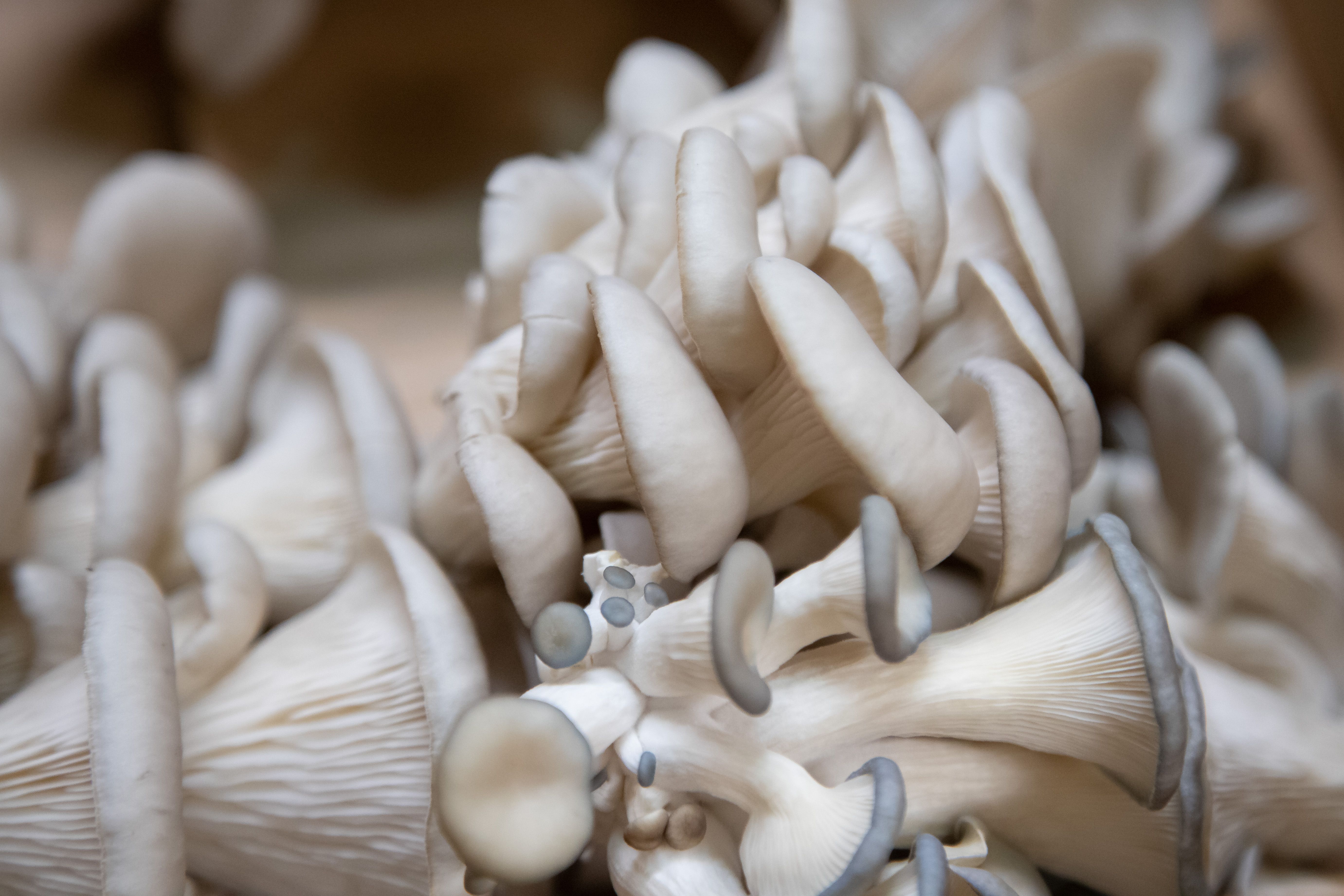
Oyster Mushroom
The mold-cultivating university — β-glucan, ergothioneine antioxidant, and the fastest-growing edible mushroom.
In 1 minute
What does it provide? Natural lovastatin content (the prototype of the statin drug family), high protein content (≈ 30% dry weight, containing most essential amino acids, with moderate methionine), β-glucan immunomodulation, and prebiotic fiber. One of today's best "LDL-lowering food" mushrooms.
How much? In the kitchen, 100–250 g fresh oyster mushroom per meal, 3–5×/week. Daily consumption is safe. No separate supplement needed.
When to avoid? High-dose statin therapy (rare additive CK elevation), mushroom allergy, high-dose immunosuppressant therapy.
The oyster mushroom (German: "Austernpilz" — oyster mushroom; English: "oyster mushroom") has been a wild mushroom gathered in Europe and Asia for centuries, appearing on beech, oak, and birch trunks in autumn and spring. In European peasant cuisine, it is "the poor man's meat" — high in protein, easily available, even safely edible raw —, and in Chinese cuisine it has been documented since the Han dynasty as "ping gu" (flat mushroom). It has been regularly collected in many European regions since the 19th century; in the 1960s, the modern indoor straw cultivation technology was developed by the Sziklay group of Hungarian mycologists, which then spread worldwide.
Science's attention was drawn by the statin line in 1973, when Japanese biochemist Akira Endo isolated compactin (ML-236B) from Penicillium citrinum — followed in 1978 by Merck (Alfred Alberts and colleagues) isolating lovastatin ("mevinolin") from Aspergillus terreus, and from the early 1980s the native statin content was documented in additional mushroom species (including Pleurotus). Gunde-Cimerman et al. in 1993 quantitatively documented Pleurotus ostreatus's natural lovastatin content (0.3–2.8 mg/g dry weight, strain-dependent). Bobek and Galanc's 1998 Slovak human pilot trial showed 8% LDL reduction with 3 weeks of 200 g/day fresh oyster mushroom consumption. Khatun et al.'s 2007 Bangladeshi RCT also showed reduced blood glucose in T2DM patients. The oyster mushroom is today one of the most economical household mushrooms (cultivable at home on straw or coffee grounds), while pharmacologically actively documented. (PubMed, J Nutr Sci Vitaminol, Pharmacological Reports)
🔬 Scientific Background
The oyster mushroom's central bioactive is lovastatin, a selective inhibitor of the human 3-hydroxy-3-methylglutaryl-CoA-reductase (HMG-CoA reductase) enzyme — exactly the pharmacological mechanism of Merck's lovastatin (Mevacor). Oyster mushroom lovastatin content is strain-dependent: 0.3–2.8 mg/g dry weight, which for a 200 g fresh serving (about 20 g dry) means 6–56 mg lovastatin. For comparison: the drug dose is 20–80 mg/day. So regular oyster mushroom consumption contains this compound at a pharmacologically relevant amount.
The Slovak group of Bobek et al. documented the HMG-CoA reductase inhibition → serum cholesterol reduction mechanism in rat models (1998, Physiol Res). In Schneider's 2011 human RCT (J Funct Foods), 3 weeks of daily 200 g fresh oyster mushroom yielded 8–12% LDL reduction and 2–4% HDL increase in moderately hyperlipidemic adults. This combines with the bile-acid-binding effect of β-glucan — in the colon, β-glucan chelates bile acids, bile acid recycling is reduced, the liver compensates by using more cholesterol for new bile acid synthesis → serum LDL ↓. Two mechanisms, one food.
The β-glucans (mainly "pleuran" — the Pleurotus-specific β-1,3/1,6-glucan) immunomodulating effect occurs via dectin-1 receptor, similar to other mushroom β-glucans. In human pilots (Jesenak et al. 2013) in children with recurrent respiratory infections, 50% reduction in infection count was demonstrated with 6 months of pleuran supplementation. At the microbiome level, oyster mushroom consumption produces Lactobacillus and Bifidobacterium increases and enhanced butyrate and propionate production.
In nutrient density, the oyster mushroom stands out: 35% protein dry weight (with all 9 essential amino acids), B-vitamin complex (B1, B2, B3, B5, B7), potassium, phosphorus, copper, and ergosterol that converts to vitamin D2 precursor under UV light. Place a fresh oyster mushroom cap on a windowsill in UV light for 1–2 hours → D2 content rises 5–10× (a simple home "functional food" trick).
- + Oatmeal or oat bran (β-glucan): synergistic LDL reduction (oat β-glucan + oyster mushroom β-glucan + oyster mushroom lovastatin = three mechanisms).
- + Legumes (lentils, chickpeas, beans): complementary amino acid profile, higher total protein biovalue.
- + Onion, garlic: sulfide + quercetin synergy, antioxidant + LDL-lowering.
- + Healthy fat (extra-virgin olive oil, butter): lovastatin and ergosterol are lipophilic — absorption aid.
- + Lemon juice: vitamin C antioxidant synergy, polyphenol stabilization.
- + UV light (windowsill 1–2 hours before cooking): ergosterol → vitamin D2 conversion.
- + Fresh herbs (parsley, thyme): chlorophyll, polyphenol complement.
- + Whole-grain cereal: fiber + β-glucan together.
- Statin drugs (lovastatin, simvastatin, atorvastatin) on a daily basis: additive HMG-CoA reductase inhibition — theoretically myalgia, CK elevation. In practice rare, because dietary lovastatin's bioavailability is lower than the drug's. Still, alongside therapeutic statins, a few servings per week is enough.
- Grapefruit juice + statin treatment: grapefruit inhibits CYP3A4, raising statin levels — combined with oyster mushroom lovastatin, theoretical overdose risk.
- CYP3A4 substrates (some immunosuppressants, calcium channel blockers) with therapeutic monitoring: modest but existing interaction.
- Immunosuppressants (tacrolimus, ciclosporin, corticosteroids): pleuran is immune-activating — consult after organ transplantation.
- Anticoagulants (warfarin) at high doses: moderate antiaggregant effect — small risk.
- Raw, in large quantities: fresh oyster mushroom can be eaten raw in small portions, but in large quantities chitin indigestibility → bloating.
- Active rhabdomyolysis, pronounced myopathy on statin treatment: theoretical additive effect — limit weekly mushroom intake.
- Chronic active hepatitis, marked liver enzyme elevation: lovastatin may be hepatotoxic — avoid in large amounts.
- Active autoimmune disease (SLE, RA) flare: β-glucan immunomodulation risk.
- After organ transplantation: consultation required.
- Mushroom allergy (Basidiomycota): rare, but described anaphylactic reactions.
- Spore allergy: fresh oyster mushroom indoor cultivation spore dispersal → asthma flare, "farmer's lung"-type reactions rarely.
- Kidney stones, calcium oxalate tendency: oyster mushroom is moderate in oxalates, controlled intake.
- Active gout, hyperuricemia: moderately rich in purines, in moderation.
Serving: 100–250 g fresh oyster mushroom per meal, even on a daily basis. 3–5 times a week is optimal for LDL effect.
Preparation: Oyster mushroom "handling" is minimal — tear by hand into smaller strips (not with a knife, which makes the texture denser). In a hot dry pan 2–3 minutes (water release), then 1–2 tbsp olive oil/butter + garlic + salt, 5–7 minutes on medium heat. The flavor is mildly earthy, anise-like.
Classic patterns:
- Pan-fried oyster mushrooms with parsley and garlic — simple, Central European peasant tradition.
- Oyster mushroom scrambled eggs — protein- and lovastatin-rich breakfast.
- Battered oyster mushroom "fried" — light batter coating; a substitute for industrial fried products.
- Oyster mushroom stew — Hungarian classic, red wine + paprika + onion.
- Stroganoff with oyster mushroom — sour cream + mustard, protein-substitute vegetarian variant.
- Grilled, with lemon juice and olive oil — minimal, mobilizing lipophilic bioactives.
UV trick: Cut side up, 1–2 hours in sunlight (or under a UV lamp), ergosterol converts to vitamin D2 — a simple home "bio-vitamin-D" production.
Storage: In the fridge, wrapped in paper, 5–7 days (NOT plastic — condensation destroys it). Freezing only after pre-sautéing. Drying (≤ 50 °C) in an airtight jar 6 months (with lovastatin loss).
What not to do: Don't overcook (≥ 25 minutes high heat — lovastatin breakdown). Don't store in plastic bags. Don't consume in large amounts raw.