


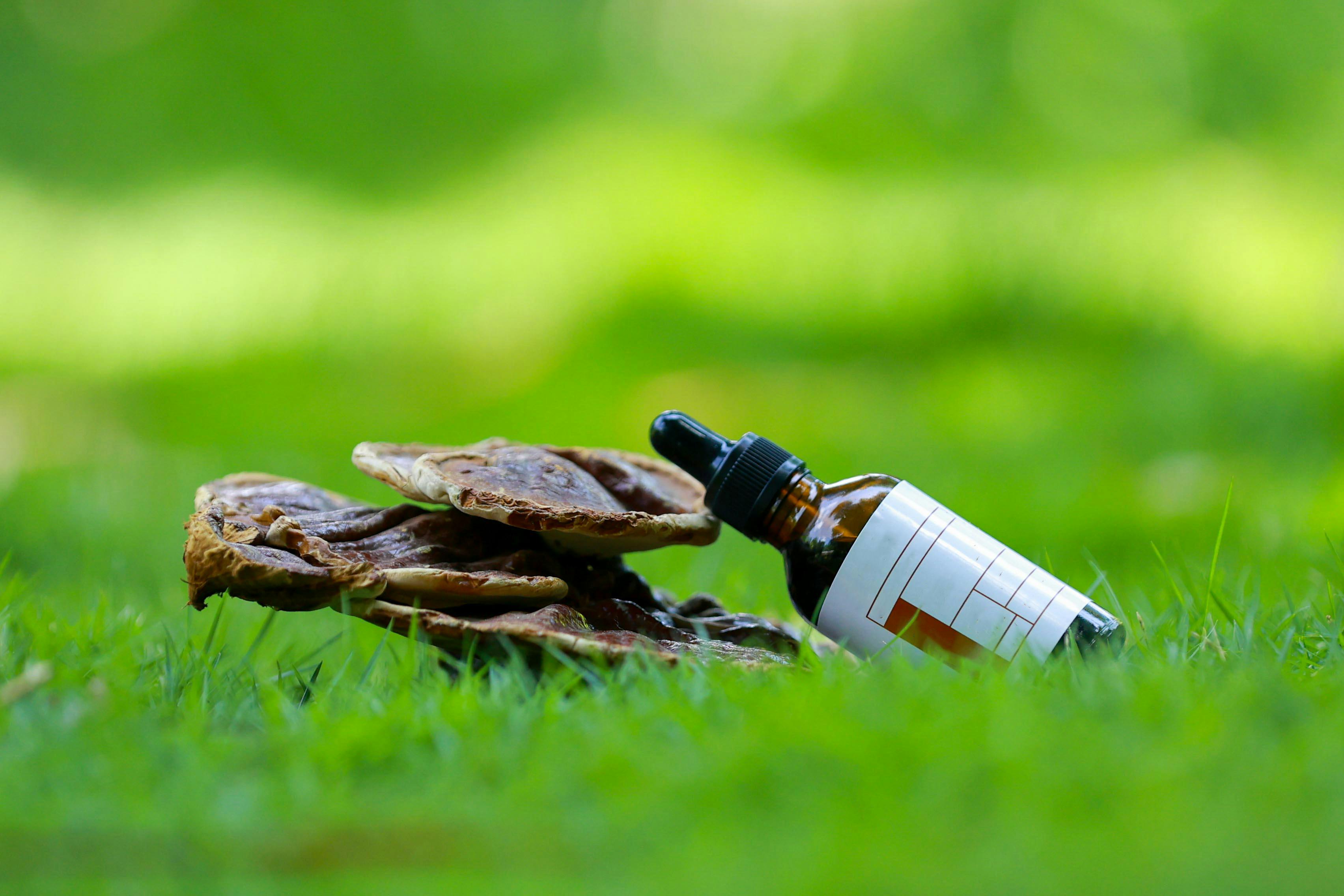
Reishi / Lingzhi Mushroom
The mushroom of immortality — triterpenoids, ganoderic acids, and surprising sleep-anxiolytic evidence.
In 1 minute
What does it provide? Two main bioactive compound families: triterpenoids (ganoderic acids — bitter taste, liver- and immune-modulating) and β-glucans (immune-activating, prebiotic). At the clinical level, sleep quality improvement, fatigue reduction, immunomodulation, and LDL lowering are the best-documented effects.
How much? Reishi is not eaten in the kitchen (tough, woody texture) — only as a decoction or powder: 1.5–6 g dried mushroom daily, or 200–1500 mg standardized dual-extract (fruiting body + spore), in 1–2 month courses.
When to avoid? During anticoagulant treatment, immunosuppressant therapy, 2 weeks before planned surgery, pregnancy, low blood pressure, active autoimmune flare.
Reishi (Chinese: "lingzhi" — spirit mushroom; Japanese: "mannentake" — ten-thousand-year mushroom) is one of the most revered medicinals in East Asian healing tradition, with more than 2,000 years of documented use. The Shen Nong Ben Cao Jing (2nd century BCE) — the oldest Chinese herbal text — lists it among the 365 herbs of the "upper class" as "The mushroom of immortality," indicated to "stabilize the spirit, strengthen the heart, and increase vital force." According to Taoist tradition, reishi is the food of sages seeking immortality, and in Chinese imperial art — porcelain, jade, painting — it is a symbol of long life and spiritual enlightenment. In the Japanese imperial court from the 7th century, it was obtained through wild collection only, and was so rare that it was kept in the carefully guarded medical chests of Buddhist temples.
Modern reishi research began in 1971, when Tokyo scientist Mori Shigeaki developed the first successful indoor cultivation method (on privet wood pieces, under controlled humidity), which first made what had been a near-mythic wild treasure widely available. Phytochemical research exploded from the 1980s: Chinese (Lin Z., Peking University), Japanese (Hikino, Kawagishi), and Korean groups isolated more than 150 different triterpenoids, and clinical trials documented Krebs-cycle-supporting, antihistamine, antiaggregant, and immunomodulating effects. Cui et al.'s 2012 Chinese RCT showed improvement in neurasthenia (chronic fatigue) after 8 weeks of reishi consumption; Wachtel-Galor et al.'s 2011 review brought the hepatoprotective effect of triterpenoid fractions to the fore. (PubMed, Chinese J Integr Med)
🔬 Scientific Background
Reishi has a "double-layer" pharmacology: the water-soluble β-glucans (β-1,3 and β-1,6) are immunomodulating — through the dectin-1 receptor of dendritic cells, macrophages, and NK cells, they induce a TH1-directed cytokine response and NK activity. The alcohol- and fat-soluble triterpenoids (ganoderic acids A–H, lucidumols, lucidenoles) concentrated in spore oil (Ganoderma spore oil) exert anxiolytic and sleep-quality-improving effects through GABAergic and serotonergic modulation. This is why the traditional "shen calm" (spirit-calming) effect is also pharmacologically grounded.
The most solid area of clinical evidence is sleep quality and fatigue syndrome. In Tang's 2005 (J Med Food) RCT, 132 neurasthenia patients received 1800 mg reishi polysaccharide extract for 8 weeks, with improvement on the Clinical Global Impression scale of 49% vs. placebo 33%. In Cui's 2012 (J Ethnopharmacol) rat model, sleep time was significantly extended — preclinical confirmation of the traditional "shen calm" effect. In oncology adjuvant trials, Jin's 2016 Cochrane review (5 RCTs, 373 patients) found that reishi added to chemotherapy improved quality-of-life scores and NK-cell activity, but does not provide evidence for tumor regression by itself.
At the microbiome level, in Chang et al.'s 2015 mouse and human study, reishi polysaccharides increased the relative abundance of Akkermansia muciniphila and Bifidobacterium, decreased the obesity-associated Firmicutes/Bacteroidetes ratio, and lowered serum LPS levels. This "prebiotic" effect partly explains the improvements seen in metabolic syndrome. Important: triterpenoids are lipophilic, β-glucans are hydrophilic — therefore a dual-extract (cold water + 95% ethanol) is necessary to obtain the full spectrum. A simple decoction gives only a small fraction of the water-soluble portion.
- + Vitamin C (lemon juice in reishi tea): according to Smith et al., vitamin C significantly increases the bioavailability of triterpenoids and β-glucans; a simple kitchen trick.
- + Healthy fat (coconut oil, MCT, ghee): triterpenoids are lipophilic — cooked or emulsified with fat, absorption is 3–5× better.
- + Magnesium (almond, spinach, dark chocolate): synergistic relaxant/sleep-supporting effect through GABAergic modulation.
- + L-theanine (matcha, green tea): anxiolytic synergy, classic combination for evening sleep support.
- + Other adaptogenic mushrooms (cordyceps, shiitake): complementary triterpenoid and β-glucan profile.
- + High-fiber diet: prebiotic synergy for the microbiome effect.
- + 1–2 hours before bedtime: triterpenoid half-life is 4–6 hours; evening dosing supports the natural sleep cycle.
- Anticoagulants (warfarin, DOACs, aspirin, clopidogrel): reishi triterpenoids and β-glucans have pronounced antiaggregant effects (Tao 1990 Korean study) — additive bleeding risk. Clinical-dose supplement to be avoided, or strict INR monitoring.
- Antihypertensives (ACE inhibitors, ARBs, calcium channel blockers): moderate hypotensive effect — orthostatic episodes, dizziness.
- Immunosuppressants (tacrolimus, ciclosporin, corticosteroids): opposite pharmacology — avoid after organ transplantation.
- Diabetes medications (insulin, sulfonylureas): hypoglycemia risk (reishi is a mild blood-glucose lowerer).
- Chemotherapy (some cytostatics, like cisplatin): theoretical cytochrome P450 interaction — oncologist consultation.
- CYP2E1 and CYP3A4 substrates: triterpenoids modulate these enzymes — drug levels may change.
- Alcohol: additive hypotension, liver stress at large doses.
- Bleeding predisposition (hemophilia, thrombocytopenia, von Willebrand): absolute contraindication due to the pronounced antiaggregant effect.
- Active autoimmune disease (SLE, RA, MS) during flare: the direction of immunomodulation is not always predictable — consultation required.
- After organ transplantation: absolute contraindication for supplement doses.
- 2 weeks before planned surgery: stop.
- Pregnancy, breastfeeding: human safety data missing for supplement doses — avoid.
- Low blood pressure (systolic < 100 mmHg) chronically: further decrease with dizziness.
- Active liver disease, transaminase elevation of unknown cause: theoretically rare, but reishi-associated hepatitis cases have been described (Wanmuang 2007, Wang 2014).
- Kidney stones, calcium oxalate tendency: reishi has moderate oxalate content.
Serving: 1.5–6 g dried reishi fruiting body daily, as a decoction or powder. As a supplement, 200–1500 mg standardized dual-extract.
Preparation (classic decoction):
1. Place 3–6 g of dried, thinly sliced reishi into 1 liter of water.
2. Simmer on low heat for 60–90 minutes under a lid (so triterpenoids and β-glucans leach out).
3. Strain; consume the liquid warm or chilled, flavored with honey or ginger (reishi is notably bitter).
4. The remaining mushroom can be re-boiled — discard after 2–3 cooks.
Classic patterns:
- Reishi tea (Chinese style) — a simple daily decoction, for evening sipping.
- Reishi bone broth (Taoist long-life broth) — 4–6 hours slow cooking with bone and ginger.
- Reishi powder in smoothies/coffee — 1 tsp standardized powder as a daily serving (taste is decidedly bitter, offset with honey/MCT).
- Reishi cocoa (evening) — warm cocoa + 1 tsp reishi powder + coconut milk + honey → magnesium-triterpenoid-theobromine sleep-support trio.
Storage: Dried fruiting body in an airtight jar, in a dark, cool place, stable for 2 years. Powder format 1 year. Liquid extract in the fridge 6 months.
What not to do: Don't cook in aluminum cookware (triterpenoids chelate Al). Don't consume on an empty stomach as a high-dose powder (bitter taste triggers nausea). Don't combine with alcohol or sedatives.