


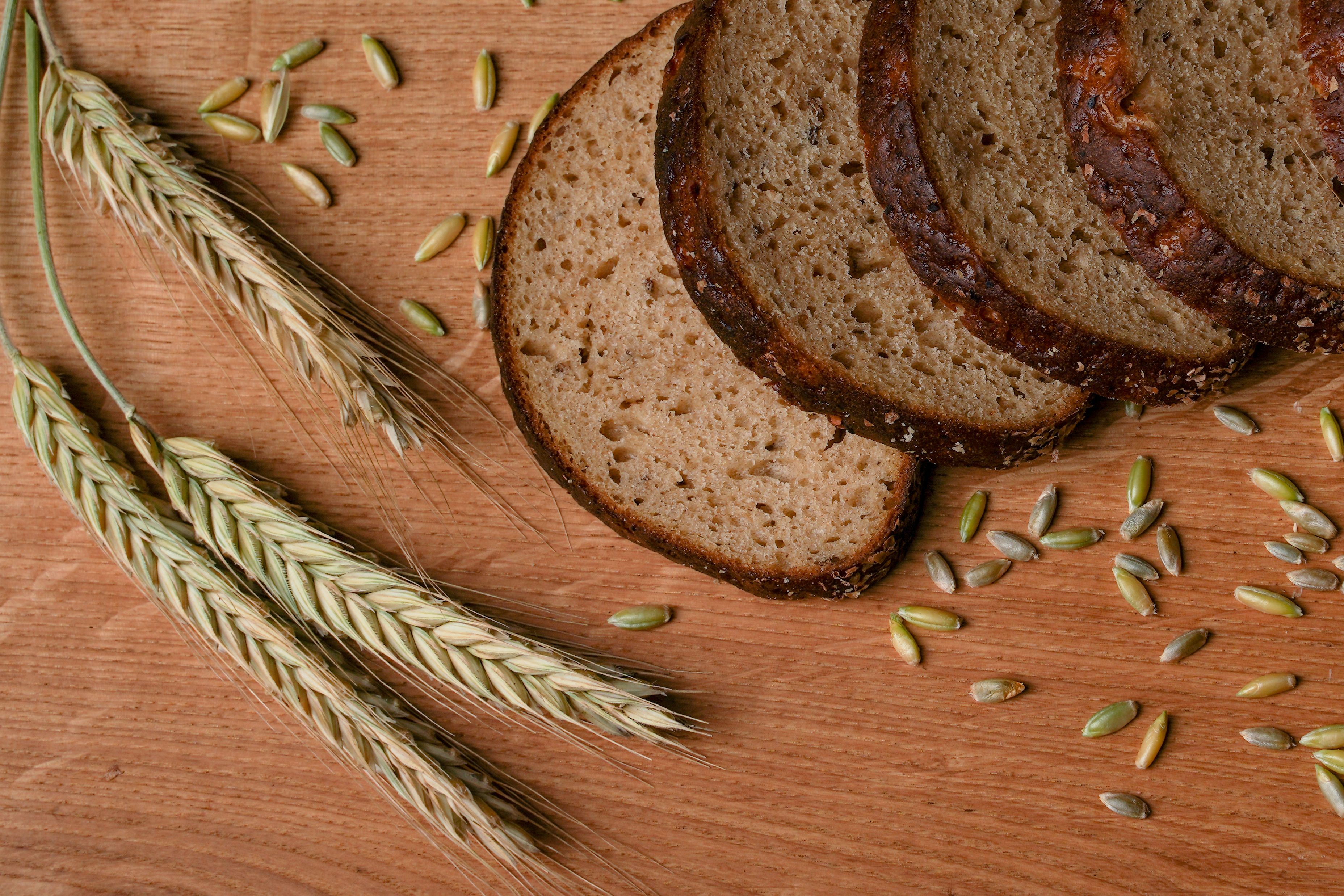
Whole-Grain Rye
The science of Scandinavian pumpernickel — arabinoxylan, alkylresorcinols, and the Lindeberg RCT.
In 1 minute
What does it provide? Arabinoxylan (AX — the main cell-wall fiber of the bran layer, broken down by gut bacteria into AXOS prebiotic, a Bifidobacterium booster), fructans, alkylresorcinols (whole-grain marker, antioxidant), and lignans. Long sourdough fermentation reduces fructans, improves the AXOS effect, and decreases phytate. The Eriksen 2020 crossover RCT (whole-grain rye vs. wheat) showed significant Bifidobacterium increase and SCFA elevation over 6 weeks.
How much? 50–80 g/day (≈ 2–3 slices) of long-fermented sourdough (≥ 12–24 h fermented) whole-grain rye bread, or 30 g rye flakes in porridge. GI ≈ 50–58 (moderate-low). Vuholm 2018 RCT: 6 weeks of whole-grain rye (75 g/day) lowered body weight vs. white wheat.
When to avoid? Celiac disease and non-celiac gluten sensitivity (rye contains secalin — gluten-related prolamin, NOT resolved by sourdough); wheat allergy (frequent cross-reaction); active IBS flare or SIBO (high fructan — sourdough only partially reduces); acute bowel stricture (high insoluble fiber); iron tablet at the same meal (phytate chelate — keep 2 hours apart).
Rye took an unusual path: it did not enter history's stage as a hero, but as a weed. As a member of the Triticeae family related to wheat and barley, it hid among the ancient grain fields of the Fertile Crescent — but when it found itself in cold, wet, poor soil, it grew faster and yielded more reliably than its noble "neighbors." Archaeologists call this "secondary domestication": humans first only tolerated it, then from the Bronze Age also began cultivating it independently. It already appeared in small quantities in Neolithic Anatolia, and in Central Europe became characteristic by the Celtic-Germanic period — already by the Roman Empire's northern limes region it appeared on military camp grain inventories.
Pliny still wrote dismissively about rye: bitter, low-prestige, only good against scarcity — the Romans avidly avoided it. In medieval Northern and Eastern Europe, however, rye became the grain ever more loyal as the climate grew colder: frost-hardy varieties became the daily bread grain of Poland, Russia, the Baltic, and Scandinavia. The German Pumpernickel, the Russian "chornyi khleb," and the Finnish ruisleipä are all fruits of long sourdough rye fermentation — behind the tangy savory aroma, sourdough lactic acid bacteria work for days. Rye history was also accompanied by mixed shadows: ergot (Claviceps purpurea) mushroom infection caused massive epidemics in the Middle Ages, "St. Anthony's fire" poisonings, and some attribute a role to it in the Salem witch trials background. Modern food science is rediscovering whole-grain rye as an arabinoxylan- and fructan-rich bioactive matrix — Swedish researcher Staffan Lindeberg's 2005 RCT first showed that Finnish-style whole-grain rye bread significantly improves insulin sensitivity in metabolic syndrome.
🔬 Scientific Background
The main bioactive fractions of whole-grain rye are arabinoxylans (AX) — pentose-based cell-wall polysaccharides concentrated in the bran layer. When depolymerized by gut bacteria, AX is converted into arabinoxylan oligosaccharides (AXOS) — several human RCTs demonstrate the bifidogenic effect of AXOS (Bifidobacterium ratio ↑, at a dose of about 10 g/day).
The HEALTHGRAIN/Vuholm 2018 (J Nutr) — a randomized 6-week study — showed that whole-grain rye (but NOT whole-grain wheat) significantly reduced body weight and body fat mass compared to refined wheat, indicating the metabolic advantage of the whole-grain rye matrix beyond classic fiber quantity. The 12-week Giacco 2014 (Nutr Metab Cardiovasc Dis) analyzed rye+wheat vs. refined-grain diet in Finnish and Italian metabolic syndrome patients and described modest improvement in some lipids, although there was no significant difference in insulin sensitivity indices — rye evidence is thus moderate but directional.
The fructan content has two faces: prebiotic substrate, but it can cause symptoms in IBS-sensitive individuals. Long sourdough fermentation (≥ 12–24 hours) significantly reduces fructan load through the enzymatic work of Lactobacillus + yeast microbes — which is why traditional pumpernickel-style bread is tolerable for many IBS patients.
Alkylresorcinols (5-alkylresorcinols) are found in rye (and wheat) bran — they serve as blood and urine markers for objectively measuring whole-grain intake in epidemiological studies (Landberg group, Sweden).
According to an EFSA-recognized claim, rye contributes to normal bowel function (stool mass, frequency). At the microbiome level, the AX/AXOS fraction also provides SCFA increase (propionate, butyrate) and a suitable matrix for Roseburia and Faecalibacterium groups.
The gluten (rye-specific secalin), however, makes rye forbidden for celiacs — this is not resolved by sourdough fermentation.
- + Long sourdough fermentation (≥ 12–24 hours): fructan reduction + AXOS in situ formation + better tolerance + phytate reduction.
- + Caraway seeds: classic Scandinavian-Central European flavor pairing, anti-flatulent effect.
- + Fermented dairy (yogurt, kefir, cultured butter): synbiotic synergy + digestibility.
- + High-fat fish (salmon, herring): Scandinavian pattern — omega-3 + fiber.
- + Avocado or soft-boiled egg: classic breakfast pattern + fat-carbohydrate balance.
- + Soaking/sprouting before baking: reduces phytate, increases AX availability.
- "Modern" quick-yeast rye bread: short (≤ 2 hour) fermentation does not reduce fructan — worse tolerance + no AXOS forms.
- Too much sugar/honey at the meal: the glycemic benefit disappears.
- Iron supplementation at the same meal: phytate content limits Fe absorption — ≥ 2 hour gap recommended.
- Ergot-contaminated flour (extremely rare under modern conditions): Claviceps poisoning risk — buy from verified sources.
- Too hot toasting: AGE formation in the rye crust.
- Celiac disease, wheat allergy (frequent cross-reaction): rye contains secalin (gluten-related prolamin) — strictly forbidden.
- Active IBS elimination phase (Monash low FODMAP): high fructan — avoid in the first 4–6 weeks; then low-FODMAP rye bread (long sourdough) can be tested for reintroduction.
- Non-celiac gluten sensitivity (NCGS): individual tolerance — causes complaints in many; long sourdough form is often better.
- FODMAP fluoroscopy or SIBO-positive state: initially avoid.
- Diabetes with insulin pump treatment: whole-grain rye is slow carb — dosing recalibration needed.
- Acute bowel obstruction, severe stricture: high insoluble fiber risk.
Daily serving
50–80 g (2–3 slices) whole-grain, long-sourdough rye bread; or 30 g rye flakes in porridge.
Preparation pattern
- Pumpernickel style: 100% whole-grain rye flour + water + salt + sourdough (≥ 12 hour fermentation) → low temperature (120 °C), long bake (4–8 hours).
- Classic sourdough rye bread: 80% rye + 20% wheat + sourdough, 12–18 hour fermentation, 220 °C for 35–45 minutes.
- Rye flake porridge: 30 g flakes + 200 ml water/milk → 8–10 minutes hot.
Classic patterns
Smörgåsbord (Swedish breakfast): ruisleipä rye bread + cultured butter + salmon + dill + herring.
German Vollkornbrot: whole-grain, long-fermented — cheese + radish + butter.
Russian "chornyi khleb": with dried garlic, alongside pickled cucumber.
Central European sourdough rye bread: caraway seeds, with liver pâté or curd cheese topping.
Storage and avoidances
Storage: Fresh sourdough rye bread at room temperature 5–7 days (stores better than wheat bread due to its acidity). Sliced and frozen 3 months.
What not to do: Don't buy "quick-yeast" rye bread for the AXOS effect. Don't combine rye with Fe supplementation at the same meal. Don't toast at too high a temperature — AGE formation.
References
[1] Giacco R et al. Effects of rye and whole wheat versus refined cereal foods on metabolic risk factors: a randomised controlled two-centre intervention study. Nutr Metab Cardiovasc Dis 2014;24(8):837–844.
[2] Damen B et al. Prebiotic effects and intestinal fermentation of cereal arabinoxylans and arabinoxylan oligosaccharides in rats depend strongly on their structural properties. J Agric Food Chem 2011;59(2):553–562.
[3] Vuholm S et al. Whole-grain rye, but not whole-grain wheat, lowers body weight and fat mass compared with refined wheat: a 6-week randomized study. J Nutr 2018;148(1):76–83.
[4] Eriksen AK et al. Effects of whole-grain wheat, rye, and lignans on the digestive system: a randomized crossover study. Br J Nutr 2020.
[5] EFSA NDA Panel. Scientific Opinion on dietary reference values for carbohydrates and dietary fibre. EFSA Journal 2010;8(3):1462.
[6] Landberg R et al. Alkylresorcinols as biomarkers of whole-grain wheat and rye intake. Am J Clin Nutr 2008;87(4):832–838.
[7] Lappi J et al. Sourdough fermentation of wholemeal wheat bread increases solubility of arabinoxylan and protein and decreases postprandial glucose and insulin responses. J Cereal Sci 2010;51(1):152–158.
[8] Laatikainen R et al. Pilot study: comparison of sourdough wheat bread and yeast-fermented wheat bread in individuals with wheat sensitivity and IBS. Nutrients 2017;9(11):1215.
[9] Pomp ER et al. Sourdough rye bread and IBS tolerance. Nutrients 2020.