


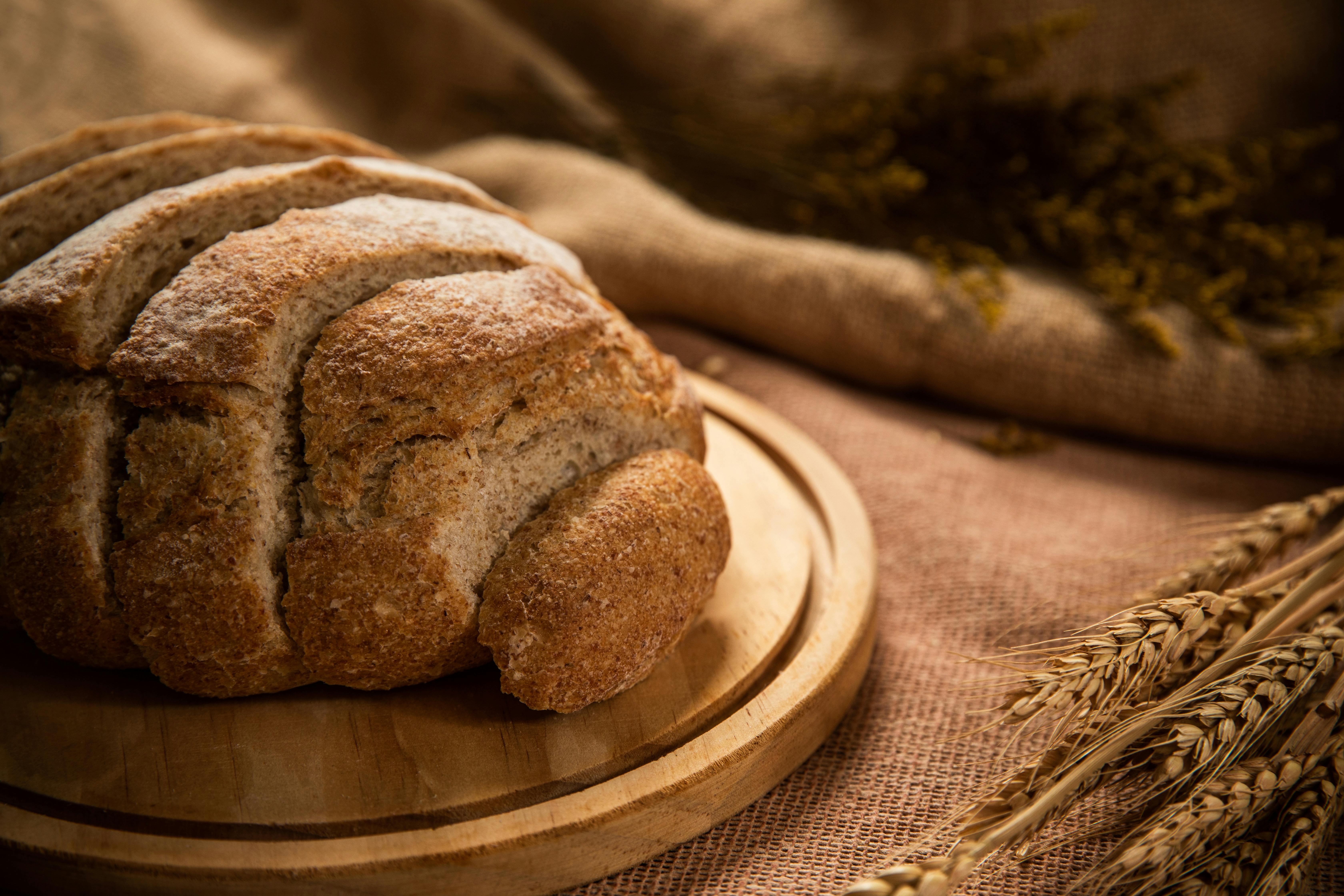
Sourdough Whole-Grain Bread
The science of San Francisco lactobacillus — phytate degradation, AXOS in situ, and the Pomp 2020 NCGS RCT.
In 1 minute
What does it provide? A whole-grain wheat matrix transformed by long lactobacillus + wild yeast fermentation: reduced FODMAP/fructan, broken-down phytate (Fe/Zn/Mg bioavailability ↑), in situ formed AXOS, reduced ATI (amylase-trypsin inhibitor), RS3 in stale form. Better tolerated by most NCGS patients (Pomp 2020 RCT).
How much? 1–3 slices (50–80 g) daily.
When to avoid? CELIAC DISEASE (sourdough fermentation does NOT make it gluten-free!), wheat allergy, severe IBS flare.
Sourdough bread is one of human cuisine's most ancient accidental inventions: probably in ancient Egypt, at latest from the Old Kingdom (around 3000 BCE), it was already documented as being baked, when in a forgotten flour-water mixture, wild yeasts and lactic acid bacteria arriving from the air began to work — and the next-day baked bread was surprisingly lighter and more aromatic than the previous flat and dense breads. Pastry remains found at archaeological sites of the Egyptian pyramids and wall paintings of Theban tombs already show long sourdough baking. Sourdough fermentation remained the dominant method in the Greco-Roman world too, and Pliny gives a detailed description: the so-called "fermentum" was prepared one day and mixed into the next day's dough. In the Middle Ages, guild bakers watched over the quality of sourdough bread; the 1290 Frankfurt baker guild rules prescribed the stocks for poor-quality bread bakers.
The appearance of industrial yeast overthrew traditional sourdough technology: after Louis Pasteur deciphered the biology of fermentation in 1857, purified baker's yeast spread in the second half of the 19th century, and by the mid-20th century, urban bread production had almost completely switched to 1–2 hour yeast technology. Sourdough culture survived continuously only in a few regions — in the rye-bread regions of Northern Europe, in Italian rural households, and in the western bakeries of San Francisco operating from 1849. Interestingly, modern microbiology also started from San Francisco: in 1971, Sugihara and Kline identified Fructilactobacillus sanfranciscensis, the bacterium found in water-flour sourdoughs worldwide. From the 2000s, American baker Chad Robertson's Tartine books and the global "back to sourdough" movement launched the worldwide renaissance of whole-grain, long-fermented sourdough breads — and today nutrition science recognizes professionally grounded advantages because of AXOS, phytate degradation, and FODMAP reduction. The 2020 Pomp RCT in NCGS patients proved that long sourdough rye/wheat bread is better tolerated than the quick-yeast version.
🔬 Scientific Background
Sourdough is a complex microbial community — its main players are Fructilactobacillus sanfranciscensis, Limosilactobacillus pontis, Latilactobacillus spp. lactic acid bacteria and wild yeasts (often Kazachstania humilis). During the 12–24 hour (or longer) maturation, enzymatic transformations take place:
1. Phytate degradation: sourdough's phytase activity breaks down phytate → Fe, Zn, Mg, Ca bioavailability dramatically improves. Classic clinical evidence (Larsson 1996 + modern reviews).
2. FODMAP/fructan reduction: long LAB fermentation breaks down a significant portion of fructans — according to Monash, some sourdough spelt/wheat breads can be consumed at low FODMAP portions (1–2 slices).
3. AXOS in situ formation: sourdough's xylanase activity transforms part of the arabinoxylan (AX) into AXOS → bifidogenic, butyrate-boosting.
4. ATI (amylase-trypsin inhibitor) reduction: ATI fractions partly break down — some NCGS symptoms are related to ATI-mediated immune activation.
5. Glycemic profile: sourdough bread often gives lower postprandial glycemia (but not in every RCT).
6. RS3 in stale form: baking-cooling-storage causes retrogradation — the bread's RS content is influenced by storage and reheating.
Human RCT evidence: - Walton 2012 — AXOS-enriched (in situ formed) wheat/rye bread consumed for 3 weeks: stool butyrate ↑ and reduction in protein fermentation markers. - Laatikainen 2017 — sourdough vs. yeast wheat bread in IBS cases: sourdough better tolerance. - Pomp 2020 — in NCGS patients, sourdough rye bread better tolerance than the quick-yeast version. NOTE: it does not say it is safe in celiac disease — only that NCGS symptoms are milder.
Celiac disease and sourdough: sourdough fermentation does NOT make wheat bread gluten-free — gluten peptides (especially the 33-mer immunogenic region) mostly remain. For celiacs, sourdough wheat/rye/barley bread is STRICTLY forbidden. There are specialized "gluten-hydrolyzed" experimental products made with long selective fermentation, but these are not traditional sourdough bread.
- + Long fermentation (≥ 12–24 hours): the main driver of fructan reduction; shorter time does not reach the maximum benefit.
- + 100% whole-grain (or high-percentage) flour: more AX → AXOS conversion, more polyphenols.
- + Refrigerated/"day-old" consumption: RS3 ↑.
- + Fermented dairy (yogurt, kefir): synbiotic matrix.
- + Mediterranean accompaniment (olive oil, tomato, chickpea cream): polyphenol + broader prebiotic matrix.
- + Seeds and nuts: polyphenol synergy.
- Quick-yeast "pseudo-sourdough" + label trick: many commercial products only flavor with sour aroma — without real long fermentation, the clinical benefits do not appear.
- Too hot toasting: AGE/acrylamide formation.
- Iron supplementation at the same meal: despite phytate reduction, worth separating.
- High-sugar jam + sourdough bread: glycemic advantage disappears.
- Every sourdough wheat/rye in celiac disease: FORBIDDEN.
- CELIAC DISEASE: sourdough fermentation does NOT make it gluten-free — strictly forbidden. Only certified gluten-free sourdough bread (made from other grains — rice, buckwheat, millet) can be consumed.
- IgE-mediated wheat allergy: strictly avoid.
- NCGS (non-coeliac gluten sensitivity): individual tolerance, sourdough better tolerated (Pomp 2020), but not safe for everyone.
- Active IBS elimination phase: Monash low FODMAP — small portion (1 slice of sourdough spelt) green, larger portion red.
- Diabetes on insulin pump treatment: slow carb + lower GI — dose recalculation.
- Severe kidney disease CKD 4–5: phosphorus high — dosing with dietitian.
Daily serving
1–3 slices (50–80 g) of long-fermented, whole-grain sourdough bread daily.
Preparation pattern
- Sourdough starter establishment: 50 g whole-grain wheat flour + 50 ml water, daily feeding 5–7 days until bubbly + sour aroma.
- Classic sourdough whole-grain bread: 400 g whole-grain flour + 280 ml water + 100 g active sourdough + 8 g salt → 12–18 hour fermentation at room temperature → 220 °C for 35–40 minutes.
- Cold "bulk fermentation": in the fridge 18–48 hours → deeper flavor, lower fructan.
- Toasting: short toasting (up to 180 °C, max 2 minutes) → AGE minimization.
Classic patterns
Tartine style (San Francisco): Chad Robertson's protocol — 70% hydration, long cold fermentation.
Italian "pane di Altamura": durum wheat sourdough, DOP-certified.
German Vollkorn-Sauerteig: 100% whole-grain, intensive sourness.
Pumpernickel style (see VII.3 chapter): 100% rye, low temperature, long steaming.
Central European adaptation: caraway seed sourdough whole-grain wheat bread.
Storage and avoidances
Storage: Room temperature 4–7 days (stores better than quick-yeast due to acidity). Sliced and frozen 3 months.
What not to do: Don't trust the "sourdough" label — look for evidence of long fermentation (dense texture, sour aroma). Don't consume in celiac disease. Don't over-toast.
References
[1] Sugihara TF, Kline L. Microorganisms of the San Francisco sour dough bread process. Appl Microbiol 1971.
[2] Larsson M, Sandberg AS. Phytate degradation in sourdough bread. Cereal Chem 1996.
[3] Walton GE et al. A randomised, double-blind, placebo-controlled cross-over study to determine the gastrointestinal effects of consumption of arabinoxylan-oligosaccharides enriched bread. Nutr J 2012;11:36.
[4] Laatikainen R et al. Pilot study: comparison of sourdough wheat bread and yeast-fermented wheat bread in individuals with wheat sensitivity and IBS. Nutrients 2017;9(11):1215.
[5] Pomp ER et al. Sourdough fermentation reduces FODMAP and improves tolerance in NCGS patients. Nutrients 2020.
[6] Gobbetti M et al. How the sourdough may affect the functional features of leavened baked goods. Food Microbiol 2014.
[7] Di Cagno R et al. Sourdough lactic acid bacteria reduce ATI activity. Appl Environ Microbiol 2010.
[8] Lopez HW et al. Phytate degradation and mineral bioavailability in sourdough bread. J Agric Food Chem 2003.
[9] Monash University. High and Low FODMAP foods — sourdough breads. Monash FODMAP database.