


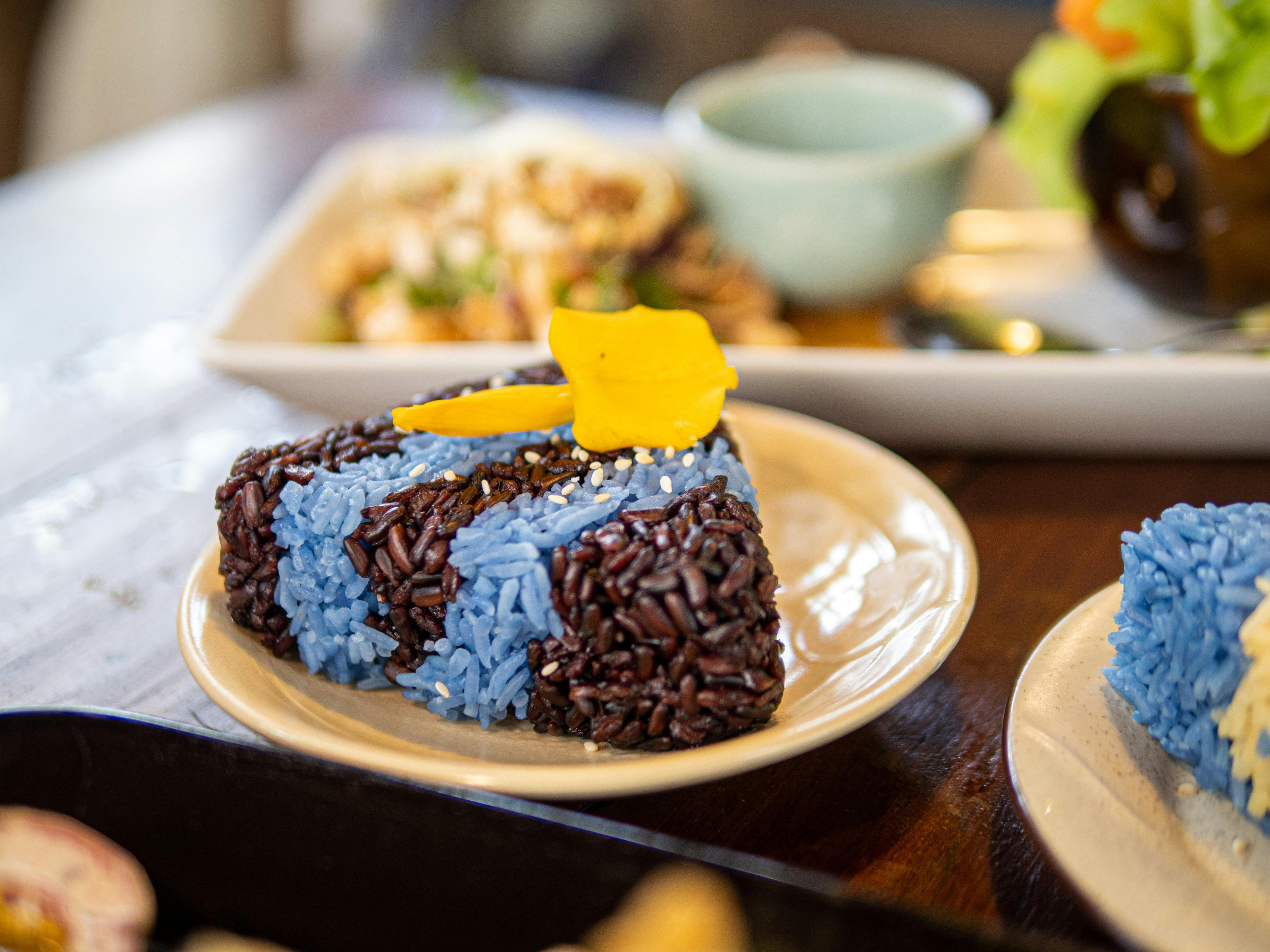
VII.17 Black Rice
The "forbidden rice" anthocyanin powerhouse — high cyanidin-3-glucoside, pigment selection, and the Chinese imperial tradition.
In 1 minute
What does it provide? Black rice's antioxidant capacity (ORAC) is 6–10× that of white rice; anthocyanin content ~200–600 mg/100 g dry (after cooking ~100–200 mg/100 g cooked, because heat breaks down 20–40%), close to blueberries. γ-Oryzanol (a ferulic acid ester in rice germ, cholesterol-lowering antioxidant) ~50–80 mg/100 g. Higher fiber, manganese, iron, and protein content than white rice. How much? ~60–80 g dry (1/3 cup) = ~1 cup cooked. 2–4 times per week; replacing white rice or high-AGE carbohydrates. Postprandial blood-glucose advantage in type 2 diabetes: in the Yamuangmorn 2018 RCT, ~150 g cooked black rice per day (≈60 g dry) gave significantly lower 1.5-hour glucose response than white rice. When to avoid? In true celiac disease, watch for processing cross-contamination; in chronic kidney disease (CKD 4–5), moderate due to higher potassium content; arsenic accumulation in industrial rice (source-country-specific problem).
Black rice originates from northeastern China (today's Heilongjiang province), as well as Burma (modern Myanmar), Indonesia (Bali), and Thailand (Khao niao dam — black sticky rice). For millennia, Asian growers kept it only on small areas, carefully guarded — during the Chinese imperial era (Ming and Qing dynasties), the black rice grown in the Guangxi and Yunnan provinces was called "forbidden rice" (jin mi 禁米, or 黑米 — heimi), because due to its high nutritional value and "long life" belief, it was transported to the Forbidden City, and only the imperial family and court could consume it. For the common man, growing and consuming it was forbidden — this is the origin of the "forbidden rice" name.
After mid-20th century Chinese land reforms, black rice returned to public consumption, but due to cultivation difficulties (low yield, long maturation) it always remained more expensive than white or brown rice. In Italy in the 1990s, the Vercelli Riserva province began cultivating the Riso Venere variety (named after the Roman goddess Venus, due to the "aphrodisiac effect" tradition). Modern phytochemical analysis (Hu et al., J Agric Food Chem 2003) demonstrated that 100 g of black rice has the same anthocyanin content as 100 g of blueberry — this is where the global "superfood" renaissance began. It has been available worldwide in health food stores since the 2010s.
🔬 Scientific Background
Black rice's anthocyanin content (mainly cyanidin-3-glucoside, C3G) is concentrated in the dark husk — preserved in the whole-grain (unpolished) variety. Anthocyanins have strong antioxidant and anti-inflammatory effects in vitro; human data: Wallace et al. (Crit Rev Food Sci Nutr 2016) meta-analysis showed significant LDL and CRP reduction with anthocyanin-rich diet. Cyanidin-3-glucoside gut microbial metabolism leads to protocatechuic acid (PCA) — this is the main circulating metabolite that improves vascular endothelial function (Czank et al., AJCN 2013).
The glycemic index (GI): black rice ~42–55 (low-moderate), while white jasmine rice ~70–85. The explanation: higher fiber (~3 g/100 g cooked vs. ~0.5 g in white), resistant starch, and the tannin and polyphenol matrix in the husk that reduces α-amylase activity. Callcott et al. (Br J Nutr 2018) in a randomized controlled trial measured decreasing oxidative stress and inflammation markers in healthy adults over 4 weeks with pigmented-rice-derived phenolic compounds; multiple post-2020 in vitro and clinical works point in a consistent direction regarding the postprandial glycemia-moderating effect of black rice anthocyanins in type 2 diabetes.
Iron, manganese, protein: black rice has ~3.5 g protein/100 g cooked (vs. 2.6 g white), ~1.9 mg manganese (~50% of the manganese RDA), and ~0.8 mg iron. Iron is non-heme, phytate content (~0.3 g/100 g) limits absorption; soaking or sprouting reduces phytate. Arsenic risk: all rice varieties tend to accumulate inorganic arsenic because of being grown in water. According to the EFSA 2014 opinion, the adult inorganic-As threshold is ~0.3 µg/kg/day; black rice is not at higher As risk than brown — the main consideration is source country (Bangladesh, India, southern China — higher; Italy, Spain — lower As).
γ-Oryzanol (in rice germ and bran) is a ferulic acid ester with cholesterol-lowering and antioxidant effect; human RCTs show 6.3% LDL reduction with 300 mg γ-oryzanol daily (Cicero & Gaddi 2001). From black rice in a meal, ~50–80 mg γ-oryzanol/100 g.
- + Fat source (coconut milk, olive oil): the lipophilic γ-oryzanol and certain polyphenols are better absorbed with fat.
- + Legumes (azuki bean, black bean): classic Asian seasonal combination, complete amino acid profile + twin prebiotic effect.
- + Vitamin C source (lime, peppers): increases non-heme iron absorption 2–3×.
- + Tofu / fatty sea fish: protein + omega-3 + carbohydrate balance.
- + Fermented soy product (miso, tempeh): Asian synergistic matrix.
- + Soaking 6–12 hours before cooking: reduces phytate, improves Fe/Zn absorption and cooking time.
- Calcium supplement (>500 mg) at the same meal: decreases iron absorption.
- Strong black tea/coffee at the meal: tannin-mediated iron and anthocyanin absorption deterioration.
- Acidic-greenish sour juice immediately after consumption: high acidity destabilizes anthocyanins — after cooking, chilled, stabilization is better.
- Rice from high-arsenic source (Bangladesh, India): reduce consumption risk through source rotation and plentiful-water rinsing before cooking (Sengupta et al. 2006 — plentiful water 6:1 ratio → 30–45% As reduction).
- Glucomannan-containing supplement simultaneously: the high soluble-fiber matrix can inhibit polyphenol absorption.
- Chronic kidney disease (CKD 3b–5): potassium content (~80 mg/100 g cooked) and phosphorus in moderation.
- Celiac disease: rice is gluten-free, but processing cross-contamination with gluten-containing grains can occur — look for "gluten-free" certification.
- Hemochromatosis / iron metabolism disorder: regular large amounts should be avoided.
- Infant (<6 months): arsenic sensitivity; per WHO recommendations, vary the source from <12 months of age (not only rice).
- Anticoagulant treatment (warfarin): black rice's vitamin K content is low — not a relevant interaction.
- Chronic kidney stones (calcium oxalate): rice is low oxalate, safe.
Daily serving: 60–80 g dry (~1 cup cooked); 2–4×/week.
Preparation pattern:
- Soaking: 6–12 hours in cold water → phytate reduction, shortened cooking time.
- Cooking: 1:2.5 rice-to-water ratio; 30–40 minutes on medium heat (shorter if soaked — 25 minutes).
- Plentiful-water method for As reduction: 1:6 water, cook until tender, drain — ~30–45% inorganic arsenic leaves.
- Pilaf style: first toast in oil (ghee, coconut oil) → aromatic + RS3 boost.
Classic patterns:
- Riso Venere insalata: Italian cold salad — cooked black rice + datterino tomato + tuna + olive + basil.
- Khao niao dam (Thai black sticky rice): with coconut milk + palm sugar + mango → dessert.
- Heilongjiang congee: slow-cooked rice porridge from black rice + licorice root + jujube → breakfast.
- "Buddha bowl": black rice + roasted sweet potato + avocado + sprouted chickpea + tahini sauce.
- Modern Central European adaptation: black rice side dish accompanying trout + parsley + pumpkin seed oil.