


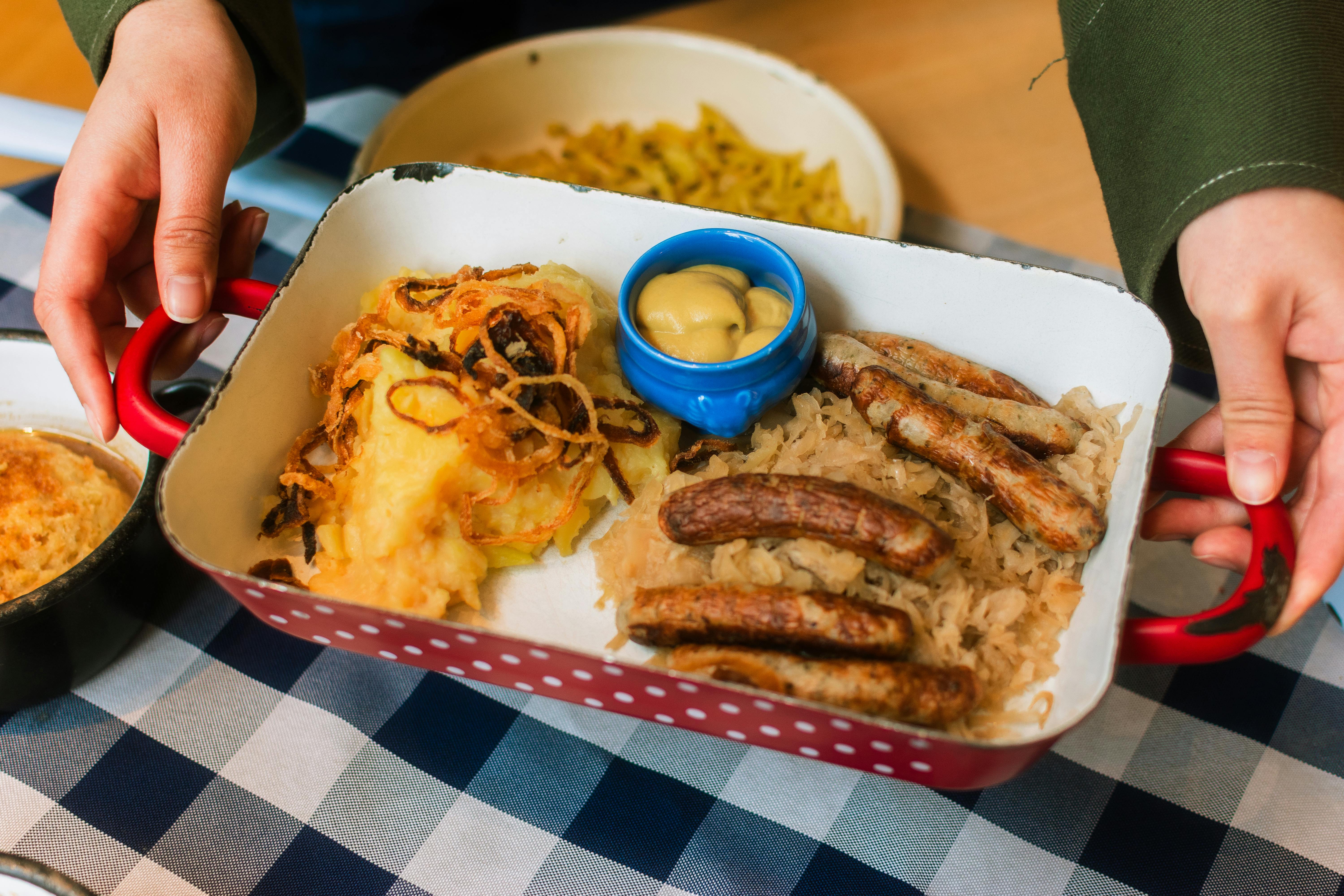
Sauerkraut
The winter vitamin C bank and live LAB matrix — an ancient preservation technique that saved lives at sea.
In 1 minute
What does it provide? Live lactic acid bacteria (Lactiplantibacillus plantarum, Leuconostoc mesenteroides), lactic acid and other organic acids, plus vitamin C and vitamin K — microbiota modulation and postbiotic substrates.
How much? Start with 1–3 tablespoons (≈ 15–30 g) daily, gradually increasing to 50–100 g. Choose a fresh, refrigerated, NON-pasteurized product.
When to avoid? Active gastric ulcer/reflux flare, histamine/tyramine sensitivity, severe sodium restriction, MAO inhibitor therapy, live-flora avoidance during immunosuppression.
The story of sauerkraut begins at the Great Wall: Chinese workers were already fermenting cabbage with salted rice wine in the 3rd century BCE during construction of the Great Wall, and legend has it that Genghis Khan's armies carried the method westward during the wave of 13th-century Tatar conquests. In Germany and Eastern Europe, the practice took root under the name "Sauerkraut," and thanks to its status as a winter source of vitamin C, it became a staple food in nearly every peasant household. The anaerobic, salt-layered fermentation kept for months, provided a rich winter supply, and became a constant fixture of medieval European cuisine.
In the age of seafaring, sauerkraut literally saved lives: Captain James Cook took nearly two tons of sauerkraut aboard the 1768 Endeavour expedition, and over the three-year voyage not a single sailor died of scurvy. The Royal Society awarded Cook the Copley Medal in 1776 for his account of the scurvy-prevention method used on his second (1772–75 Resolution) voyage. From that point on, sauerkraut became one of the classic examples of "functional food" in nutritional history: anti-scorbutic, shelf-stable, and — as became clear in the late 20th century — a source of live lactic acid bacteria too.
🔬 Scientific Background
Sauerkraut is the result of a spontaneous lactic acid fermentation: the natural surface microbiota — initially Leuconostoc mesenteroides, then as acidity rises Lactiplantibacillus plantarum and Pediococcus species — convert the sugars of shredded cabbage (≈ 4 g/100 g) into lactic acid. The pH drops below 4.0, creating a stable, pathogen-free ecosystem. Fresh, non-pasteurized product contains 10⁷–10⁸ CFU/g of live LAB.
The vitamin C paradox: fresh cabbage is already high in vitamin C (≈ 36 mg/100 g), but during fermentation the antioxidant environment of the bacteria preserves a significant portion (vs. boiling, which degrades ≥ 50%). For 18th-century sea voyages this was decisive: even after six months of barrel storage, it retained 20–25 mg/100 g vitamin C.
According to the 2021 Stanford study (Wastyk et al., Cell), a 10-week fermented-food-rich diet (including daily sauerkraut) was associated with increased microbiome diversity and a decrease in 19 inflammatory signaling proteins — a clinically relevant shift affecting IL-6, MCP-1, and TNF-α levels. In a 2025 crossover trial, 100 g/day of fresh VS pasteurized sauerkraut both produced species-level microbiota changes and elevated serum SCFAs — proving that not only the live bacteria but also the fermentation metabolites (postbiotics) are active.
- + Fiber-rich sides (legumes, whole grains, oat β-glucan): synbiotic synergy — sauerkraut's LAB + prebiotic fiber = broader SCFA profile (acetate/propionate/butyrate).
- + Olive oil, flaxseed: polyphenol synergy, anti-inflammatory effect; the fat aids vitamin K absorption.
- + Cold or lukewarm serving (NOT boiled): heating above 60 °C kills live LAB — for live effect, add at serving, don't cook it in.
- + As a side to roasted/steamed meat or fish: the acidic matrix supports protein digestion.
- + With grated apple or caraway seed: classic flavor, FODMAP-mitigating (caraway is carminative).
- + A splash of apple cider vinegar: if acidity has dropped — additional pH reduction.
- High-salt + sugary, refined foods: sauerkraut alone contains 500–800 mg Na/100 g — don't combine it daily with high-sodium sausages or bacon.
- MAO inhibitor therapy: tyramine can form during fermentation — risk of hypertensive crisis with MAOIs.
- Prolonged boiling (≥ 30 minutes): kills live LAB — only the postbiotic matrix remains.
- During antibiotic course: in theory, fermented food interaction is minor, but if you specifically want live-culture effect, wait until the course ends.
- Large servings on an empty stomach: the high acidity can provoke reflux symptoms — add it to a meal.
- Iron supplementation: polyphenols and acids can chelate iron — separate by ≥ 2 hours.
- Active gastric ulcer, GERD flare: acidic content and postbiotics can aggravate GI irritation — wait for remission.
- Histamine intolerance: biogenic amines (histamine, tyramine, putrescine) form during fermentation — test with a small portion.
- MAO inhibitor (phenelzine, tranylcypromine) therapy: tyramine can cause hypertensive crisis — strictly avoid.
- Severe hypertension, heart failure, sodium restriction: avoid due to high Na content, or rinse it (lowers Na, but also LAB).
- Severe immunosuppression (chemo neutropenia, post-transplant isolation): live microbes should be avoided.
- Hashimoto's / autoimmune thyroid, iodine sensitivity: Brassica glucosinolates have goitrogenic potential — moderate consumption.
- IBS SIBO flare: high LAB intake may temporarily worsen symptoms — start with a small portion.
- Kidney stones (oxalate): moderate oxalate content — portion control for high oxalate sensitivity.
Daily serving
Introductory phase: 1–3 tablespoons (≈ 15–30 g) daily, 1–2 weeks.
Maintenance: 50–100 g (≈ ½ cup) daily or 3–4 × 100 g per week.
Preparation pattern — homemade sauerkraut
- 1 kg cabbage thinly shredded + 15–20 g salt (≈ 1.5–2%).
- Pack tightly in a clean glass jar/ceramic crock until it sits in its own juice.
- Press down with a weight so it is sealed from oxygen.
- Room temperature (18–22 °C) for 1–4 weeks. Taste from day 5.
- Once it reaches the acidity you like → into the refrigerator.
Classic patterns
Polish bigos: slow-braised sauerkraut + roasted meats — add fresh sauerkraut at the end so live LAB remains.
Choucroute garnie (Alsatian): classic French version — braised with white wine, served with meat.
Reuben sandwich: rye bread + sauerkraut + corned beef — live LAB stays in the filling.
Smoothie boost: 1 tbsp sauerkraut juice in a morning smoothie (green apple, spinach, ginger).
On a salad bowl: Brussels sprouts, apple, walnut + sauerkraut + olive oil dressing.
Storage
Refrigerated airtight for 4–6 months. White mold on the surface → discard the top 1 cm, the rest is fine. Pink/green mold → discard the whole batch.
What not to do
Don't heat to ≥ 60 °C if live LAB is the goal. Don't rinse (you'd lose LAB along with the sodium). Don't store in metal cans (acidic medium).
References
[1] Wastyk HC et al. Gut-microbiota-targeted diets modulate human immune status. Cell 2021;184(16):4137–4153.
[2] Stiemsma LT et al. Does Consumption of Fermented Foods Modify the Human Gut Microbiota? J Nutr 2020;150(7):1680–1692.
[3] Beganović J et al. Improved sauerkraut production with probiotic strain Lactobacillus plantarum L4 and Leuconostoc mesenteroides LMG 7954. J Food Sci 2014;79(3):M531–M535.
[4] Nielsen ES et al. Lacto-fermented sauerkraut improves symptoms in IBS patients independent of product pasteurisation — a pilot study. Food Funct 2018;9(10):5323–5335.
[5] Han K et al. Comparison of fresh versus pasteurised sauerkraut on the human gut microbiota and serum short-chain fatty acids: a randomised crossover trial. Front Microbiol 2025.
[6] Cook J, Pringle J. The Method Taken for Preserving the Health of the Crew of His Majesty's Ship the Resolution. Phil Trans Royal Soc 1776.
[7] Hill C et al. The International Scientific Association for Probiotics and Prebiotics consensus statement. Nat Rev Gastroenterol Hepatol 2014;11(8):506–514.
[8] Penas E et al. Health benefits of fermented vegetables and cereals. Foods 2017;6(8):65.