


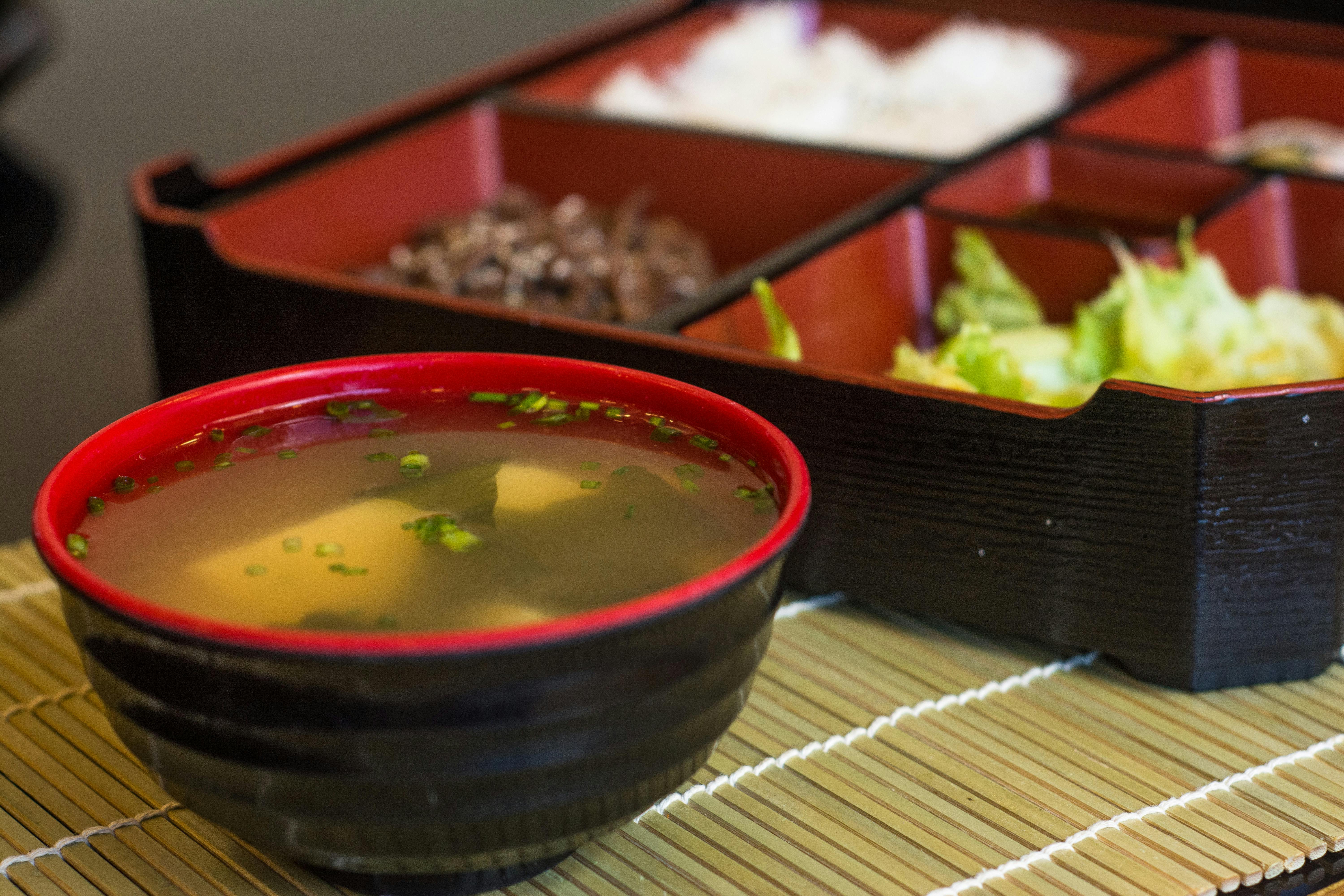
Miso
Fermented soybean paste with koji mold — isoflavone aglycone matrix, sodium question, and a barley/gluten warning.
In 1 minute
What does it provide? Isoflavone aglycones (genistein, daidzein — koji fermentation converts the poorly absorbed glycoside form of soy flavonoids into the aglycone form, absorbed 5–10× better, with a phytoestrogen role), salt-tolerant lactic acid bacteria (Tetragenococcus halophilus), yeast (Zygosaccharomyces rouxii), and ACE-inhibitor-like bioactive peptides. A 14-day intervention (Inoue 2021) showed Bifidobacterium enrichment.
How much? 1–2 tablespoons (≈ 12–18 g) daily in soup or sauce. Choose a live, refrigerated, NON-pasteurized product. Clinical trials (Kondo 2019, Yoshida 2017): one bowl of miso soup per day produced nighttime blood pressure reduction and lower pulse rate in middle-aged Japanese — peptides counterbalance the Na load.
When to avoid? Celiac disease with barley-koji mugi-miso (gluten content — choose hatchō or rice-koji variants); MAO inhibitor therapy (ripened aka/hatchō high tyramine → hypertensive crisis); levothyroxine replacement (≥ 4-hour separation); strict Na restriction (≈ 4 g salt/tablespoon). Detailed condition-specific contraindications (histamine intolerance, ER+ breast cancer, infant < 1 year) in the section below.
The ancestor of miso must be sought in the Chinese jiàng (醤) paste: ancient Chinese cuisine mentions fermented soy-like pastes as early as the 2nd century BCE, and Buddhist monks brought them to Japan during the 6th–7th-century Asuka and Heian-era cultural transfers, as part of monastic fasting cuisine. The word "miso" itself first appears in 9th-century Heian documents and was initially a luxury good of monasteries and noble courts — at the early Heian court, cubed miso was given as a special gift to high-ranking officials. During the Kamakura era, Zen monks tied miso soup to daily meals, cooked from a dashi base, and this combination became the backbone of the shōjin ryōri plant-based culinary tradition.
During the Muromachi and Edo eras, miso permanently left the court storehouses and became a winter staple of peasant households: every household fermented it in its own wooden taru barrel, and regional styles emerged — the white, sweet shiro-miso around Kyōto, the redder aka-miso in the Tōhoku provinces, and the deep coffee-colored hatchō-miso in Aichi province, still ripened today for 24–35 months in huge cypress vats under towers of river stones. In the 20th–21st century, microbiology finally identified the players of the tradition by name: the Aspergillus oryzae koji mold, the salt-tolerant Tetragenococcus halophilus lactic acid bacterium, and the Zygosaccharomyces rouxii yeast.
🔬 Scientific Background
Miso is made with a double fermentation: first the koji-rice/barley is inoculated with Aspergillus oryzae (the koji mold, which also holds national mold status in Japan), then the koji + cooked soybean + salt (5–13%) mixture is ripened for 6–36 months. Koji enzymes (proteases, amylases, lipases) break the soy down into free amino acids (glutamate = umami!) and peptides, while salt-tolerant LAB (T. halophilus) produce lactic acid and the Z. rouxii yeast produces complex aroma compounds.
The isoflavone aglycone paradox: in raw soy, isoflavones are in glycosidated form (genistin, daidzin), which are poorly absorbed. During miso fermentation, β-glucosidase enzymes convert them to the aglycone form (genistein, daidzein) — these are absorbed 5–10× better. Equol production (the gut-bacteria-catalyzed bioactivation of daidzein → equol) is individual: 20–35% of the Western population are equol producers.
Clinical evidence: - Blood pressure: In an 8-week Japanese human study, daily miso soup produced a nocturnal BP reduction, while daytime BP did not change significantly. Despite miso being high in Na — multiple studies indicate its hypertensive effect is weaker than that of an equivalent NaCl load (peptides and isoflavones compensate). - Pulse rate: Lower pulse rates are measurable in regular miso consumers among middle-aged/older Japanese. - Microbiota: A 2-week combined miso + natto intervention reported Bifidobacterium↑, Bacilli↑, Clostridia↓ shifts.
The gluten question: hatchō-miso (only soy + salt) is gluten-free. Barley-koji miso (mugi-miso) contains gluten — to be avoided by celiacs.
- + Seaweed dashi (kombu, wakame): classic Japanese base — alginate fiber + miso = synbiotic pattern.
- + Tofu: extra isoflavone content, complex soy matrix.
- + Cold/lukewarm serving (NOT boiled): if live LAB is the goal — add miso to the soup off the heat.
- + Whole-grain rice (AX/AXOS): prebiotic fiber combination.
- + Vegetables (spinach, mushroom, scallion): micronutrient + polyphenol.
- + As a glaze on roasted fish or vegetables (yuzu-miso): classic marinade.
- High-Na meals (instant noodles, salted fish): miso ≈ 4 g salt/tablespoon.
- MAO inhibitor therapy: ripened miso (aka-, hatchō-) higher tyramine → risk of hypertensive crisis.
- Boiled soup (≥ 80 °C, prolonged): live LAB and yeast are destroyed.
- Thyroid disease with iodine overload: if combined with kombu dashi — monitor iodine level.
- Anticoagulant + vitamin K–rich greens: if lots of scallion + miso soup together.
- Iron supplementation: time separation ≥ 2 hours (polyphenol, phytate).
- Celiac disease/gluten sensitivity + BARLEY-koji miso (mugi-miso): strictly avoid. Choose pure soy or rice-koji variants.
- Severe hypertension, heart failure with Na restriction: portion control or low-Na labeled product.
- MAO inhibitor (phenelzine, tranylcypromine) therapy: long-ripened miso (aka, hatchō) has high tyramine — to be avoided.
- Histamine intolerance: biogenic amine content is variable — test with a small portion.
- Thyroid disease with hormone replacement: soy isoflavones interfere with levothyroxine absorption — time separation (≥ 4 hours).
- Hormone-sensitive tumors (ER+ breast cancer): isoflavones are phytoestrogens — medical consultation recommended (overall human evidence is rather protective, but individual judgment is warranted).
- Severe kidney failure with Na/K limits: miso is high in Na.
- Infant < 1 year: high Na — to be avoided.
Daily serving
1–2 tablespoons (≈ 12–18 g) miso, ideally in the form of 1 bowl of soup or 1 marinade.
Preparation pattern — simple miso soup
- Seaweed dashi: 1 liter water + 10 g kombu (30 min soak), then heat to 80 °C, do not boil.
- Remove kombu, optionally add bonito flakes (10 g, 30 sec, strained).
- Take off the heat.
- In a cup, suspend 1 tbsp miso in 100 ml dashi (lukewarm!).
- Return to the pot, do NOT re-boil.
- Tofu, wakame, scallion → serve.
Classic patterns
Shiro-miso (white, sweet): short ripening (3–6 mo), mild, for soups and sauces.
Aka-miso (red): medium ripening (1–2 years), stronger, classic morning soup.
Hatchō-miso: deep ripening (2–3 years), pure soy + salt, gluten-free, intense umami.
Mugi-miso: with barley koji, CONTAINS GLUTEN, to be avoided by celiacs.
Marinade (miso-glaze): miso + mirin + sake + sugar → on fish (black cod), on vegetables.
Salad dressing: miso + sesame oil + rice vinegar + grated ginger.
Storage
Refrigerated airtight, covered with parchment on the surface → 6–12 months. White crystals (tyrosine) are normal. Mold → discard.
What not to do
Don't boil the miso (yeasts and LAB die). Don't leave at room temperature for long (yeast overgrowth). Don't mix barley miso into food intended for a celiac patient.
References
[1] Allwood JG et al. Fermentation and the microbial ecology of miso. Front Microbiol 2021;12:643343.
[2] Kondo H et al. Effect of miso soup consumption on nocturnal blood pressure. Hypertens Res 2019.
[3] Yoshida M et al. Miso soup intake and pulse rate. Tohoku J Exp Med 2017.
[4] Messina M. Soy and health update: evaluation of the clinical and epidemiologic literature. Nutrients 2016;8(12):754.
[5] Setchell KDR et al. Bioavailability, disposition, and dose-response effects of soy isoflavones. J Clin Endocrinol Metab 2003.
[6] Inoue Y et al. Miso intake and gut microbiota: a 14-day intervention. Nutrients 2021.
[7] Watanabe H. Beneficial biological effects of miso with reference to radiation injury, cancer and hypertension. J Toxicol Pathol 2013;26(2):91–103.
[8] EFSA. Genistein and daidzein safety assessment. EFSA Journal 2015.