
Natto
The world's most concentrated MK-7 (vitamin K₂) source — Bacillus-fermented soy with nattokinase. STRICTLY forbidden with warfarin.
In 1 minute
What does it provide? MK-7 (vitamin K₂) — the most concentrated natural source in the world (≈ 700–1000 µg/100 g), nattokinase (a fibrinolytic enzyme), γ-polyglutamic acid (γ-PGA), live/spore-form Bacillus subtilis.
How much? 30–50 g (≈ 1 small pack) daily or 3–4× weekly. Refrigerated/frozen product.
When to avoid? ⚠️ WARFARIN strictly FORBIDDEN — the high MK-7 disrupts INR. Histamine sensitivity, peptide sensitivity.
The story of natto begins with a samurai legend: according to tradition, the provincial lord Minamoto no Yoshiie, during the late 11th-century Gōsannen War, had cooked soybeans wrapped in rice straw during a military campaign, and by the time the army reached its next camp, the Bacillus subtilis spores naturally present in the warm straw had transformed the beans into a fermented, stringy, sticky variant. Its first written mention dates to 1405, under the name "itohiki daizu" — "stringy soybean" — and from the Middle Ages onward it was eaten both by the bushi class and as a winter protein in peasant households. Until the early 20th century, natto was made in almost every household with its own straw bundles — the so-called wara-natto.
In the late Meiji era (1905), the microbiologist Hanzaburo Sawamura isolated Bacillus subtilis var. natto in pure culture at Tokyo Imperial University, and from that point on controlled industrial production without straw became possible. Natto, however, does not stand alone: related Bacillus-fermented soy products exist in China (shuǐdòuchǐ), Korea (cheonggukjang), and Nepal (kinema), but the vitamin K₂ (MK-7) level is by far highest in Japanese natto — more than 700 µg/100 g — which is why it has landed on the osteoporosis-research map in recent decades. Today natto is a proud part of Japanese washoku culture, available worldwide in refrigerated/frozen packaging.
🔬 Scientific Background
Natto is cooked soybean fermented by an aerobic spore-forming bacterium — Bacillus subtilis var. natto. The Bacillus produces three clinically relevant metabolite families:
1. MK-7 (menaquinone-7, vitamin K₂): MK-7 is the longest-half-life (~3 days, vs. MK-4 ~hours) member of the vitamin K family, and that is exactly why it is most effective at placing calcium into bone. Natto's MK-7 content is exceptional (~ 775–1000 µg/100 g), a 50 g serving ≈ 400 µg MK-7 — many times that of any other food. In human intervention, natto consumption raised circulating MK-7 levels and osteocalcin carboxylation (functional vitamin K effect).
2. Nattokinase: A fibrinolytic serine protease, isolated by Sumi in the 1980s. The SUPPLEMENT form of nattokinase (NOT natto food!) showed modest BP reduction and reduction of pro-thrombotic markers (vWF, fibrinogen) in RCTs. Heat sensitive — inactivated at ≥ 60–70 °C.
3. γ-PGA (γ-polyglutamic acid): The source of natto's "stringy" texture. In a human RCT, a γ-PGA + GOS combination produced Bifidobacterium longum↑ along with bowel and mood improvement.
Bones: In prospective Japanese cohorts, high natto consumption is associated with lower osteoporotic fracture risk; an ecological analysis showed a negative correlation between natto consumption and hip fracture incidence at the prefecture level.
Microbiota: In human sampling, transient compositional change and Bacillus detectability after consumption — spores show GI survival and temporary colonization.
Warfarin warning: Natto's MK-7 content is so high that a single serving can disrupt INR stability for days during warfarin therapy. This is an absolute contraindication, not a portion question.
- + Hot rice (not scalding, cooled to warm): classic Japanese breakfast — RS3 rice + natto = synbiotic pattern.
- + Mustard + soy sauce + scallion: classic "karashi-natto" — the flavors don't impair carboxylation.
- + K-vitamin-absorbing fat (sesame oil, avocado): MK-7 is fat-soluble, better bioavailability together.
- + Calcium sources (leafy greens, small fish, tofu): complementary bone-building matrix.
- + Vitamin D (sunlight, fish): K₂ + D₃ synergistic in bone building.
- + Live yogurt, kimchi, sauerkraut: multi-fermented diet.
- ⚠️ Warfarin (Marcoumar, Coumadin): STRICTLY FORBIDDEN — any amount disrupts INR.
- DOACs (apixaban, rivaroxaban, dabigatran, edoxaban): in theory the interaction is small (they are independent of vitamin K), but due to nattokinase's fibrinolytic activity, exercise bleeding-risk caution.
- Aspirin, clopidogrel at high doses: theoretical additive bleeding risk — individual judgment.
- Boiling (≥ 70 °C): destroys nattokinase and live Bacillus cells (spores survive).
- High-Na meals: if lots of soy sauce + miso together — Na overload.
- Levothyroxine (T4): soy isoflavones interfere — separate by ≥ 4 hours.
- ⚠️ WARFARIN THERAPY: STRICT CONTRAINDICATION. Natto's MK-7 content is many times the daily requirement; INR will be unstable for days.
- Active bleeding, recent stroke, hemorrhagic origin: nattokinase is fibrinolytic — to be avoided.
- Planned surgery within 2 weeks: stop (bleeding risk).
- Severe thrombocytopenia: to be avoided.
- Histamine intolerance: Bacillus fermentation can produce biogenic amines (tyramine, β-phenylethylamine) — test with a small portion.
- Thyroid disease with levothyroxine replacement: isoflavones — separate by ≥ 4 hours.
- Severe kidney failure: vitamin K overload caution (although natural dietary MK-7 generally does not cause overdose).
- Infant < 1 year, pregnant woman: limited safety data for high doses — dietary amounts are likely safe.
- Soy allergy: strictly avoid.
Daily serving
30–50 g (1 small commercial pack) daily or 3–4× weekly.
Preparation pattern — Japanese breakfast
- 1 pack of natto (40 g) — thawed to room temperature (if it was frozen).
- Stir vigorously for 30 sec until white, stringy, and foamy.
- Add the sachet mustard + soy sauce.
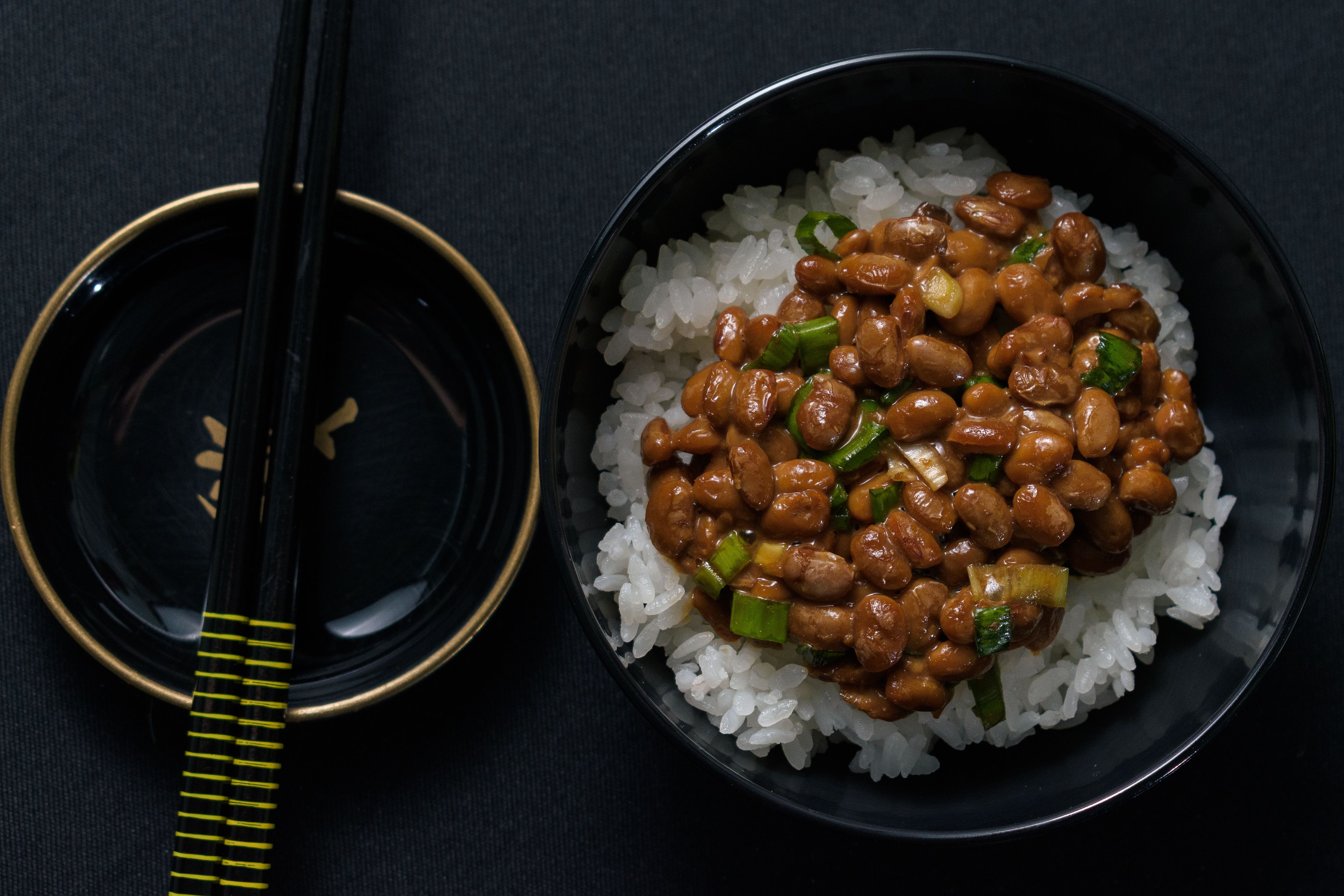
- Serve over 200 ml of warm (not hot) rice or in a bowl.
- Top with finely chopped scallion, optionally raw egg.
Classic patterns
Natto-don: rice + natto + egg + scallion.
Natto + avocado: the fat content aids MK-7 absorption.
Natto-tekkamaki: as a sushi accompaniment.
Smoothie (vegan B12 hack): banana + soy milk + 1 tbsp natto — unusual, but a B12 source.
Breakfast dip: natto + miso + sesame oil — vegetable dip.
Storage
Refrigerated 7–10 days (continues to ripen). Frozen for 3 months — thaw 24 hours in the refrigerator. Surface white tyrosine crystals are normal.
What not to do
Don't cook at ≥ 70 °C — nattokinase will be lost. Don't leave at room temperature beyond 2 hours. Don't combine with warfarin therapy IN ANY AMOUNT.
References
[1] Schurgers LJ et al. Vitamin K-containing dietary supplements: comparison of synthetic vitamin K1 and natto-derived menaquinone-7. Blood 2007;109(8):3279–3283.
[2] Sumi H et al. A novel fibrinolytic enzyme (nattokinase) in the vegetable cheese Natto. Experientia 1987;43(10):1110–1111.
[3] Kojima A et al. Natto intake and bone mineral density. Eur J Clin Nutr 2020.
[4] Ikeda Y et al. Intake of fermented soybeans, natto, is associated with reduced bone loss in postmenopausal women: Japanese Population-Based Osteoporosis Study. J Nutr 2006.
[5] Knapen MH et al. Three-year low-dose menaquinone-7 supplementation helps decrease bone loss in healthy postmenopausal women. Osteoporos Int 2013.
[6] Chen H et al. Nattokinase: a promising alternative in prevention and treatment of cardiovascular diseases. Biomark Insights 2018;13:1177271918785130.
[7] Ozawa Y et al. γ-PGA + GOS clinical trial — B. longum increase. J-STAGE 2020.
[8] EFSA. Menaquinone (K₂) safety assessment. EFSA Journal 2017.