


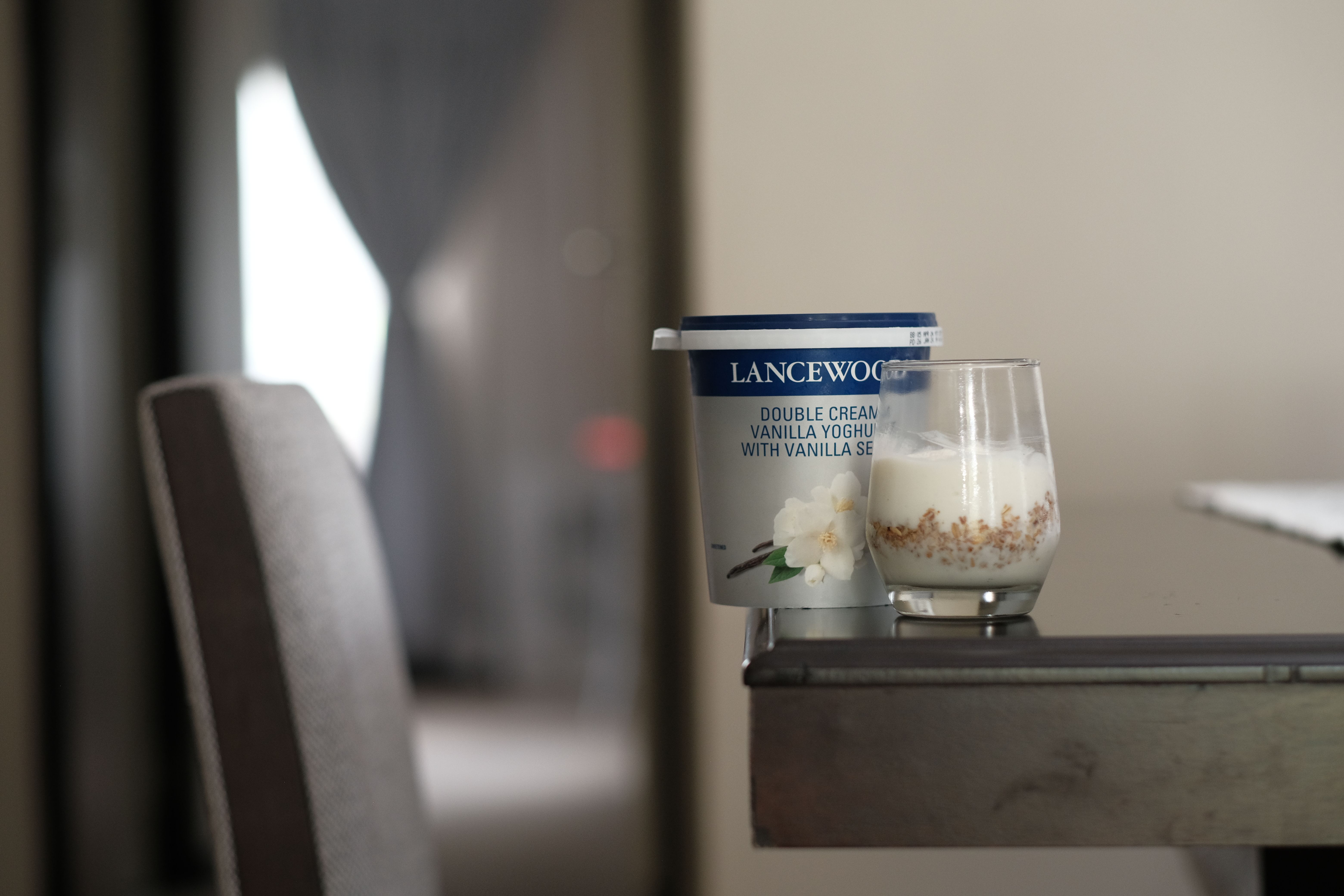
Yogurt (with live cultures)
The first EFSA-approved live microbe claim — Metchnikoff's Bulgarian shepherds, lactose, and modern Bifido RCTs.
In 1 minute
What does it provide? Live yogurt cultures (Streptococcus thermophilus + Lactobacillus bulgaricus — ≥ 10⁸ CFU/g per Codex), whose β-galactosidase enzyme supports digestion of milk sugar (lactose) — this is the world's first, and to this day the only, health claim accepted by EFSA for live microbes. High-biological-value protein (≈ 4 g/100 g plain, ≈ 10 g/100 g Greek), calcium (≈ 120 mg/100 g), and vitamin B12. "Probiotic" versions (BB-12, DN-173 010) shorten colonic transit time in RCTs.
How much? 150–250 g (1 cup) of plain, unsweetened, live-culture product daily. On the label: "live yogurt cultures" or "live active cultures" — NOT pasteurized/heat-treated.
When to avoid? Cow's milk protein allergy (strictly avoid — choose live-culture soy/plant yogurt); galactosemia (absolute contraindication); severe immunosuppression (chemo-induced neutropenia, post-organ-transplant period — Lactobacillus bacteremia is rare but reported); severe lactose intolerance (choose lactose-free or Greek/strained variants); histamine intolerance with aged versions; ≥ 2 hours separation from levothyroxine, tetracycline, ciprofloxacin, iron supplements (calcium chelation).
Yogurt and its relatives were born in the shepherd cultures of Central Asia and the Near East more than six thousand years ago: the Turkish word "yoğurt" ("to thicken") first appears in the 11th-century Dīwān Lughāt al-Turk dictionary by Māhmūd al-Kāshgharī and is based on the summer-milk preservation of Turkish and Balkan shepherds. Modern scientific "appearance on the scene" was defined by Nobel laureate Ilya Metchnikoff: in 1904, in his theory of aging, he pointed to the connection between the long lives of Bulgarian peasants and their consumption of sour-milk yogurt, and with that he made lactic acid bacteria one of the early symbols of "functional food" in the 20th century.
In 1905, the young Bulgarian doctor Stamen Grigorov isolated one of the key bacteria of yogurt in Geneva, later named Lactobacillus delbrueckii subsp. bulgaricus in honor of his homeland — this became the foundation of industrial production and research. In the 20th century, the standardization of starter cultures, the cold chain, and pasteurization made yogurt globally available, and today's definitions are set out by Codex Alimentarius and regional regulators. EFSA's official health claim states that live yogurt cultures improve lactose digestion — this is the world's first EFSA-accepted nutritional claim based on "live microbes."
🔬 Scientific Background
The definition of yogurt (Codex Alimentarius): symbiotic lactic-acid fermentation of milk by two strains — Streptococcus thermophilus and Lactobacillus delbrueckii subsp. bulgaricus. The two strains have a mutualistic relationship: Streptococcus produces amino acids that Lactobacillus uses; Lactobacillus provides peptides that Streptococcus uses. The endpoint is pH 4.2–4.6, where the milk proteins coagulate.
The EFSA claim (world first): Live yogurt cultures produce β-galactosidase enzyme, which improves lactose digestion in lactose-malabsorbing individuals. Condition: ≥ 10⁸ CFU/g live starter at the time of consumption. This is the world's first and to date only EFSA-accepted health claim for live microbes.
Heat-treated yogurt: Pasteurized (post-heat-treated) yogurt contains almost no live LAB — per Codex it is a separate category. Only a postbiotic effect is expected.
Probiotic supplementation: Many industrial yogurts contain additional strains, most often Bifidobacterium animalis subsp. lactis (BB-12, DN-173 010 = "Activia"). These bring a separate body of clinical evidence: - Colonic transit time shortening (DN-173 010 — Marteau RCT, Roy RCT). - Bowel parameter improvement. - Reduction of functional GI symptoms.
Microbiota RCTs: Thanks to the fermented-food portfolio (including yogurt) of the Wastyk 2021 Stanford study, microbiome diversity rose and 19 inflammatory signaling proteins decreased. Synbiotic yogurt (inulin + probiotic) produces Bifidobacterium elevation and a favorable SCFA profile.
Natural lactose reduction: During fermentation, most of the lactose (≈ 30–50%) is converted to lactic acid, which is why plain yogurt is tolerated by many lactose-intolerant individuals. Lactose-free yogurt can be part of a low-FODMAP pattern.
- + Inulin/FOS/GOS: synbiotic synergy — Bifidobacterium elevation.
- + Berries (raspberry, blueberry, strawberry): polyphenol + LAB = favorable microbiota substrate.
- + Oat β-glucan, whole-grain müesli: fiber + LAB combination.
- + Flaxseed, chia: fiber + omega-3 + LAB synergy.
- + With honey (small amount): classic, natural prebiotic oligosaccharides.
- + Turmeric, cinnamon (golden yogurt): polyphenol–gut-barrier synergy.
- Added-sugar / flavored yogurts: they worsen the metabolic profile — choose plain and flavor it yourself.
- Antibiotic course (right alongside): separate by ≥ 2 hours.
- Levothyroxine (T4): calcium interferes — separate by ≥ 4 hours.
- High-dose iron supplements: separate by ≥ 2 hours.
- Heating to high temperatures (≥ 80 °C): live LAB is destroyed.
- Tetracycline, ciprofloxacin: calcium chelation — separate by ≥ 2 hours.
- Cow's milk protein allergy: strictly avoid (choose a plant alternative, e.g., soy yogurt with live cultures).
- Severe lactose intolerance: choose lactose-free or Greek/strained yogurt (lower lactose).
- Severe immunosuppression (chemo neutropenia, post-transplant): Lactobacillus bacteremia is rare but reported — to be avoided.
- Galactosemia: strictly avoid.
- Histamine intolerance: some aged versions are problematic.
- Acute (viral) diarrhea: moderate — certain probiotic strains (LGG) may help.
- Infant < 6 months: to be avoided (infant feeding guidelines).
- Hashimoto's + iodine sensitivity: dietary amounts OK.
Daily serving
150–250 g (1 cup or 1 larger müesli bowl) daily.
Preparation pattern — homemade yogurt
- 1 liter whole milk scalded to 85 °C (denser texture).
- Cool to 42–45 °C.
- Add 2 tbsp live yogurt or starter culture.
- In a thermos or yogurt maker at 42 °C for 6–12 hours.
- Refrigerate.
Classic patterns
Müesli bowl: yogurt + rolled oats + berries + flaxseed + walnut.
Tzatziki: strained yogurt + cucumber + garlic + dill + olive oil.
Lassi: yogurt + water + cardamom + honey (sweet) or salt (savory).
Meat/fish marinade: yogurt + spices — enzymatic tenderizing.
Dressing: yogurt + Dijon + lemon + olive.
Storage
Refrigerated airtight for 7–14 days. Surface whey is normal.
What not to do
Don't boil (loss of live LAB). Don't leave at room temperature. Don't choose sweetened, flavored yogurt if microbiota is the goal.
References
[1] EFSA NDA Panel. Scientific opinion on the substantiation of health claims related to live yoghurt cultures and improved lactose digestion. EFSA Journal 2010;8(10):1763.
[2] Codex Alimentarius. Standard for Fermented Milks (CXS 243-2003, Rev. 2025).
[3] Wastyk HC et al. Gut-microbiota-targeted diets modulate human immune status. Cell 2021;184(16):4137–4153.
[4] Marteau P et al. Bifidobacterium animalis strain DN-173 010 shortens colonic transit time. Aliment Pharmacol Ther 2002.
[5] Hill C et al. ISAPP consensus on the term "probiotic". Nat Rev Gastroenterol Hepatol 2014;11(8):506–514.
[6] Sanders ME et al. Probiotics and prebiotics in intestinal health and disease. Nat Rev Gastroenterol Hepatol 2019;16(10):605–616.
[7] Mantzouridou FT, Paraskevopoulou A. Yogurt manufacture — chemistry & technology. Crit Rev Food Sci Nutr 2020.
[8] Metchnikoff E. The Prolongation of Life: Optimistic Studies. 1908.