


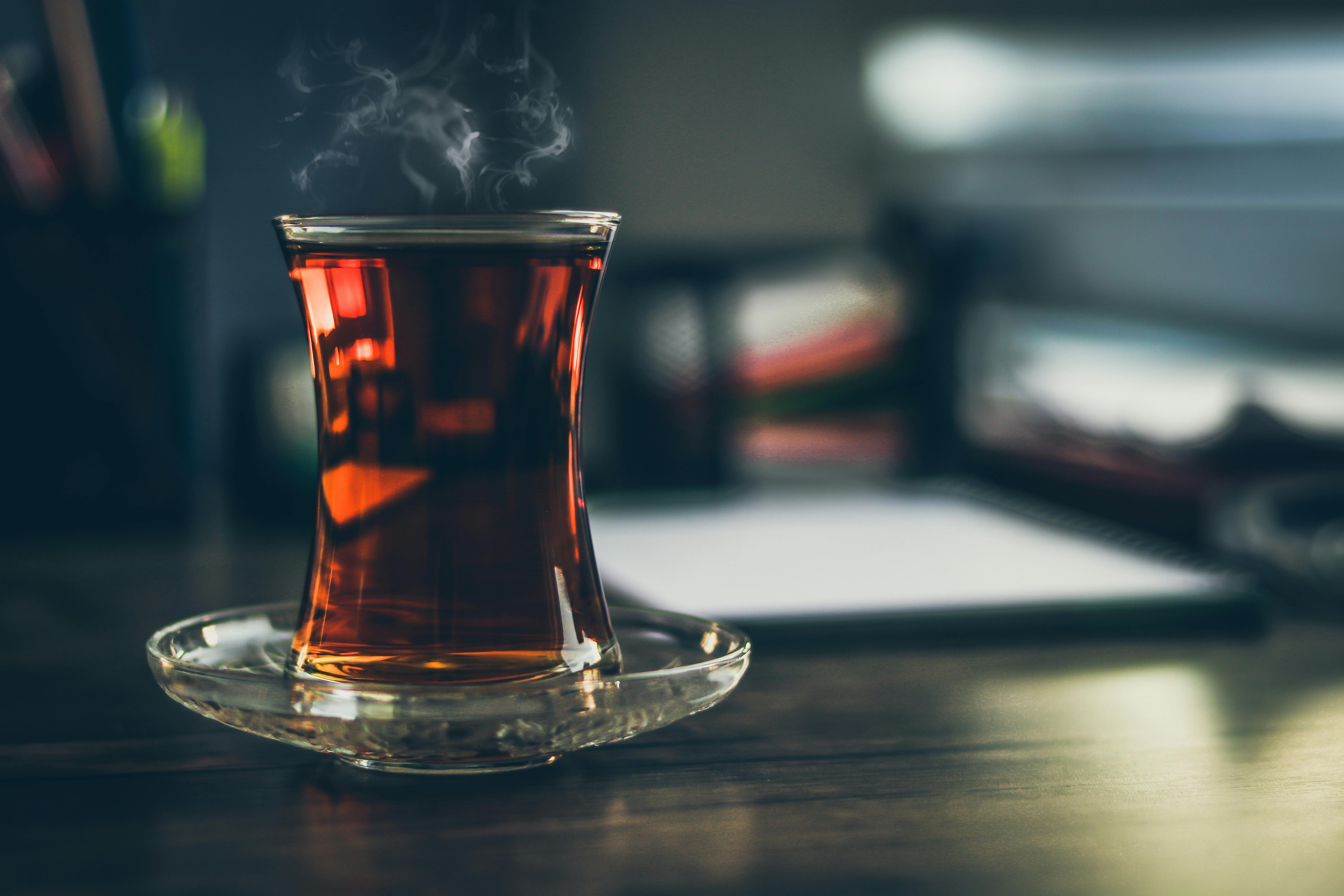
Black tea
Oxidation transforms the catechins — theaflavin and thearubigin polyphenol consortium, with a modern Prevotella-raising RCT.
In 1 minute
What does it provide? Theaflavins (the red-colored polyphenols of catechin oxidation, ≈ 5%) and thearubigins (larger brown polymers, ≈ 10–20%) — the colonic microbiome (Lactobacillus, Bifidobacterium, Eggerthella) breaks them down into phenolic metabolites. Caffeine ≈ 40–70 mg/cup. Mou 2018 RCT (n=72, 3 cups/day for 12 weeks): Prevotella proportion increase. Hartley/Liu meta-analyses: modest LDL and blood pressure reduction with 3+ cups/day.
How much? 1–3 cups (250–750 ml) daily, 3–5 min steeping (CTC 2–3, orthodox 4–5 min). Decaffeinated variant after 4 pm (polyphenols ≈ 80% preserved).
When to avoid? Iron-deficiency anemia under treatment (tannin chelates non-heme iron — separate by ≥ 1–2 hours from meals and iron tablets), pregnancy and lactation (max. 2 cups, caffeine < 200 mg/day), severe anxiety and insomnia (don't drink in the afternoon), active reflux disease and gastric ulcer flare (not on an empty stomach), oxalate kidney stone predisposition, severe cardiac arrhythmia, children under 6 (caffeine). Moderate with MAO inhibitor therapy.
The long-fermented variant of tea craft developed in early modern China — under the late Ming and early Qing dynasties — particularly around the Wuyi mountains of Fujian province, where the pine-smoked variant Lapsang Souchong was made for European tastes. Legend has it that the dark-oxidized tea was born by accident, when a Ming-era army occupied the tea factory of a Wuyi village, and the partially oxidized tea leaves found there could only be dried quickly with pinewood to still get to market — and as it happened, this was exactly what European demand wanted. In the 17th century, the Dutch East India Company and then British traders brought it to Europe, and in 1662 tea officially entered the British court as part of Queen Catherine of Braganza's Portuguese dowry — this is the origin of the "afternoon tea" tradition.
In the 19th century, the British colonial empire revolutionized black-tea production: in the 1820s the Scottish military officer Robert Bruce discovered the wild Assam tea variety in India, and from there began the huge plantation system of the subcontinent, later extended to Ceylon (Sri Lanka). The 20th century's great innovation was the CTC (crush-tear-curl) process, developed by Sir William McKercher in the 1930s in Assam: this small, "granule-like" tea form, with fast extraction, was an ideal shape for tea bags and the mass-consumer market. Today, black tea is one of the world's most consumed drinks, and the catechins of the fresh leaves are transformed during oxidation into theaflavins and thearubigins — these provide the characteristic reddish-brown color and the new focus of microbiome research.
🔬 Scientific Background
Black tea is NOT a fermentation in the strict sense — although it is traditionally called "fermented." It is actually enzymatic oxidation: the polyphenol oxidase enzymes of the fresh green leaf react with atmospheric oxygen and polymerize the catechins:
Theaflavins (TF): Smaller polymer (~ 5% of dry matter), orange-red color, "lively" in flavor.
Thearubigins: Larger polymer (~ 10–20% of dry matter), brownish color, "deep" in flavor.
Residual catechins: ~ 1–5% (vs. 30–40% in green tea).
The absorption of the polymerized polyphenols is even weaker than that of catechins — so the colonic microbial breakdown and the formation of phenolic metabolites even more strongly determine the clinical effect. The presence of Lactobacillus, Bifidobacterium, and Eggerthella species influences how much phenyl-γ-valerolactone and other phenolic catabolites form.
Clinical human evidence:
- Mou Q et al. 2018 (n=72, 12 weeks, 3 cups black tea/day): Randomized single-blind placebo-controlled RCT — significant Prevotella proportion increase, fecal acetic acid reduction. The effect was more pronounced in participants with low baseline SIgA. - Cardiometabolic: Several meta-analyses (Hartley 2013, Liu 2014) show modest LDL reduction and small BP moderation with 3+ cups/day. - Endothelial function: Acute and chronic human studies describe improvements in flow-mediated dilation (FMD). - Theaflavin-specific RCTs: Modest effects on lipid and inflammation markers.
Tannin + iron: Black tea also significantly chelates non-heme iron — time separation from iron supplements.
Caffeine: ≈ 40–70 mg/cup (≈ ⅔ of green tea or half of coffee).
- + Lemon: stabilizes polyphenols (vitamin C), classic British pattern.
- + With a meal (NOT on an empty stomach): reduces iron chelation.
- + Fiber-rich diet (inulin, β-glucan): broader microbiota substrate.
- + Morning / early-afternoon consumption: OK from a caffeine standpoint.
- + Polyphenol matrix (dark chocolate, berries): synergistic polyphenol intake.
- + Milk alternative (coconut milk, almond milk): if milk is a concern.
- Iron supplementation: time separation ≥ 1–2 hours.
- Milk + tea (debated): some studies suggest milk protein reduces polyphenol absorption — if polyphenol effect is the goal, little or no milk.
- MAO inhibitor therapy: caffeine interaction.
- Long boiling-temperature brewing: bitter (tannin over-extraction).
- Anticoagulant (warfarin) + large amounts of tea: theoretical — vitamin K is moderate.
- Diuretic + large amounts of tea: dehydration.
- Iron-deficiency anemia under treatment: moderate consumption, separate from iron supplements.
- Severe anxiety, insomnia: avoid after 4 pm.
- Pregnancy, lactation: max. 2 cups/day (caffeine < 200 mg/day).
- Active reflux disease, gastric ulcer flare: don't drink on an empty stomach.
- Kidney stones (oxalate-type): portion control (moderate oxalate).
- Severe kidney disease: moderate.
- Infant, young child < 6 years: to be avoided (caffeine).
- Severe cardiac arrhythmia: to be avoided in large amounts.
- CYP1A2 slow metabolizer (genetic): caffeine sensitivity, moderate.
Daily serving
1–3 cups (250–750 ml) daily. After 4 pm, choose a decaffeinated variant.
Preparation pattern — classic
- 2 g (≈ 1 bag or 1 tsp loose leaf) black tea.
- 200 ml water at 95–100 °C.
- 3–5 min steeping (CTC: 2–3 min; orthodox: 4–5 min).
- Strain. Lemon / honey to taste.
Classic patterns
English breakfast: robust blend, breakfast, classic with milk and sugar.
Earl Grey: bergamot-scented — afternoon classic.
Assam, Darjeeling, Ceylon: single-origin by region.
Lapsang Souchong: pine-smoked, Chinese classic.
Chai (Indian masala): black tea + milk + spices (cardamom, cinnamon, ginger, clove).
Cold brew iced tea: 5 g tea + 1 liter cold water + 8–12 hr in refrigerator → smooth, less bitter.
Storage
In an airtight, dark container at room temperature. Fresh black tea keeps for 1–2 years.
What not to do
Don't steep 7+ minutes (bitter). Don't drink right before/after iron intake. Don't combine with a high-dose EGCG supplement.
References
[1] Mou Q et al. Black tea polyphenols and gut microbiota — human RCT. Food Funct 2018.
[2] Hartley L et al. Green and black tea for the primary prevention of cardiovascular disease. Cochrane Database Syst Rev 2013.
[3] Liu G et al. Habitual tea consumption and risk of coronary heart disease — meta-analysis. Br J Nutr 2014.
[4] Lorenz M et al. Addition of milk prevents vascular protective effects of tea. Eur Heart J 2007.
[5] Khan N, Mukhtar H. Tea polyphenols in promotion of human health. Nutrients 2018;11(1):39.
[6] Kyle JA et al. Effects of infusion time and addition of milk on content and absorption of polyphenols from black tea. J Agric Food Chem 2007.
[7] Liu Z et al. Tea polyphenols and gut microbiota interactions. Crit Rev Food Sci Nutr 2022.
[8] Yan Z et al. Theaflavin in black tea and human health. Trends Food Sci Technol 2020.