


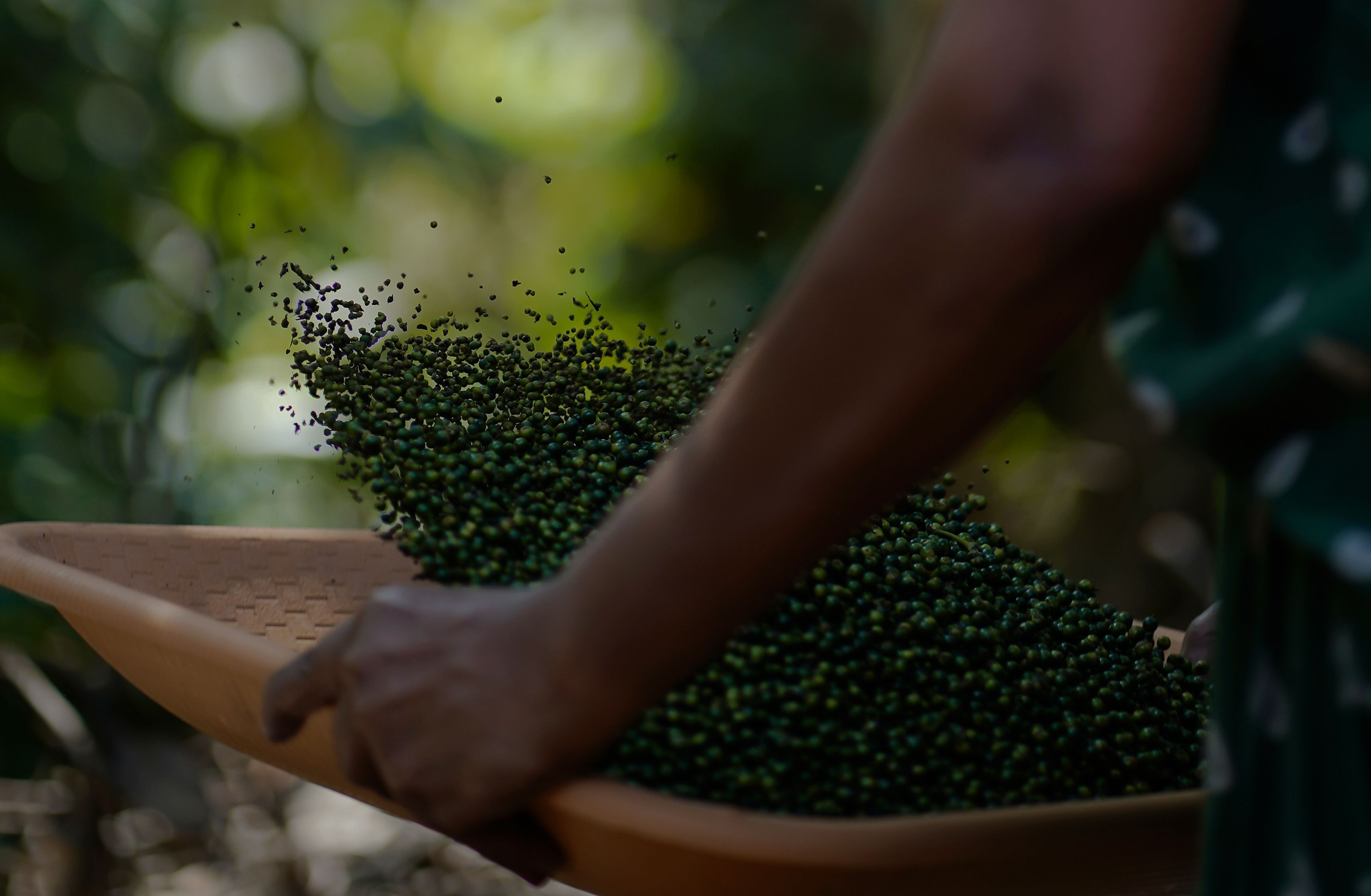
Black pepper
The king of spices — piperine, CYP3A4 inhibition, and 20× curcumin bioavailability.
In 1 minute
What does it provide? Piperine (1–9% of pepper), essential oil terpenes — with bioavailability-enhancing, thermogenic, antioxidant, and mild antimicrobial effects.
How much? In the kitchen, freshly ground black pepper is unlimited; per meal 1–2 pinches (≈ 0.3–1 g). For clinical purposes (curcumin bioavailability boost) 5–20 mg of standardized piperine (BioPerine).
When to avoid? With CYP3A4 substrate medications (statin, tacrolimus, cyclosporine) when alongside high-dose supplementation, in active gastric ulcer flare, in GERD irritation.
Black pepper is the "king of spices" — already around 2000 BCE, Malabar Coast merchants delivered it to Persian, Egyptian, and Roman ports. Peppercorns were placed in the nostrils of Pharaoh Ramses II's mummy as preservative (1213 BCE). In the Roman Empire, pepper was a status symbol — Pliny complained that "paying for Indian pepper costs 50 million sestertii annually"; the Visigoth king Alaric, besieging Rome in 410 CE, demanded 3,000 pounds of pepper as ransom. In medieval Europe, pepper became "money by the grain" — the origin of the London stock exchange's "peppercorn rent" expression.
The 16th-century Portuguese conquest opened the Malabar Coast monopoly — Vasco da Gama landed at Calicut in 1498, and control over the pepper route became the basis of the Portuguese, then Dutch, colonial empire. The active component, piperine, was isolated by Hans Christian Ørsted in 1819 — interestingly, the same scientist who also discovered electromagnetism. The pharmacological significance of piperine became globally known with Shoba's 1998 human study: 20 mg of piperine taken with 2000 mg of curcumin increased curcumin bioavailability by approximately 2000% — this revolutionized phytotherapy and the industry of piperine combination preparations. However, piperine's CYP3A4 and P-glycoprotein inhibition is a drug-interaction risk: in the clinical context, this cannot be ignored. (Planta Medica, EMA)
🔬 Scientific Background
Piperine (1-piperoyl-piperidine) is the alkaloid responsible for the "pungency" of black pepper — it activates the TRPV1 receptor, similarly to capsaicin, but more weakly. Its main pharmacological significance is metabolic inhibition: piperine simultaneously inhibits CYP3A4 (the most important drug-metabolizing enzyme in the liver), UGT (glucuronidation), and P-glycoprotein (efflux pump). This explains why the plasma levels of coadministered drugs and bioactives can dramatically increase.
In the classic Shoba 1998 human crossover study, 20 mg of piperine increased the bioavailability of 2000 mg of curcumin by about 20-fold (~2000%), which has since been the cornerstone of phytotherapeutic formulations. Similar bioavailability-enhancing effects have been confirmed for resveratrol, coenzyme Q10, and certain B vitamins.
At the microbiome level, piperine in vitro and in animal experiments showed relative enrichment of Akkermansia muciniphila, as well as improvement in the expression of TJ (tight junction) proteins (occludin, ZO-1) — i.e., a gut-barrier-supporting effect. Human data are more limited but promising in metabolic syndrome.
Its thermogenic effect is moderate: ~50 mg piperine postprandially increases energy expenditure by 5–7% — clinically small but measurable.
The essential oil of black pepper (β-caryophyllene, limonene, pinene) has weak antimicrobial activity, mainly explaining storage stability and traditional preservation.
- + Turmeric: classic synergy (Shoba 1998) — a pinch of pepper with curcumin. In the kitchen, every day.
- + Green leafy vegetables (iron, magnesium): piperine also improves mineral absorption.
- + B-vitamin complex (meal or supplement): bioavailability increase.
- + Hot food, end of simmering: piperine is thermolabile — add at the end of cooking.
- + With fat (olive, ghee, butter): piperine is fat-soluble, bioavailability increases.
- + Polyphenol-rich diet (green tea, cacao, berries): piperine synergistically increases flavonoid absorption.
- CYP3A4 substrate drugs + high-dose piperine supplement: statins (atorvastatin, simvastatin), calcium-channel blockers (amlodipine), immunosuppressants (tacrolimus, cyclosporine), some antiretrovirals — drug level elevation.
- Anticoagulants + high dose (clinical supplement): theoretical additive risk.
- Thyroid hormone (levothyroxine) ± black pepper alone acceptable, but with high-dose piperine supplement: bioavailability disturbance.
- Hepatotoxic medications + high-dose piperine: theoretical additive hepatic stress.
- High amount on empty stomach: GI irritation, in reflux-prone individuals.
- For infants, small children, to provoke sneezing: respiratory irritation — not a toy.
- Active gastric ulcer, reflux disease flare: piperine irritates the gastric mucosa via TRPV1.
- Hemorrhoid flare, anal fissure: spicy seasonings may worsen.
- Migraine trigger predisposition: rare but documented spice trigger.
- Planned surgery within 2 weeks + high-dose supplement: stop.
- Severe liver disease: piperine metabolism is delayed, sensitivity to side effects.
- Severe GERD, Barrett's esophagus: to be avoided.
- Infant < 1 year: avoid concentrated doses.
- Piperaceae allergy: rare.
Daily serving
Freshly ground black pepper per meal ½–1 pinch (≈ 0.3–0.5 g), boldly a recurring element of the diet.
Preparation pattern
- Store whole peppercorns in a dark glass jar.
- Use a pepper mill — add freshly ground to the finished dish.
- Add at the end of high-temperature, long cooking — preserves essential oil.
- Mixed-pepper blend (black + white + pink + green) — interesting flavor profile, but watch for allergy.
Classic patterns
Golden milk turmeric + pepper: ½ tsp turmeric + ¼ tsp freshly ground pepper + warm milk + ghee.
Cacio e pepe: spaghetti + Pecorino Romano + plenty of freshly ground pepper + cooking water.
Steak au poivre: coarsely crushed black pepper crust, seared in butter.
Indian chai: black tea + milk + cardamom + cinnamon + ginger + pepper + sugar — classic breakfast tea.
Storage and what to avoid
Storage: whole peppercorns 2–3 years airtight, in a dark place; ground 6 months, then piperine loss.
What not to do: don't cook for a long time at high heat (piperine degrades), don't arbitrarily combine 20+ mg piperine supplement with tacrolimus/cyclosporine, don't confuse with pink pepper for pistachio-allergic.
References
[1] Shoba G et al. Influence of piperine on the pharmacokinetics of curcumin in animals and human volunteers. Planta Medica 1998;64(4):353–356.
[2] Srinivasan K. Black pepper and its pungent principle piperine: a review of diverse physiological effects. Crit Rev Food Sci Nutr 2007;47(8):735–748.
[3] Bhardwaj RK et al. Piperine, a major constituent of black pepper, inhibits human P-glycoprotein and CYP3A4. J Pharmacol Exp Ther 2002;302(2):645–650.
[4] Atal CK et al. Biochemical basis of enhanced drug bioavailability by piperine: target organs and drug-metabolizing enzymes. J Pharmacol Exp Ther 1985;232(1):258–262.
[5] Damanhouri ZA et al. A review on therapeutic potential of Piper nigrum. Med Aromat Plants 2014;3:161.
[6] Wang Y et al. Piperine and gut microbiota — metabolic regulation in obesity model. Food Funct 2020.
[7] EMA/HMPC. Piperine — herbal substance overview.