


Injera
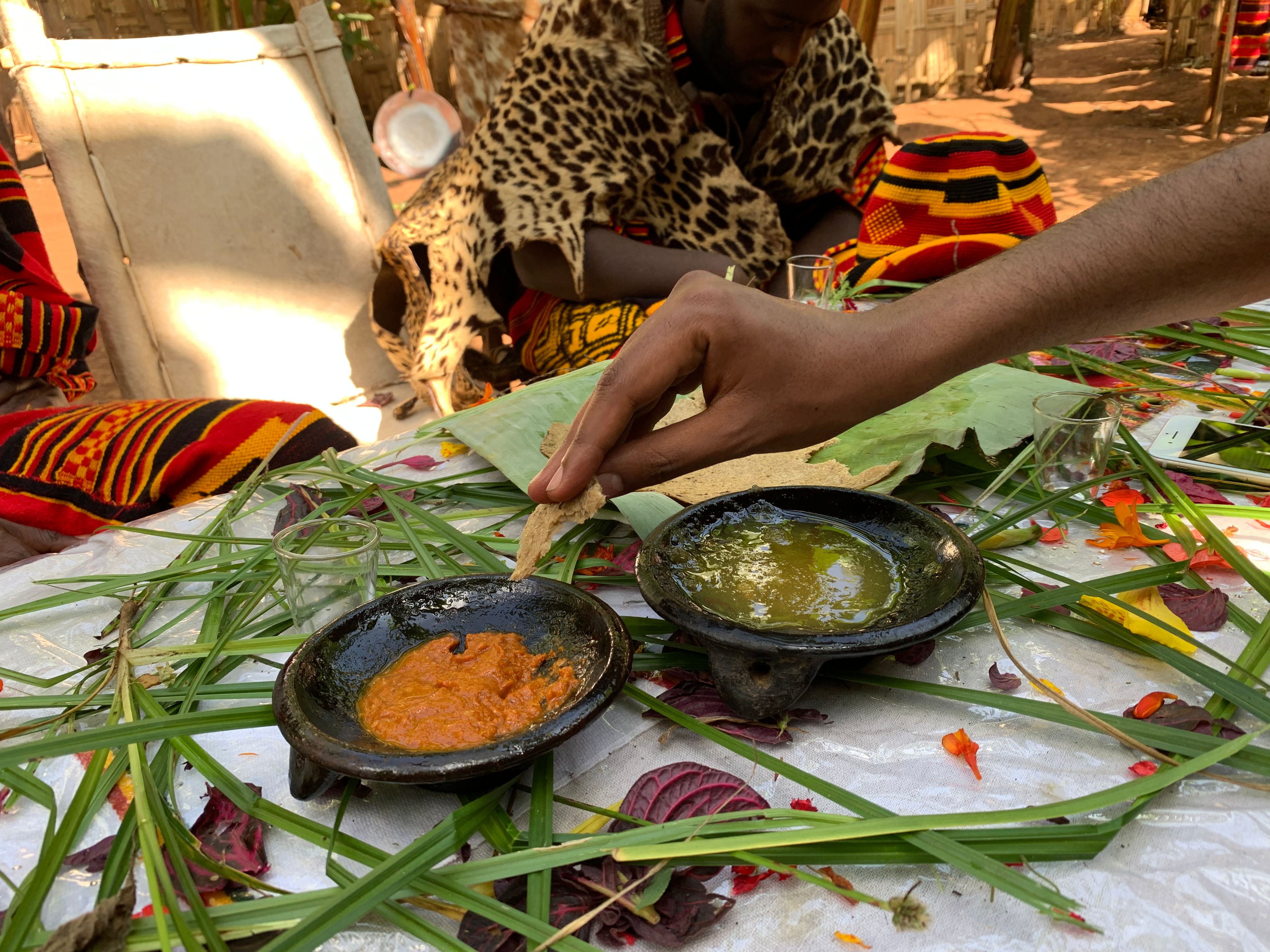
Ethiopia's spongy bread — teff fermentation with live lactic acid bacteria, high iron content and reduced phytate, the ancient foundation of Ethiopian cuisine.
- Latin név
- Eragrostis tef (teff) + spontaneous Lactobacillus + Candida + Saccharomyces
- FODMAP
- 🟡 moderate (fermentation-mediated)
- Evidence
- ★ ★ (Ethiopian population data + small pilots)
- Microbiota
- Live LAB + postbiotic matrix, iron bioavailability enhancement
- What does it provide?
- Ethiopian teff ferment (the world's smallest grain, a true "pseudo-grain" — gluten-free and genetically distinct from wheat) with the classic "ersho" starter (3–5 day unpasteurized injera liquid) fermented for 24–72 hours. The ferment contains live lactic acid bacteria (Lactobacillus pontis, L. plantarum) and wild yeast (Candida milleri, Saccharomyces); the end result is injera, a porous, slightly sour-fermented, sponge-like flatbread. The ferment reduces phytate content (40–50%), so teff's naturally high iron content (≈ 7.6 mg/100 g) becomes more bioavailable. Riboflavin (B2) and small B12 analogs are also produced during fermentation.
- How much?
- 1–2 injera (≈ 100–200 g) per meal — as side to wat (curry) and atkilt (vegetable curry).
- When to avoid?
- Teff sensitivity (extremely rare); severe IBS flare; in celiac disease only GMP-grade teff injera (contamination risk — in Ethiopian restaurants it is often made in a shared kitchen with wheat bread); severe histamine intolerance.
Injera is Ethiopia's national bread — teff (Eragrostis tef) was domesticated in the Ethiopian highlands three thousand years ago and remains one of the world's most nutrient-rich and gluten-free grains. In the ancient Ethiopian Aksum Empire (100 BCE — 940 CE), teff was a central actor in grain production; Coptic Christian monks and Muslim communities used it too. The "ersho" (3–5 day unpasteurized injera liquid) tradition was passed from mother to daughter — starter-culture transmission within the family for centuries ensured a stable microbiome matrix.
Modern scientific discovery came in the 21st century: the Ethiopian population has the lowest osteoporosis rate in Africa thanks to teff-based diet (Hailu 2006) — high iron + calcium content + ferment-mediated better bioavailability. In the 2020s teff entered the "superfood" market: gluten-free alternative, micronutrient-rich. Clinical microbiome research (Ashenafi 2006, Marco 2017) investigates the ferment LAB and yeast symbiosis — injera is one of the classic representatives of African ferment tradition.
🔬 Scientific Background
Teff (Eragrostis tef) is a gluten-free pseudo-grain with high nutrient density: iron 7.6 mg/100 g (vs. wheat 3.2), calcium 180 mg/100 g (vs. wheat 33), magnesium 184 mg/100 g, B-vitamin matrix. High iron content may partly come from processing contamination (iron pots), but the plant iron (non-heme) is also substantial.
Injera fermentation is spontaneous microbiome succession: 1. Soaking-pasting: teff flour + water, paste. 2. Ersho starter addition: 3–5 day unpasteurized injera liquid (≈ 1–2 tbsp/cup paste). 3. Fermentation (24–72 hours): succession of Lactobacillus pontis, L. plantarum, L. brevis and wild yeasts (Candida milleri, Saccharomyces cerevisiae). pH drops from 6.2 to 3.5–4.0, with CO₂ formation (porous texture). 4. Baking: on hot clay or iron platter ("mitad"), 100–120 °C, 2–3 minutes — baked on one side.
Phytate reduction: 24–72 hour fermentation reduces phytic acid content by 40–50% (LAB phytase). Result: iron, zinc, calcium bioavailability rises 30–60% — critical for micronutrient supply in the vegetarian-dominant Ethiopian diet.
B-vitamin synthesis: Ashenafi (2006) reports that injera ferment produces riboflavin (B2) and small amounts of B12 analogs. Ethiopian vegetarians' B12 levels are often borderline — injera contributes but does not fully replace.
Glycemia: teff GI ≈ 57 (low-medium) — slow absorption due to fermentation and high fiber content. Forsido (2013) Ethiopian study showed favorable effects in diabetic populations.
Microbiome RCT: small Ethiopian pilots (Mengiste 2018) showed Bifidobacterium and Lactobacillus elevation with injera consumption. The 2017 Marco review discusses injera as a classic representative of African postbiotic + live LAB.
Celiac disease: teff is genuinely gluten-free, safe for celiac patients — BUT: Ethiopian restaurants often combine it with wheat injera (cost reasons), and cross-contamination is common. Only certified gluten-free injera should be consumed in celiac disease.
- + Doro wat (spicy chicken curry): classic Ethiopian, high iron + protein.
- + Misir wat (red lentil curry): vegetarian, high fiber + iron + phytate reduction.
- + Atkilt (vegetable curry: potato, carrot, cabbage): classic side.
- + Shiro (chickpea or lentil paste): high plant protein.
- + Berbere spice blend: complex polyphenol + capsaicin.
- + Fresh salad (tomato + cucumber + lime): vitamin C aids iron absorption.
- High-dose calcium supplement at the same meal: suppresses iron absorption.
- High-dose iron supplement + residual phytate: chelation effect reduces absorption.
- Milk, yogurt in large amounts right after injera: calcium-iron competition.
- Coffee, tea (tannin) at the same meal: reduces iron absorption.
- Combined with high-histamine foods: in histamine sensitivity.
- Wheat-containing "combined" injera: for celiac patient.
- Celiac disease: only certified gluten-free injera (contamination risk).
- Active IBS flare: slowly, small portions.
- Severe histamine intolerance: aged ferment may contain biogenic amines.
- Hemochromatosis: high iron content should be avoided.
- Iron metabolism disorders (thalassemia): moderate.
- Severe zinc deficiency: ferment reduces phytate, so positive.
- Infant < 1 year: avoid (infant feeding).
- Diabetic carb counting: 1 injera ≈ 30–40 g carbs.
- SIBO flare: small portions, ferment-mediated bloating possible.
- Chronic kidney disease (CKD 4–5): monitor due to high phosphorus content.
"Injera is so iron-rich it replaces iron supplementation." Overstated. Teff is indeed high in iron (7.6 mg/100 g), and fermentation reduces phytate — BUT non-heme plant iron absorption is 5–10% (vs. heme iron 15–35%). 200 g injera ≈ 15 mg iron, of which ≈ 1.5 mg is absorbed. In iron deficiency this does not replace a supplement.
"Injera = gluten-free in all cases." Partly a myth. Pure teff injera is gluten-free, BUT: Ethiopian diaspora restaurants often combine it with wheat flour (cost). Cross-contamination is common. Celiac patients should only have certified gluten-free injera.
"Ersho starter is a super-power probiotic." Overstated. Ersho ferment contains live LAB, but at strain and CFU level it is not standardized — "fermented food," not a clinical probiotic.
"Injera is 100% Ethiopian tradition — other teff is only imitation." Overstated. Teff was domesticated in Ethiopia/Eritrea, but is now also grown in the Netherlands, USA, Australia. The "real" injera experience is with ersho and the classic "mitad" platter, but teff flour works elsewhere too.
"Teff has a low glycemic index, so diabetics can eat it without limit." Overstated. GI ≈ 57 (low-medium), BUT 1 injera ≈ 30–40 g carbs — must be counted in carbohydrate management.
"Injera ferment is a 'cleansing' / 'detox' food." False. The ferment improves nutrient bioavailability, but "cleansing" / "detox" is a popular concept — biological basis is weak.
"Fresh injera and 2–3 day injera are the same." Partly a myth. 2–3 day aged injera (Ethiopian restaurant practice) is slightly more acidic, higher in histamine — may cause symptoms in histamine-sensitive individuals.
🍳 Kitchen Protocol
Daily serving: 1–2 injera (≈ 100–200 g) per meal.
Preparation pattern — homemade injera: 1. 2 cups teff flour + 3 cups water + 2 tbsp "ersho" (previous injera liquid) or 1 tbsp wild-yeast-LAB starter. 2. Mix to smooth paste. 3. Fermentation: 24–72 hours at room temperature (25–28 °C optimal). Volume ≈ 1.5x, porous surface, slightly sour-fermented aroma. 4. Baking: on hot "mitad" (clay/cast iron) platter at medium heat. Thin paste layer, 2–3 minutes — baked on one side.
Classic patterns:
Doro wat: chicken + berbere + injera as side.
Misir wat: red lentil curry, vegetarian, iron-rich.
Atkilt: potato + carrot + cabbage curry (gomenSenese variation).
Shiro: chickpea paste + berbere — high plant protein.
Tibs: roasted meat cubes + scallion + injera.
Storage: injera fresh-made (1–2 days max in refrigerator). Ersho starter can be refreshed for weeks in the refrigerator (weekly "feeding" with fresh paste).
What not to do: don't bake on both sides (one side only, so porous side stays up). Don't bake too hot (burnt). Don't leave starter for weeks without feeding (it dies).
📚 References (selected)
1. Ashenafi M. A review on the microbiology of indigenous fermented foods and beverages of Ethiopia. Ethiop J Biol Sci 2006;5(2):189–245. 2. Hailu D et al. Bone mineral density of Ethiopian teff consumers. Int J Vitam Nutr Res 2006. 3. Forsido SF et al. Teff (Eragrostis tef) consumption and glycemic response. Eur J Clin Nutr 2013. 4. Marco ML et al. Health benefits of fermented foods: microbiota and beyond. Curr Opin Biotechnol 2017;44:94–102. 5. Mengiste B et al. Nutrient and microbiome effects of teff-based diets. Front Nutr 2018. 6. Tamang JP et al. Functional properties of microorganisms in fermented foods. Front Microbiol 2016;7:578. 7. Saturni L et al. The gluten-free diet: safety and nutritional quality. Nutrients 2010;2(1):16–34. 8. Baye K et al. Phytate, zinc, iron and calcium content of selected raw and prepared foods consumed in rural Ethiopia. J Food Compos Anal 2014;33(2):163–172.