


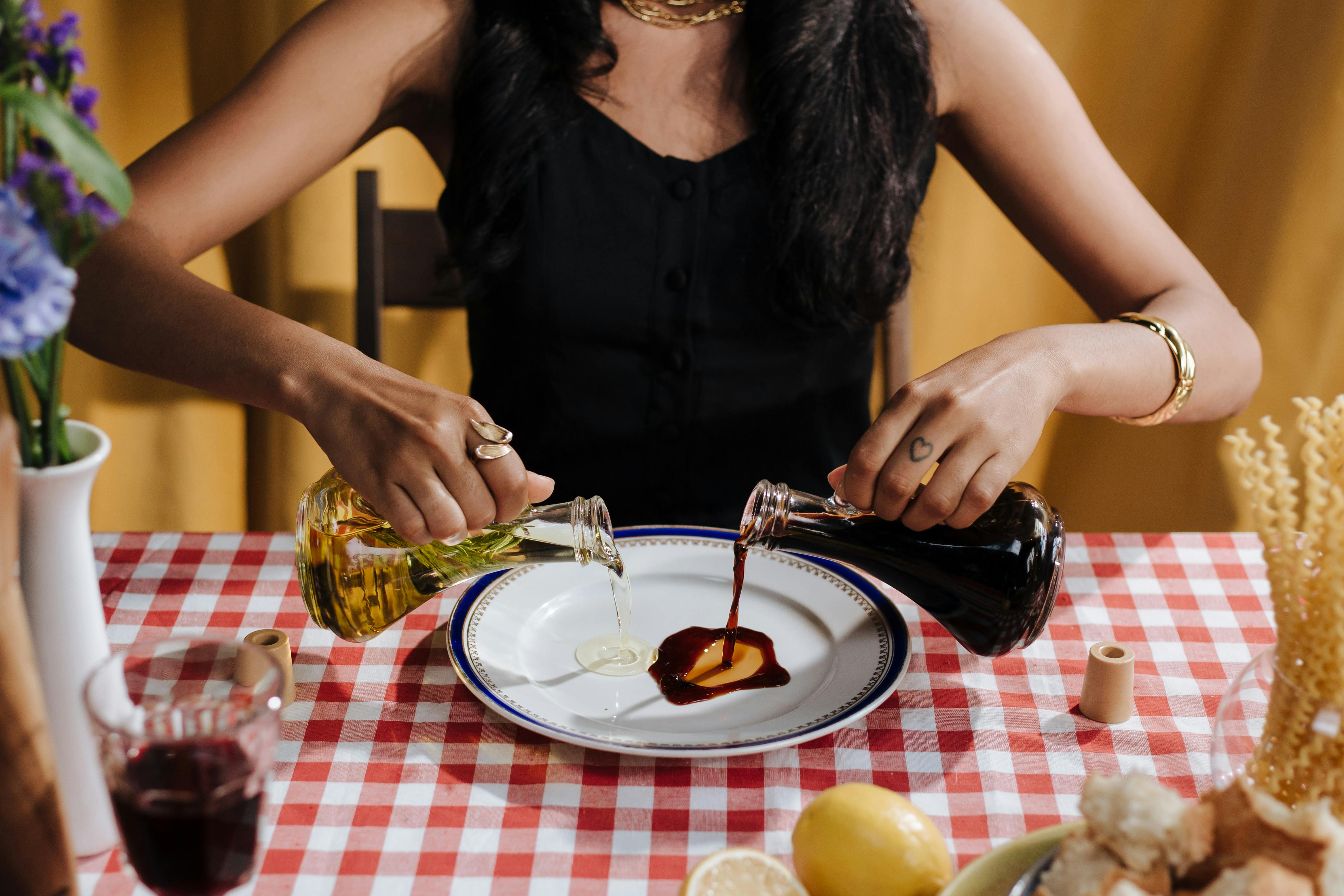
Wine vinegar
A polyphenol-rich vinegar — anthocyanin, resveratrol and gallate matrix from grape skin, the scientific backbone of
Wine vinegar in 1 minute
What does it provide? Acetic acid (5–7%) — direct acetate-SCFA, bypassing the colonic fermentation step and feeding butyrate-producing bacteria (Faecalibacterium prausnitzii, Roseburia). Polyphenols from grape skin: gallic acid, anthocyanin (in red-wine vinegar), resveratrol, catechins, quercetin. Tartaric acid — the grape-specific organic acid. The flavor is deeper and more complex than apple cider vinegar; the higher polyphenol content gives a greater antioxidant capacity.
How much? 1–2 tablespoons (≈ 15–30 ml) in salad dressing or food at meals — practically unlimited. For glycemic control: 5–10 minutes before a meal, 1 tbsp diluted in water. Red-wine vinegar > white-wine vinegar in polyphenol content.
When to avoid? Active GERD flare, erosive esophagitis, gastric ulcer (acid irritation); sulfite sensitivity (wine vinegar may contain residual SO₂ — check the label); MAO inhibitor therapy (tyramine in aged versions); undiluted consumption causes tooth-enamel erosion; ≥ 2 hours separation from iron supplements (polyphenols chelate iron).
Wine vinegar is the proto-form of vinegar — it appears automatically alongside every wine culture, because Acetobacter bacteria entering the wine oxidize the alcohol into acetic acid. It already appears in Sumerian cuneiform tablets of ancient Mesopotamia (3000 BCE); it was a fundamental seasoning and preservative in Greek and Roman cuisine. Posca, the daily drink of Roman legionnaires, was water diluted with wine vinegar — hydrating, antimicrobial, and energy-providing.
Hippocrates (400 BCE) prescribed it for cleaning wounds, for cough (in oxymel form with honey), and for digestive disorders. The medieval European kitchens' "aceto" (Italian), "vinaigre" (French), and "vinegar" (English) all derive from the meaning "sour wine" ("vin aigre"). Modena balsamic vinegar has been a fixed gastronomic specialty since the 11th century, with a long aging protocol in multiple woods (oak, chestnut, cherry, mulberry, locust). 21st-century clinical research quickly extended the glucose-lowering effects of vinegar after Johnston 2004 (apple cider vinegar) to wine vinegar — the polyphenol content adds value beyond the pure acetic acid effect.
Scientific Background
Wine vinegar is the result of two-step fermentation: Saccharomyces cerevisiae yeast converts grape sugars to alcohol, then Acetobacter genus members (A. aceti, Komagataeibacter europaeus) oxidize the alcohol to acetic acid. The end product contains 5–7% acetic acid, a small residue of ethanol, tartaric acid, minerals, and — from grape skin — polyphenols.
The polyphenol matrix is the unique value of wine vinegar: red-wine vinegar contains anthocyanins (malvidin-3-O-glucoside dominant), resveratrol (stilbene class — anti-inflammatory for blood vessels), gallic acid, catechins, quercetin, and condensed tannins. According to Liu et al. (2019 Antioxidants), the polyphenol content and antioxidant capacity of long-aged red-wine and balsamic vinegars are substantially higher than those of white-wine vinegar or other light vinegars.
Clinical evidence for the glucose-lowering effect extrapolates from the Johnston vinegar protocol (see VIII.10 apple cider vinegar); Sakakibara 2010 was a small human pilot examining postprandial endothelial effects of vinegar, and Shishehbor 2017 — a meta-analysis (pooling 11 trials) — confirmed that vinegar in general (including wine vinegar) significantly attenuates postprandial glucose and insulin responses. The polyphenol content additionally improves endothelial function (flow-mediated dilation) and reduces LDL oxidation — similar to grape-seed proanthocyanidins.
At the microbiome level, acetate provides direct energy substrate for butyrate-producing bacteria (cross-feeding). The polyphenols (anthocyanin, resveratrol) act prebiotically by elevating Bifidobacterium and Akkermansia muciniphila levels and lowering the Firmicutes/Bacteroidetes ratio. Marco et al. (2017 Curr Opin Biotechnol) comprehensive review covers the microbiome effects of fermented foods — wine vinegar belongs in the postbiotic + polyphenol category.
Modena balsamic vinegar (Aceto Balsamico Tradizionale di Modena DOP) is a special category: aged at least 12 years, even 25–50 years — more concentrated, sweeter (due to sugar content), with higher melanoidin content (Maillard products). Its antioxidant capacity is extremely high (ORAC > 8000 µmol TE/100 g).
- + Extra virgin olive oil in salad dressing: classic Mediterranean, polyphenol synergy; fat aids absorption of fat-soluble polyphenols (resveratrol).
- + High-carbohydrate meal (bread, pasta, rice): 5–10 minutes before the meal, 1 tbsp diluted in water — reduces postprandial glucose peak by 20–30%.
- + Roasted/grilled meat or fish: acidic matrix reduces HCA formation, adds flavor complexity, supports digestion.
- + Fresh berries (strawberry, raspberry) + balsamic vinegar + basil: classic Italian, a polyphenol bomb.
- + Caprese salad (tomato, mozzarella, basil + balsamic vinegar): classic lycopene + polyphenol + LAB.
- + Slow-braised vegetables, mushrooms: reduced wine vinegar as a flavor-concentrating sauce base.
- Undiluted, directly on teeth: chronic tooth enamel erosion — always with food or diluted.
- Large doses on an empty stomach (> 2 tbsp): esophageal irritation, reflux flare, nausea.
- Iron supplements: polyphenols chelate non-heme iron — separate by ≥ 2 hours.
- MAO inhibitor therapy (phenelzine, tranylcypromine): aged wine vinegar may contain tyramine — avoid.
- Sulfite sensitivity (asthma + sulfite hypersensitivity): wine vinegar may contain residual SO₂ (≤ 100 mg/l) — check the label.
- Strong antioxidant supplementation (high-dose vitamin C, NAC) + chronic high-dose polyphenol vinegar: effects duplicate, small risk.
- Active GERD flare, erosive esophagitis, gastric ulcer: acid irritation — wait for remission.
- Gastroparesis (diabetic autonomic neuropathy): vinegar further slows gastric emptying.
- Eosinophilic esophagitis, esophageal stricture, achalasia: avoid.
- Severe hypokalemia or predisposition (chronic diuretic): chronic extreme dose (> 4 tbsp/day for years) is a theoretical risk.
- Thin tooth enamel, erosive caries: with a straw, then rinse.
- Sulfite-sensitive asthma: choose a low-sulfite or "solfiti < X mg/l" labeled product.
- Migraine with tyramine trigger: aged versions should be avoided.
- Severe kidney disease: individual consideration for potassium matrix.
- Histamine intolerance: aged wine vinegar may contain biogenic amines.
- Insulin or sulfonylurea therapy: glucose monitoring (additive hypoglycemia).
Daily serving: 1–2 tbsp (15–30 ml) in salad dressing or food daily without limit. Glycemic target: 5–10 minutes before a meal, 1 tbsp diluted in water.
Preparation patterns:
- Classic vinaigrette: 3 tbsp extra virgin olive oil + 1 tbsp red-wine vinegar + 1 tsp Dijon mustard + salt, pepper + ½ garlic clove. Over salad, steamed vegetables.
- Caprese salad: tomato + mozzarella + fresh basil + olive + a drop of balsamic.
- Strawberry-balsamic dessert: fresh strawberries + 1 tsp aged balsamic + black pepper + basil — surprising Italian classic.
- Reduction (concentrated sauce): 100 ml wine vinegar + 2 tbsp honey/sugar slowly simmered to 1/3 — thick sweet-sour sauce for meat, cheese.
- Meat marinade: red-wine vinegar + olive oil + spices + crushed garlic — acidic matrix tenderizes meat.
- Posca (Roman tradition): 1 tbsp red-wine vinegar + 250 ml water + clove/mint — hydrating summer drink.
Storage: in a dark, cool place. Years after opening (self-preserving due to acidity). Glass, NOT metal (acidic).
Tooth and esophageal protection: see VIII.10 apple cider vinegar. Dilute, use a straw, rinse with water after.
What not to do: don't drink undiluted. Don't store in metal cans. Don't cook too long at high heat (polyphenols degrade — add at serving for polyphenol effect).
References
[1] Liu Q, Tang GY, Zhao CN, Gan RY, Li HB. Antioxidant activities, phenolic profiles, and organic acid contents of fruit vinegars. Antioxidants 2019;8(4):78. Link
[2] Sakakibara S et al. Vinegar intake enhances flow-mediated vasodilatation. Biosci Biotechnol Biochem 2010;74(5):1055–1061. Link
[3] Shishehbor F, Mansoori A, Shirani F. Vinegar consumption can attenuate postprandial glucose and insulin responses; a systematic review and meta-analysis of clinical trials. Diabetes Res Clin Pract 2017;127:1–9. Link
[4] Shishehbor F et al. Apple cider vinegar attenuates lipid profile in normal and diabetic rats (an animal study). Pak J Biol Sci 2008;11(23):2634–2638. Link
[5] Marco ML et al. Health benefits of fermented foods: microbiota and beyond. Curr Opin Biotechnol 2017;44:94–102. Link
[6] Petsiou EI et al. Effect and mechanisms of action of vinegar on glucose metabolism, lipid profile, and body weight. Nutr Rev 2014;72(10):651–661. Link
[7] Ho CW et al. Varieties, production, composition and health benefits of vinegars: a review. Food Chem 2017;221:1621–1630. Link
[8] Johnston CS et al. Vinegar improves insulin sensitivity to a high-carbohydrate meal in subjects with insulin resistance or type 2 diabetes. Diabetes Care 2004;27(1):281–282. Link
[9] Tagliazucchi D et al. Antioxidant properties of traditional balsamic vinegar and influence of in vitro digestion. Food Chem 2007;103(4):1419–1426. Link