
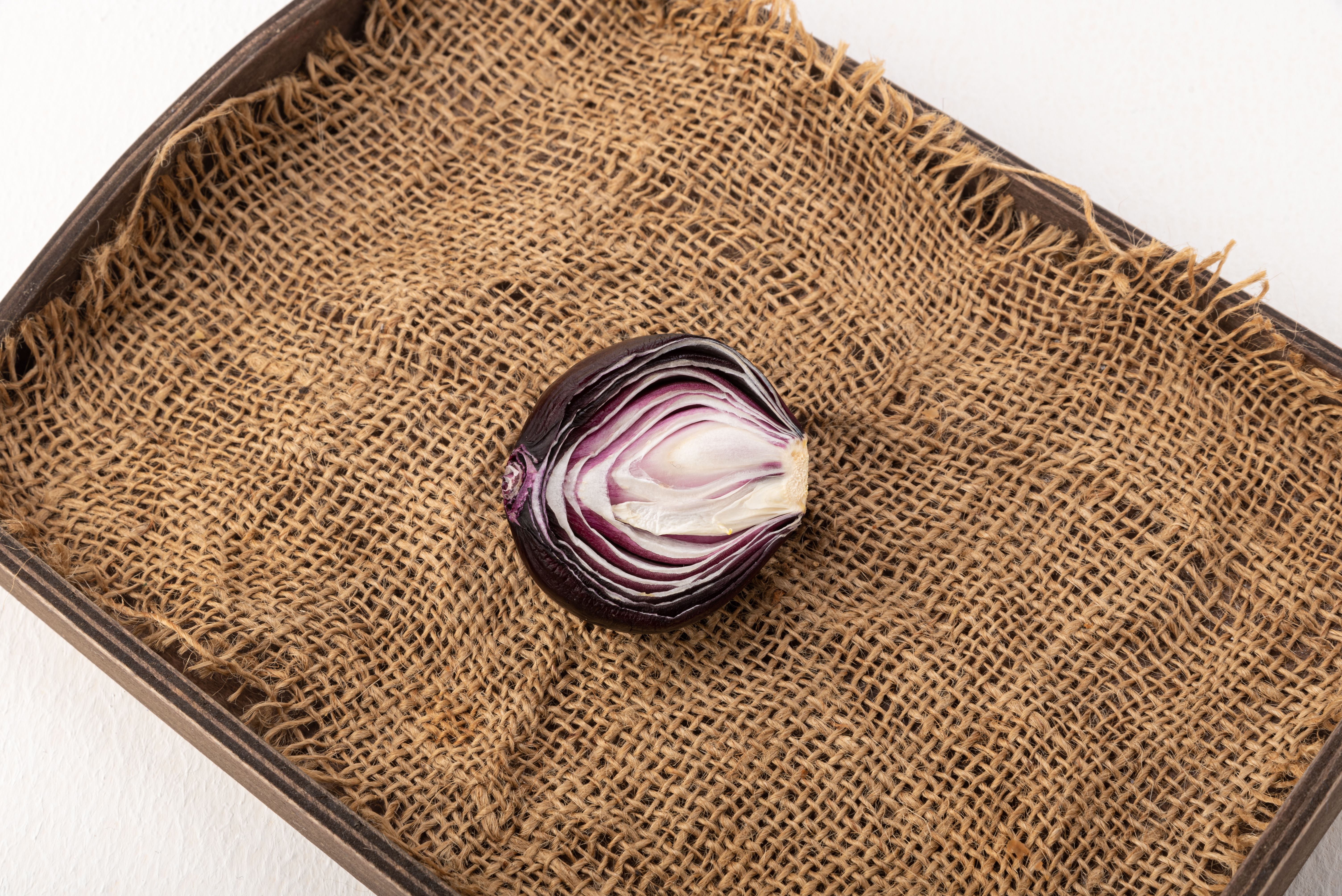
Red Onion
The quercetin-concentrate onion variant — anthocyanin bonus + powerful cardiovascular polyphenol matrix.
Red Onion in 1 minute
What does it provide? Compared with the classic yellow onion (I.5), 2—5× higher quercetin content (40—100 mg/100 g) and an anthocyanin concentrate (cyanidin-3-glucoside 50—150 mg/100 g) in the red outer skin and flesh. The fructan-prebiotic fraction (FOS) is identical to the yellow onion.
How much? ½—1 bulb (≈ 50—100 g) raw or roasted/day. Quercetin RCTs (Brüll 2015 Br J Nutr) used a daily dose of 162 mg, which a single red onion sufficiently covers.
When to avoid? IBS elimination phase (high FODMAP — fructan). Warfarin therapy (allicin-mediated weak anticoagulant potential). Allium allergy (rare).
The red onion varieties (Tropea, Cipollini, Red Wing) emerged through natural mutation in the 16th-century Italian region of Calabria — a variant of the MYB gene regulating anthocyanin synthesis produced the red-purple color. In Renaissance Italy, "cipolla rossa" was chosen over white onions for its prized characterful flavor. In modern quercetin literature, Brüll 2015 Br J Nutr RCT placed the red onion as a recognized clinical blood-pressure-lowering ingredient.
Scientific Background
The red onion's main bioactive difference from the yellow onion (I.5) is its quercetin and anthocyanin concentration. Quercetin content is 40—100 mg/100 g — 2—5× that of the yellow onion. Systemic quercetin bioavailability is low (5—10%), but the colonic microbiome converts it into protocatechuic acid and other phenolic acids, and these metabolites improve endothelial function.
**Brüll 2015 *Br J Nutr*** randomized, double-blind, crossover RCT showed that 162 mg/day quercetin (≈ 1 red onion or equivalent capsule) significantly reduced 24-hour ambulatory systolic blood pressure (≈ −2.6 mmHg) over 6 weeks. Edwards 2007 J Nutr showed LDL reduction with a similar protocol.
The anthocyanin fraction (concentrated in the red skin) provides an Akkermansia-Bifidobacterium-supporting polyphenol matrix — analogous to the anthocyanin effect of elderberry and red cabbage. The evidence is based on small human pilots and in vitro fermentation studies.
The fructan-prebiotic fraction is identical to the yellow onion — bifidogenic, but red (Monash category) for FODMAP-sensitive individuals.
- + Extra-virgin olive oil + tomato: classic "sofrito" + red onion = polyphenol stack.
- + Balsamic vinegar: acid + anthocyanin color stabilization + glycemic control.
- + Roasted meat (beef, chicken): classic "red onion gravy."
- + Avocado + lime: Mexican "salsa" matrix.
- + Fermented dairy (yogurt, kefir): quercetin + LAB synbiotic.
- + In a raw salad matrix: maximum quercetin preservation.
- Very long boiling (> 30 min): quercetin loss 40—60%; brief sauté or raw preferred.
- Milk consumed directly with raw red onion: GI discomfort varies individually.
- GERD flare: raw consumption may aggravate.
- IBS elimination phase: high FODMAP — avoid in the first 4—6 weeks.
- Warfarin therapy: dietary amount is safe; high-dose quercetin supplement to be avoided.
- Allium allergy: complete avoidance.
- Infants under 8 months: avoid (as with all alliums).
- GERD: raw to be avoided, roasted/sautéed OK.
- Brüll V et al. Effects of a quercetin-rich onion skin extract on 24 h ambulatory blood pressure in pre- and stage I hypertension — randomized controlled trial. Br J Nutr 2015;114(8):1263—1277. https://pmc.ncbi.nlm.nih.gov/articles/PMC4594049/
- Edwards RL et al. Quercetin reduces blood pressure in hypertensive subjects. J Nutr 2007;137(11):2405—2411. https://pubmed.ncbi.nlm.nih.gov/17951477/
- Lee J, Mitchell AE. Quercetin and isorhamnetin glycosides in onion (Allium cepa L.): varietal comparison, physical distribution, coproduct evaluation, and long-term storage stability. J Agric Food Chem 2011;59(3):857—863. https://pubs.acs.org/doi/abs/10.1021/jf1033587
- USDA FoodData Central — Onion, red, raw (NDB #170006). https://fdc.nal.usda.gov/
- Monash University. Onion, red — Low FODMAP serving guidance (classic red Monash, as for the yellow). https://www.monashfodmap.com/about-fodmap-and-ibs/high-and-low-fodmap-foods/
- Boots AW et al. Health effects of quercetin: from antioxidant to nutraceutical. Eur J Pharmacol 2008;585(2-3):325—337. https://pubmed.ncbi.nlm.nih.gov/18417116/