


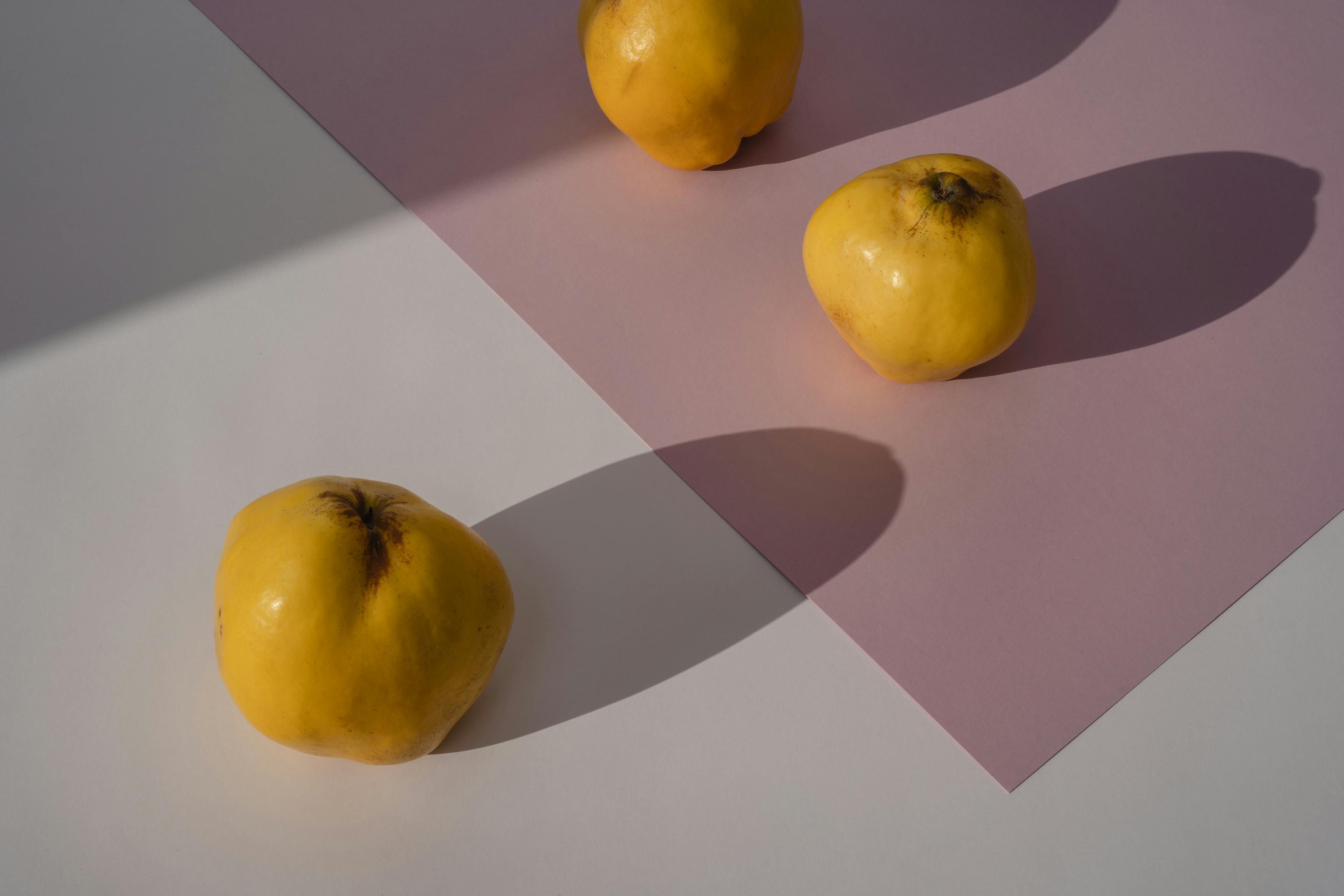
Quince
Astringent raw, golden when cooked — a pectin bomb and the Mediterranean kitchen's tidy microbiome trick.
Quince in 1 minute
What does it provide? High soluble pectin (≈ 1.5–2 g/100 g — one of the highest among temperate fruits), chlorogenic acid and other hydroxycinnamic-acid derivatives, quercetin glycosides, triterpene ursolic acid, and a mucilaginous mucilage fraction. The peel and seed-surrounding tissue are also tannin-concentrated — when cooked, these soften and the pectin gels (hence the classic Iberian quince paste and the French pâte de coing). Pectin reaching the colon is a substrate for Bifidobacterium and Faecalibacterium prausnitzii, raising propionate and acetate output (Bang 2018, Holscher 2017).
How much? Raw is rare — most often eaten cooked-poached or in compote, 80–150 g/day. Quince paste (membrillo) is sugar-rich; small portions (15–25 g) with cheese. Fibrous, unsweetened quince juice: 100–150 ml.
When to avoid? Raw with dental issues (hard, sour, astringent), severe GERD active phase (acidity), Rosaceae allergy (possible apple/pear cross-reactivity), swallowing disorder with larger pieces, infants (seeds must be removed — amygdalin content).
Quince originates from the southern Caspian coast and the foothills of pre-Asian Caucasus, where wild Cydonia oblonga was already a food in the 2nd millennium BCE. The ancient Greeks named it "kydōnion mēlon" after the Cretan city of Kydonia — in Pliny and Virgil it appears as "malum cydonium," giving rise to the French coing, Italian cotogna, and English quince. In Greek and Roman kitchens, quince almost always reached the table cooked, simmered with honey; Apicius' recipe describes a quince purée flavored with saffron and ground spices. According to Plutarch, the young bride would bite into a quince upon entering the wedding chamber — a symbol of fertility and binding.
In the Middle Ages, quince became one of the main fruits in European monastery gardens and manor orchards: long-keeping, high in pectin, storable as preserve, mixed with mustard, or as the Portuguese marmelada made from marmelo. The word "marmalade" originally meant quince paste and only shifted to citrus in the 17th century. In Andalusia, dulce de membrillo (quince paste) remains the mandatory companion of manchego cheese, and French cuisine treats pâte de coing as a classic of the dessert table. In the 19th century, England and the Habsburg Empire were major quince growers, but homogenized 20th-century fruit demand pushed it back — today it is enjoying a renaissance with the slow food and fermented / cooked-fruit cuisine revival.
Scientific Background
Quince owes its unique position among fruits to its exceptionally high pectin concentration — 1.5–2.2 g/100 g fresh weight (Silva 2004, Wojdyło 2013). Pectin is a soluble fiber with a homogalacturonan backbone; in the colon, Bifidobacterium, Bacteroides, and Faecalibacterium prausnitzii ferment it into propionate and acetate. In a human study (Larsen 2019), pectin supplementation significantly raised total SCFA output and the Bifidobacterium ratio. The mucilage fraction of quince — mainly the slippery layer surrounding the seeds — is an arabinogalactan-protein complex with in vitro prebiotic and mucosa-protective effects (Hemmati 2019).
A defining element of the polyphenol profile is chlorogenic acid (3-O-caffeoylquinic acid) and other hydroxycinnamic-acid derivatives — Silva 2004 measured 200–400 mg/kg chlorogenic acid in fresh peel. Colonic bacteria hydrolyze these to caffeic and dihydrocaffeic acid, forming anti-inflammatory and vascular-protective metabolites (Stalmach 2009). The quercetin glycosides (rutin, hyperoside) concentrated in the peel are antioxidant and mast-cell stabilizing; ursolic acid, a triterpene also known from apple peel, is an anti-inflammatory component that modulates lipid metabolism (Kashyap 2016).
The characteristic astringency of raw quince is due to its high proanthocyanidin (condensed tannin) content — these polymeric flavanols are enriched in the peel and seed-surrounding tissue. On cooking, the tannins partly polymerize / bind, the pectin gels, and chlorogenic acids partly enter Maillard reactions — hence the characteristic rusty-gold color and soft texture of cooked quince. Moderate cooking (≤ 30 min, ≤ 90 °C) preserves most polyphenols; with prolonged / very high heat, 40–60% of chlorogenic acid can be lost (Silva 2004).
The seed kernel contains amygdalin cyanogenic glycoside (like apple and apricot seeds) — therefore seeds must be removed when cooking, and consuming whole seeds is not recommended. The flesh and peel, along with the mucilage around the seeds, are safe and valuable; the mucilage is traditionally also the base of a cough-soothing decoction (decoctum cydoniorum) (Hemmati 2019).
- + Lamb or beef stew, game meat: classic Persian-Caucasian cuisine; pectin emulsifies, polyphenols temper lipid oxidation.
- + Manchego, sheep cheese, goat cheese: Iberian membrillo pairing; pectin slows milk-fat digestion, polyphenol-tannin balances saltiness.
- + Walnut, almond, hazelnut: + MUFA and plant sterols → cardiovascular synergy, cooked quince salad.
- + Yogurt or kefir (live culture): synbiotic breakfast — cooked quince purée into plain yogurt.
- + Cinnamon, clove, cardamom: Mediterranean-Iranian compote classics; additive polyphenol effect.
- + Stewed with apple or pear: Rosaceae synergy, softer astringency.
- Iron supplementation in the same meal: tannins and pectin chelate non-heme iron — ≥ 2-hour separation.
- High-dose fruit-sugar syrups (membrillo + sweet drinks): glycemic spike, despite the polyphenol benefit.
- Blending with seeds (smoothie): amygdalin-release risk — seed removal is mandatory.
- Prolonged, high-temperature cooking (≥ 60 min): chlorogenic acid and quercetin partly degrade, pectin overgels.
- Long alcohol maceration: polyphenols extract from flesh to liquid — flesh nutrient content drops (unless you consume both).
- Raw with poor dentition / active periodontitis: hardness and tannin content can damage teeth and gums.
- Severe GERD active phase: fresh fruit acidity (pH ≈ 3.3–3.5) can provoke symptoms — cooked, honey-softened form is better.
- Rosaceae allergy (apple, pear, strawberry): possible cross-reactivity — gradual challenge under allergist supervision.
- Swallowing disorder (dysphagia): raw pieces are an aspiration risk — purée texture.
- Sustained uncontrolled diabetes + quince paste (membrillo): the traditional product is 50–60% sugar — moderate portions, alongside cheese.
- IBS elimination phase: the high pectin causes symptoms in some patients — reintroduce in small portions.
- Infant (under 1 year): mandatory seed removal, compote form in minimal amounts.
- Celiac / NCGS: quince itself is safe, but commercial membrillo may contain flour — label check.
- Kidney stones, on high-oxalate diet: moderate oxalate content — moderate the serving.
References
[1] Silva BM et al. Quince (Cydonia oblonga Miller) fruit (pulp, peel, and seed) and jam: antioxidant activity. J Agric Food Chem 2004;52(15):4705–4712. Link
[2] Wojdyło A, Teleszko M, Oszmiański J. Antioxidant property and storage stability of quince juice phenolic compounds. Food Chem 2014;152:261–270.
[3] Hemmati AA et al. Anti-inflammatory effect of Cydonia oblonga leaf and seed mucilage. Avicenna J Phytomed 2019;9(2):177–185.
[4] Larsen N et al. Effect of potato fiber on survival of Lactobacillus species at simulated gastric conditions and composition of the gut microbiota in vitro. Food Res Int 2019;125:108644.
[5] Holscher HD. Dietary fiber and prebiotics and the gastrointestinal microbiota. Gut Microbes 2017;8(2):172–184. Link
[6] Bang SJ et al. The influence of in vitro pectin fermentation on the human fecal microbiome. AMB Express 2018;8(1):98.
[7] Stalmach A et al. Metabolite profiling of hydroxycinnamate derivatives in plasma and urine after the ingestion of coffee. Drug Metab Dispos 2009;37(8):1749–1758.
[8] Kashyap D et al. Ursolic acid (UA): a metabolite with promising therapeutic potential. Life Sci 2016;146:201–213.
[9] Monash University. High and Low FODMAP foods — quince. Monash FODMAP database. Link