
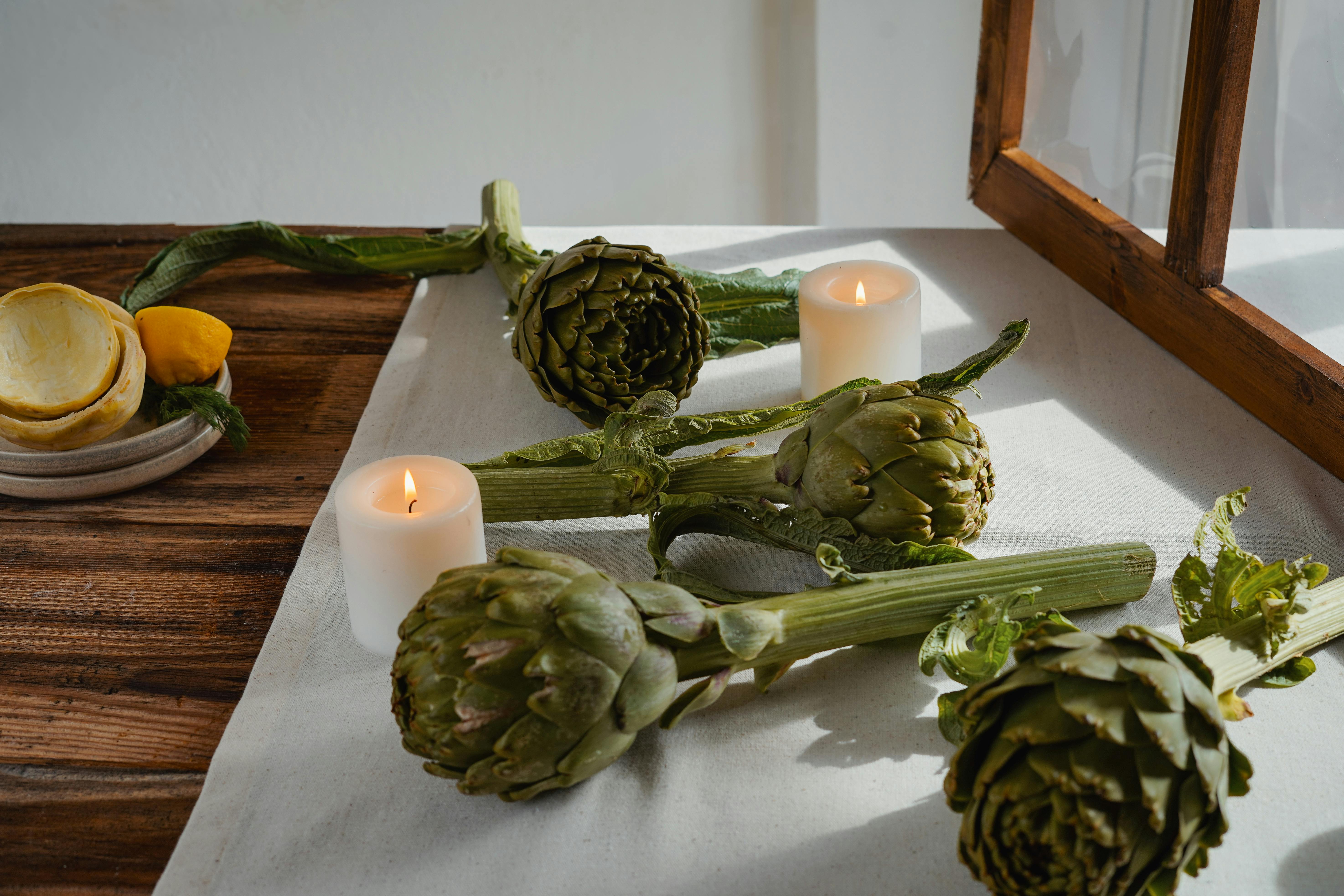
Artichoke
- Latin név
- Cynara cardunculus var. scolymus
- FODMAP
- 🔴 high (fructan-dominant)
- Evidence
- ★ ★ ★
- Microbiota
- ITF (inulin) + polyphenol — dual prebiotic matrix
- What does it provide?
- Inulin-type fructans (ITF) and polyphenols (cynarin, chlorogenic acid, luteolin) — selective bifidogenic effect + bile-acid metabolism support.
- How much?
- One medium fresh artichoke (≈ 120–150 g heart + bracts) 2–3×/week; ALE (Artichoke Leaf Extract) as a supplement at 320–640 mg/day for dyspepsia (EMA).
- When to avoid?
- Gallstones, active biliary disease, cholangitis, hepatitis, Asteraceae allergy, IBS elimination phase.
The artichoke's history begins in the warmth of the Mediterranean: the "globe artichoke," almost fully crossable with wild cardoon (Cynara cardunculus), was domesticated in Roman times, mainly around Sicily. Greek and Roman authors still described the wild form as "kaktos" or "carduus" — both Pliny and Columella mention it, and it was considered a delicacy at imperial tables. In the early Middle Ages, Arab gardeners advanced its development: through new cultivation techniques and irrigation, they achieved much meatier flower heads, and thus the refined cultivar returned to Italy by the Renaissance.
In the 16th century, artichoke conquered Europe as a fashionable vegetable: it arrived in France from Italy and Spain, then crossed the English Channel — Henry VIII grew it in his gardens around 1530, and the Tudor court called it an aphrodisiac, which only boosted its popularity. Catherine de' Medici reportedly loved it so much that she nearly made herself ill from overconsumption at the French court. Cardoon and artichoke are still closely related cultivar groups of the same species today, and genetic data show that the two lineages never fully separated — a millennia-long botanical dialogue that continues on our plates. (Wikipedia)
🔬 Scientific Background
Artichoke's dual bioactive matrix is unique: edible parts and byproducts contain inulin-type fructans (ITF), with bracts/stems reaching ITF content of around 70%, while caffeoylquinic acid derivatives (cynarin = 1,3-dicaffeoylquinic acid) and luteolin glycosides provide the polyphenol fraction. The leaf's aqueous extract (Artichoke Leaf Extract, ALE) is recognized by the EMA/HMPC as a traditional herbal medicine for relieving functional dyspepsia (fullness, bloating). PMC, European Medicines Agency
Clinical evidence rests on three pillars. Dyspepsia: in a 6-week randomized, double-blind trial (Holtmann 2003), ALE produced significant symptom reduction in functional dyspepsia. Hypercholesterolemia: Bundy 2008 RCT showed ALE moderately but reproducibly reduces plasma LDL in mild-to-moderate hypercholesterolemia. Microbiome: Costabile 2010 human crossover RCT with very-long-chain inulin (VLCI) isolated from artichoke demonstrated marked bifidogenic effect, with mild-to-moderate bloating as a dose-dependent side effect. PubMed
The polyphenol fraction also acts through the microbiota: in vitro fermentation (Holgado 2021) induced SCFA increase and Lactobacillus/Bifidobacterium enrichment. EFSA recognized the normal-defecation-maintaining effect of native chicory inulin at ≥ 12 g/day — this is a model claim that extends to artichoke ITF as well. EFSA Journal, ScienceDirect
- + Live cultures (yogurt, kefir): synbiotic synergy — inulin + Bifidobacterium combination yields a stronger SCFA response than either alone.
- + Polyphenol-rich matrix (olive oil, lemon): ALE-cynarin antioxidant potential maximized with vitamin C and MUFA fat.
- + Fiber-diverse side (oats, legumes, whole grains): different fermentable substrates = broader microbiota activity and more stable SCFA profile.
- + Gentle heat (steaming, brief sautéing): maximizes inulin and polyphenol retention; return the cooking liquid to sauces or creams.
- + Diet-managed gradual introduction: start with ¼ artichoke weekly, increase as tolerated.
- Strong acid + long heat (pH ≤ 4, ≥ 60 °C, 30+ min): partially hydrolyzes inulin to fructose — reduces prebiotic yield. Long vinegar pickling should be avoided if targeting microbiome effect.
- Anticoagulant (warfarin) + high-dose ALE: theoretical, moderate bleeding risk due to choleretic effect; medical supervision.
- Iron supplementation + large polyphenol intake: time separation (≥ 2 hours) recommended — polyphenols can chelate iron.
- Empty stomach + ALE supplement: choleretic effect may cause GI irritation on an empty stomach; take with meals.
- Raw artichoke (without thorough cooking): harder bracts are poorly digestible; cook or steam 15–25 minutes.
- Gallstones, active biliary disease, cholangitis, biliary obstruction: EMA monograph explicitly contraindicates — choleretic effect carries colic risk.
- Active hepatitis, liver complaints: avoid until enzyme values normalize.
- Asteraceae allergy: cross-reactivity in chamomile, ragweed, mugwort allergics.
- IBS elimination phase (FODMAP protocol): high fructan — avoid in the first 4–6 weeks, then small-dose reintroduction.
- Active gastric ulcer, reflux disease flare: choleretic effect may worsen GI symptoms.
- Severe kidney disease with potassium restriction: moderately high potassium — caution with portion size.
- Infant (under 1 year): fibrous bracts pose choking/aspiration risk.
"Artichoke detoxifies." The "liver detox" concept is marketing — no human evidence shows artichoke removes "toxins." The choleretic (bile-emptying) effect is REAL, but it's not detox; it's moderate functional dyspepsia support (EMA-approved indication).
"You should pour out artichoke cooking water." Quite the opposite — inulin is WATER-SOLUBLE, so most of the prebiotic fiber leaches into the cooking water. Use the cooking liquid for sauces, creams, or soup bases if you want the microbiome effect.
"All edible artichokes are the same." The globe (Cynara cardunculus var. scolymus), cardoon, and Jerusalem "artichoke" (sunchoke, Helianthus tuberosus) are entirely DIFFERENT plants. Sunchoke is a tuber with a different inulin profile and different carbohydrate content (see chapter I.14).
"Artichoke is forbidden in IBS." During the elimination phase it is indeed to be avoided (high fructan), but during the reintroduction phase small doses (¼ heart) can be used to test individual tolerance — and is often tolerated.
🍳 Kitchen Protocol
Daily/weekly serving
Fresh artichoke: 1 medium heart + bracts (≈ 120–150 g edible portion) 2–3×/week. ALE supplement: 320–640 mg/day per EMA monograph, with meals (for dyspepsia indication).
Preparation pattern
1. Cut off the stem at the base, remove tough outer bracts. 2. Cut off the top 1/3 (the spiny tip), rub with lemon juice (prevents browning). 3. Steam 20–25 min (small artichoke 15 min), or simmer in water + lemon juice + olive oil 25–35 min covered. 4. It's done when an outer bract can be easily pulled off.
Classic patterns
Roman style (carciofi alla romana): sautéed in olive oil with mint and garlic (without garlic for FODMAP-sensitive) — the cooking liquid reduced into a sauce.
Provençal cream: steamed artichoke heart + olive oil + lemon juice + soft cheese (or cashew) — on bread or as a side.
On salad: pre-cooked, cooled artichoke heart sliced over greens with balsamic + olive oil.
ALE tea: dried artichoke leaf 2 g, 200 ml hot water, 10 min steep — for digestive complaints AFTER meals.
Storage
Fresh: refrigerated raw 5–7 days, cooked 2–3 days. Frozen (pre-cooked hearts): 6 months. Canned (in oil): refrigerated 1 week after opening.
What not to do
Don't eat large quantities raw (indigestible, abdominal discomfort). Don't cook 35+ min in strongly acidic medium (ITF hydrolysis). Don't substitute fresh artichoke with sunchoke (different species).
📚 References (selected)
1. Sonnante G et al. The Domestication of Artichoke and Cardoon: From Roman Times to the Genomic Age. Annals of Botany 2007;100(5):1095–1100. 2. European Medicines Agency (HMPC). Community herbal monograph on Cynara scolymus L., folium. 2011. 3. Holtmann G et al. Efficacy of artichoke leaf extract in functional dyspepsia: a six-week placebo-controlled, double-blind, multicentre trial. Aliment Pharmacol Ther 2003;18(11):1099–1105. 4. Bundy R et al. Artichoke leaf extract reduces plasma lipids in mild–moderate hypercholesterolaemia: a randomised, double-blind, placebo-controlled trial. Phytomedicine 2008;15(9):668–675. 5. Costabile A et al. A double-blind, placebo-controlled, cross-over study to establish the bifidogenic effect of a very-long-chain inulin extracted from globe artichoke in healthy human subjects. Br J Nutr 2010;104(7):1007–1017. 6. Feiden T et al. Bioactive Compounds from Artichoke and Application Potential. Food Technol Biotechnol 2023;61(3):312–327. 7. Holgado F et al. In vitro fermentability of globe artichoke by-product by Lactobacillus acidophilus and Bifidobacterium bifidum. Bioact Carbohydr Diet Fibre 2021;26:100286. 8. EFSA NDA Panel. Scientific Opinion on chicory inulin and maintenance of normal defecation. EFSA Journal 2015;13(1):3951. 9. Glibowski P, Bukowska A. The effect of pH, temperature and heating time on inulin chemical stability. Acta Sci Pol Technol Aliment 2011;10(2):189–196. 10. Monash University. High and Low FODMAP foods. Monash FODMAP database.