


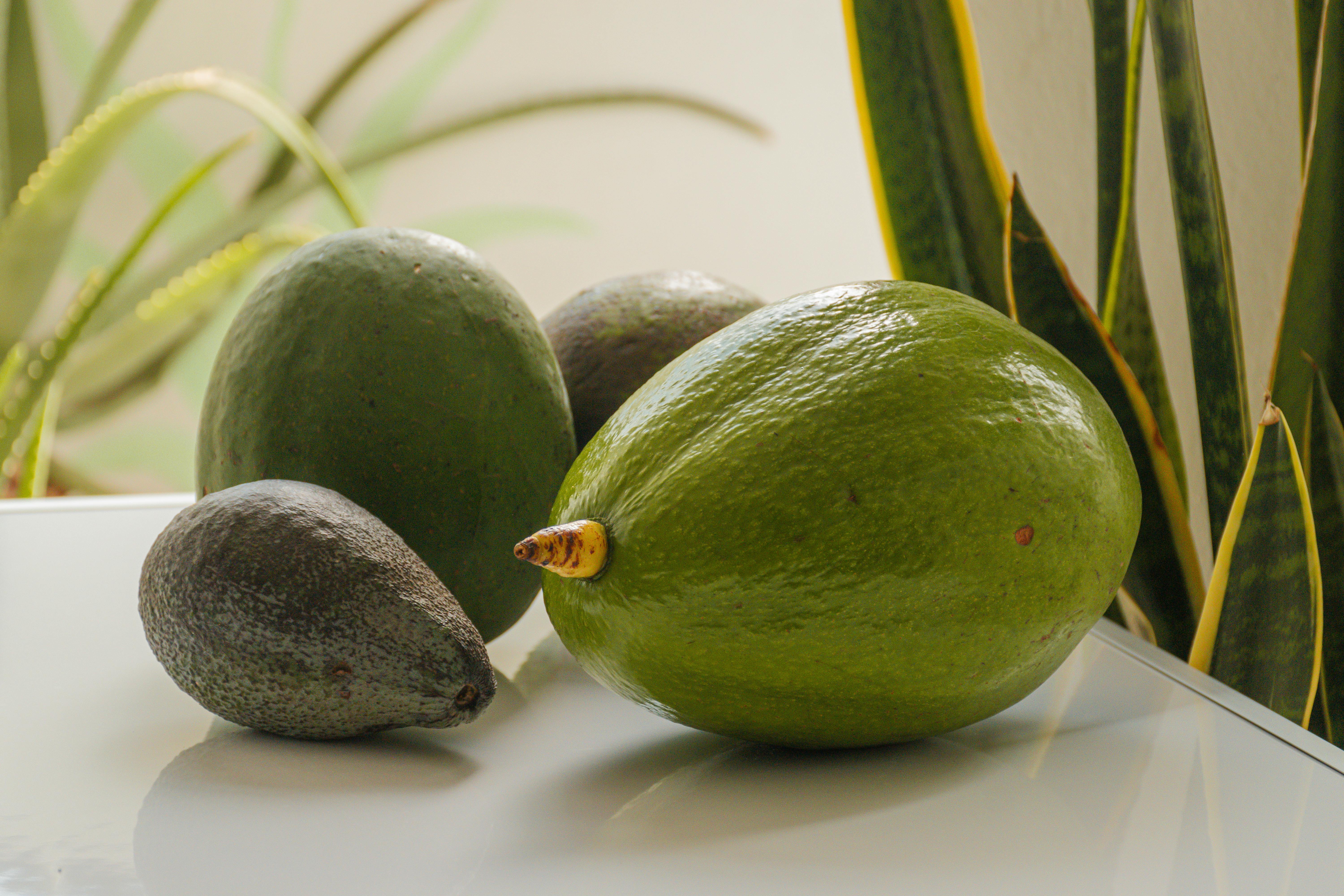
Avocado
The buttery Mexican fruit — fiber, MUFA, and carotenoid carrier in one edible fat bomb.
In 1 minute
What does it provide? Dietary fiber (≈ 6.7 g/100 g), monounsaturated fatty acids (oleic acid), lutein/zeaxanthin (yellow-green carotenoid pigments protecting the macula), and phenolic compounds — with microbiota-modulating and carotenoid "carrier" effects (the fat helps absorption of fat-soluble carotenoids).
How much? ½–1 medium avocado/day was tolerated in human RCTs; for IBS-sensitive individuals, ¼ (≈ 60 g) is the low-FODMAP serving.
When to avoid? Latex-fruit syndrome allergy (banana/kiwi/avocado cross-reactivity), warfarin therapy (vitamin K), IBS elimination phase in large servings.
The avocado's homeland is Mesoamerica, and its history reaches deep into humanity's early agricultural experiments: archaeobotanical finds in Mexico's Tehuacán Valley suggest it was gathered and consumed as early as 8000–7000 BCE, while the gradual increase in seed size over time tells a clear story of domestication. According to a "10,000-Year History" review, the species emerged in the region and from there spread to today's Central America; genetic analyses confirm the Mesoamerican origin and the parallel development of multiple cultivation lineages — Mexican, Guatemalan, and West Indian. The Aztecs knew it as "āhuacatl," which in Nahuatl also meant "testicle" — a playful name based on shape that followed the fruit on its journey into European kitchens.
Following the Spanish conquest, European chroniclers discovered avocado and many contemporary writers praised it — Martín Fernández de Enciso first described it in print in 1519, and conquistadors quickly grew to love its buttery flesh on long sea voyages. In the 19th–20th centuries, as California and Florida plantations emerged, it became a truly globally cultivated fruit; the most widespread Hass variety was born in 1926 as an accidental seedling in postman Rudolph Hass's garden in La Habra Heights, and from there began its conquest of the world. (bioone.org, OUP Academic)
🔬 Scientific Background
Avocado's nutritional profile creates a unique combination: substantial dietary fiber (≈ 6.7 g/100 g, USDA), high oleic acid content (MUFA), and fat-soluble phytonutrients — particularly lutein/zeaxanthin supporting macular pigment. Upon reaching the colon, the fiber ferments, converts to SCFAs, and increases the proportion of fiber-fermenting taxa.
In a 12-week randomized human trial (Thompson 2021), daily avocado consumption was associated with lower stool bile acid concentrations, higher SCFA levels, and Faecalibacterium enrichment in overweight adults. The 2025 26-week HAT-ancillary RCT with 1 avocado/day showed persistent α-diversity increase from week 4 onward and F. prausnitzii elevation — the effect was more pronounced in those with lower baseline diet quality.
The fat matrix acts as a "carrier" for carotenoids: avocado or avocado oil added to salads or salsas significantly increases the absorption of tomato lycopene, carrot β-carotene, and leafy-green lutein (Unlu 2005). According to the 2024 Monash update, the main FODMAP component is not sorbitol but perseitol; the low-FODMAP serving is ≈ 60 g (¼ medium).
- + Leafy greens, tomato, carrot (carotenoid boost): ½ avocado on a salad dramatically increases lutein, β-carotene, and lycopene bioavailability.
- + Whole-grain matrix (AXOS sources: oats, rye, sorghum): fiber synergy, broader SCFA profile.
- + Lemon/lime (acid + vitamin C): slows browning (polyphenol oxidase inhibition), polyphenol stabilization.
- + Live cultures (kefir, yogurt) as a separate course: fiber + live cultures = synbiotic profile.
- + Egg (breakfast): choline + B12 + MUFA — satiating, low-glycemic-index breakfast foundation.
- Warfarin (vitamin K interaction): avocado contains moderate vitamin K; large servings (≥ 1 piece/day) can cause INR fluctuations. Consistent daily intake recommended.
- Latex allergy: in latex-fruit syndrome (banana, kiwi, avocado cross-reactivity) acute anaphylaxis is possible.
- Empty stomach large serving (≥ 1 piece) in IBS-sensitive individuals: perseitol-FODMAP can cause rapid bloating.
- Excessive daily intake in kidney disease: moderately high potassium — for kidney patients, dose under medical guidance.
- Unrefrigerated cut avocado after prolonged storage: can become a Listeria contamination breeding ground — consume quickly or freeze.
- IBS elimination phase (FODMAP protocol): avoid ≥ 80 g servings during the first 4–6 weeks; test reintroduction with ¼ avocado.
- Severe chronic kidney disease (CKD 4–5): potassium restriction — medical consultation required.
- Latex-fruit syndrome allergy: complete avoidance.
- Warfarin therapy: consistent small-to-moderate daily intake; avoid large fluctuations.
- Migraine trigger sensitivity: ripened avocado has high tyramine content — some patients experience it as a trigger.
- Infant under 6 months: to be avoided until solid food introduction (texture, allergen introduction protocols).
- Under weight control: calorie-dense (≈ 160 kcal/100 g) — portion control is important.
Daily/weekly serving
½–1 medium avocado (≈ 100–200 g) daily or 3–4×/week. IBS-sensitive: ¼ piece (≈ 60 g) as a low-FODMAP starter serving.
Preparation pattern
- Cut lengthwise around, twist apart, lift out the pit with a spoon (or gently tap out with a knife).
- Scoop out the flesh with a spoon, or dice in the skin.
- Apply lemon/lime juice immediately against browning if not consumed right away.
Classic patterns
Guacamole: avocado + lime + tomato + jalapeño + cilantro + salt. Mediterranean/IBS-sensitive version: leek greens instead of onion.
Avocado toast: whole-grain bread + smashed avocado + soft-boiled egg + chili flakes + olive oil.
Salad boost: ½ avocado on greens with tomato — lycopene + lutein "double" carotenoid bowl.
Smoothie: ¼ avocado + spinach + kefir + banana — creamy, satiating breakfast.
Storage
Unripe: room temperature 3–5 days (faster ripening near apples). Ripe whole: refrigerated 5–7 days. Cut: covered with lemon juice and plastic wrap, max 24 h. Frozen (pureed): 3–6 months.
What not to do
Don't microwave to "ripen" — it becomes bitter and oxidized. Don't discard the tomato/lemon liquid if you made avocado salsa — it can be reworked into dressing.
References
[1] USDA FoodData Central. Avocados, raw, all commercial varieties. USDA Agricultural Research Service.
[2] Thompson SV et al. Avocado consumption alters gastrointestinal bacteria abundance and microbial metabolites in adults with overweight or obesity. J Nutr 2021;151(4):753–762.
[3] Edwards CG et al. Effects of one avocado per day on the microbiota: 26-week HAT-ancillary RCT. 2025.
[4] Unlu NZ et al. Carotenoid absorption from salad and salsa by humans is enhanced by the addition of avocado or avocado oil. J Nutr 2005;135(3):431–436.
[5] Galindo-Tovar ME et al. Some aspects of avocado (Persea americana Mill.) diversity and domestication in Mesoamerica. Genet Resour Crop Evol 2008.
[6] Monash University. High and Low FODMAP foods — avocado update (perseitol). 2024.
[7] Scott TM et al. Avocado consumption increases macular pigment density: a randomized controlled trial. Nutrients 2017.
[8] Pacheco LS et al. Avocado consumption and body weight in NHANES adults. J Am Heart Assoc 2022.