


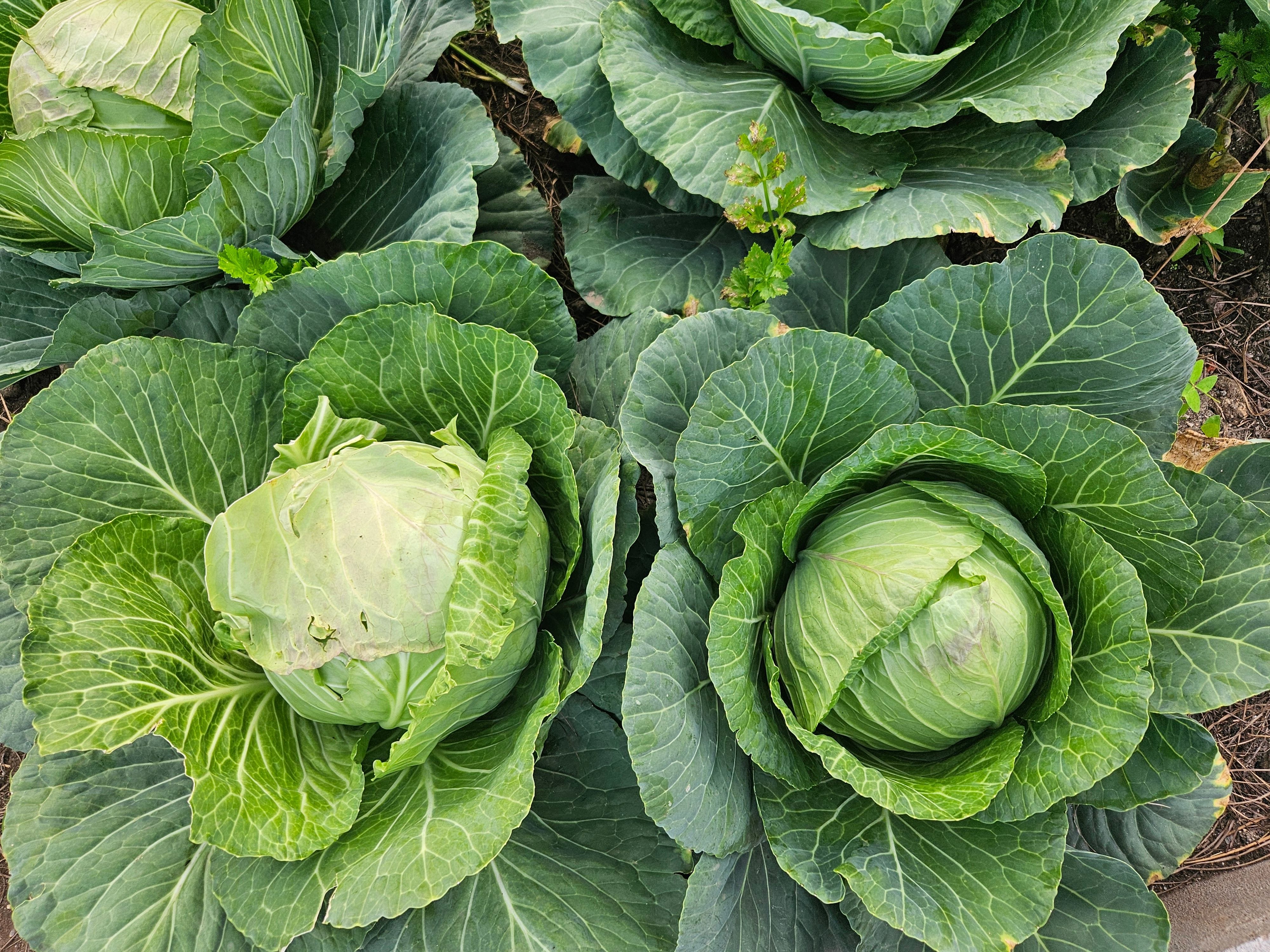
Cabbage
Vegetable of the ancient sages — sinigrin + glucobrassicin, and Captain Cook's scurvy-defeating sauerkraut.
In 1 minute
What does it provide? Sinigrin (allyl-glucosinolate → AITC, allyl-isothiocyanate — the pungent, mustard-like sulfur compound) + glucobrassicin (→ I3C / DIM — indole-3-carbinol and its derivative, estrogen metabolism modulators) + vitamin C (≈ 36 mg/100 g) + soluble fiber (pectin).
How much? ¾–1 cup (≈ 75–100 g) fresh or lightly sautéed cabbage 3-4×/week; unpasteurized, live sauerkraut 2-3 tbsp (≈ 30–60 g) as a daily synbiotic carrier — the heat-treated store-bought type no longer contains live lactic acid bacteria.
When to avoid? Thyroid disease with iodine deficiency + large raw doses, IBS flare (fructan), with warfarin fluctuating vitamin K, with antiplatelet drugs extreme sauerkraut.
The Brassica oleracea "cabbage relatives" spread in the ancient Mediterranean from the wild coastal cabbage ancestor; among the Romans, Cato the Elder and Pliny wrote about cabbage in detail, mentioning it both as food and medicine — Cato in De Agri Cultura called it "the best vegetable," soothing digestion, healing wounds, and protecting from illness for those who eat it regularly. The Greeks even called it "vegetable of the sages," and Pythagoras reportedly was particularly fond of it. From the early Middle Ages, manuscripts and decrees — including Charlemagne's famous Capitulare de villis — list it among vegetables to be cultivated, and monastery gardens treasured it as one of the vegetables storable for winter.
European domestication of head cabbage is ancient, rooted as early as the first millennium BCE; savoy cabbage emerged as a separate cultivated type in 16th-century Italy — the territory of the Duchy of Savoy was famous for it. Cabbage became a staple food across medieval and early modern Europe, with numerous preparation methods: raw, cooked, stewed, and fermented. Captain James Cook's British sailors on 18th-century voyages of discovery defended against scurvy with sauerkraut — one of the first documented cases of a fermented food solution saving lives among seafarers. (Wikipedia)
🔬 Scientific Background
Cabbage is a cruciferous foundation member of the Brassicaceae family, and its glucosinolate profile differs from both broccoli and cauliflower: sinigrin (allyl-glucosinolate) → through myrosinase → AITC (allyl-isothiocyanate, the component responsible for pungent mustard and horseradish flavor) + glucobrassicin (indolic) → I3C/DIM. Both pathways are well-documented Nrf2 activators and inflammation modulators.
The "vitamin U" (S-methyl-methionine-sulfonium, SMM) — fresh cabbage juice-bound, antiulcer factor described by Cheney in 1949 — is historically important, but modern evidence is weak and not standard in clinical practice. The real fresh-juice effect is most likely tied to the sinigrin-AITC pathway combined with vitamin C.
Human cruciferous microbiome RCTs (Kellingray 2017, Li 2009) confirm significant microbiota shift: sulfate-reducing bacteria proportion decreases (reduced H₂S production — favorable in IBD context), and activity of some butyrate-producing taxa increases.
Sauerkraut is a separate category: lactic-acid fermentation (heterofermentative Lactobacillus, Leuconostoc) provides AITC-glucoside → AITC + organic acids (lactic, acetic) + live probiotic bacteria combined. Captain Cook on his 1772-1775 Resolution voyage completed the 3-year journey with 60 barrels of sauerkraut without a single scurvy death — early documented clinical evidence.
- + Brown mustard powder (for cooked cabbage): "enzyme replacement" isothiocyanate boost.
- + Apple cider vinegar + caraway (sauerkraut): classic Slovak-Hungarian, polyphenol stabilization.
- + Live cultures (kefir, yogurt): synbiotic.
- + Extra-virgin olive + lemon: classic Mediterranean dressing.
- + Meat (traditional stuffed cabbage, sauerbraten): fat + protein + glucosinolate.
- + Legumes (lentil-cabbage one-pot): fiber + GOS + AITC.
- + Raw grated (coleslaw): maximum glucosinolate + vitamin C preservation.
- Long boiling (≥ 30 min) with water discard: sinigrin + vitamin C loss.
- Warfarin + large fluctuating vitamin K (kale/savoy particularly high): INR fluctuation.
- Thyroid hormone intake simultaneously in large raw amount: time separation.
- Too much sauerkraut + other fermented (kimchi, kombucha) for IBS-sensitive: histamine + FODMAP flare.
- Iron supplementation + large polyphenol: time separation.
- Too hot preparation (200+ °C) shifts toward nitriles: glucosinolate products are less bioactive forms.
- Thyroid disease with iodine deficiency + large raw dose: moderate; cooked + adequate iodine is safe.
- IBS flare: red cabbage (≤ 75 g) low-FODMAP; otherwise moderately.
- Warfarin therapy: consistent daily amount.
- Histamine intolerance + sauerkraut: fermented → high histamine.
- Active gallstone flare + large raw dose: choleretic effect.
- Infant under 8 months: avoid (gas).
- Brassica allergy (rare): avoidance.
- Severe kidney disease potassium restriction: moderate potassium — portion control.
- Gout: low purine — safe.
Daily/weekly serving
¾–1 cup (≈ 75–100 g) fresh or lightly sautéed cabbage 3-4×/week. Sauerkraut: 2-3 tbsp (≈ 30–60 g) as daily live-culture accompaniment.
Preparation pattern
- Remove rough outer leaves, rinse.
- Quarter, remove the core.
- Raw (coleslaw): thinly sliced + lemon + olive + carrot.
- Sautéed: thin slices in oil for 6-8 min on medium-high.
- Stuffed: leaves blanched individually, rolled with filling, baked in tomato liquid.
Classic patterns
Stuffed cabbage (Hungarian): cabbage leaf + ground meat + rice + paprika + tomato sauce + sauerkraut base.
Coleslaw: grated cabbage + carrot + mayonnaise + vinegar + mustard.
Choucroute garnie (Alsatian): sauerkraut + various meats + white wine + potato.
Cabbage stew (Hungarian): thinly sliced cabbage + onion + paprika + sour cream + roux.
Cook's sauerkraut: classic homemade sauerkraut — cabbage + 2% salt + caraway, 4-6 weeks.
Storage
Fresh whole: refrigerated 1-2 months. Cut: refrigerated 5-7 days. Sauerkraut (live, non-pasteurized): refrigerated 4-6 months. Frozen (blanched): 8-10 months.
What not to do
Don't boil uncovered 30+ min (sulfur smell, glucosinolate loss). Don't reboil sauerkraut (live cultures die — for flavor warm only to 60-70 °C). Don't discard the outer green leaves if they're good — more chlorophyll.
Red cabbage is an anthocyanin-accumulating mutant of regular head cabbage — a variant of the MYB gene responsible for anthocyanin synthesis gives the purple-red color.
Differences from white cabbage:
| Parameter | White cabbage | Red cabbage |
|---|---|---|
| Anthocyanin content | practically none | 50—200 mg/100 g |
| Vitamin C | 36 mg/100 g | 57 mg/100 g (≈ 1.6×) |
| Glucosinolate | similar (sinigrin) | similar |
| Vitamin K | similar | similar |
| Antioxidant capacity (ORAC) | base | 3—4× the white |
Cyanidin-3-glucoside and cyanidin-3-sambubioside are the main pigments — analogous to the anthocyanins of black elderberry (IV.26) and aronia (IV.13). Wiczkowski 2013 Eur J Nutr documented human bioavailability of red cabbage-derived anthocyanin — plasma concentration measurable as early as 2 hours after consumption.
Microbiome perspective: the anthocyanin matrix provides indirect Akkermansia muciniphila support — analogous to the mechanism of black elderberry, aronia, and cacao (XVI.1). Specifically red cabbage RCT with human microbiome measurement is sparse.
Clinical relevance: red cabbage is a classic German "Rotkohl" and Hungarian tradition — fermentation (red sauerkraut) further raises lactic acid bacteria intake. Red sauerkraut is particularly valuable — anthocyanin + live LAB synbiotic.
Other parameters (glucosinolate, vitamin K, FODMAP, contraindication) are the same as white cabbage.
References
[1] Verkerk R et al. Glucosinolates in Brassica vegetables: the influence of the food supply chain on intake, bioavailability and human health. Mol Nutr Food Res 2009;53 Suppl 2:S219–S265.
[2] Cheney G. Rapid healing of peptic ulcers in patients receiving fresh cabbage juice. Calif Med 1949;70(1):10–15.
[3] Kellingray L et al. Consumption of a diet rich in Brassica vegetables is associated with a reduced abundance of sulphate-reducing bacteria: a randomised crossover study. Mol Nutr Food Res 2017;61(9):1600992.
[4] Li F et al. Human gut bacterial communities are altered by addition of cruciferous vegetables to a controlled fruit- and vegetable-free diet. J Nutr 2009;139(9):1685–1691.
[5] Hanschen FS et al. Reactivity and stability of glucosinolates and their breakdown products in foods. Angew Chem Int Ed Engl 2014;53(43):11430–11450.
[6] Beganović J et al. Lactic acid bacteria in fermented vegetables: from selection to industrial application. Front Microbiol 2014.
[7] Cook J. The journals of Captain James Cook on his voyages of discovery, Hakluyt Society ed., 1955.
[8] Monash University. Cabbage (green, red, savoy) FODMAP content. Monash FODMAP database.