


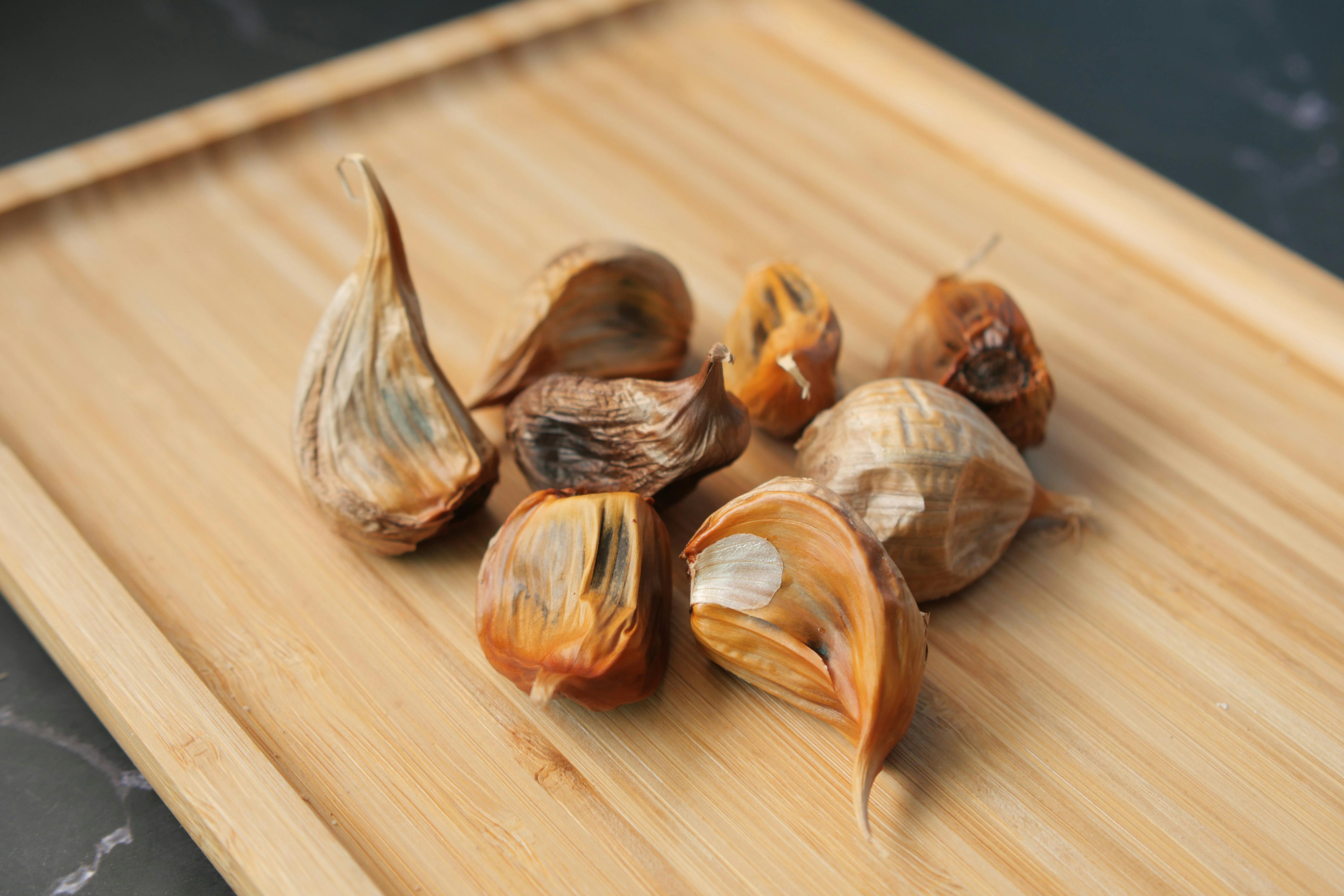
Black Garlic
The aged variant of fresh garlic — low FODMAP, high polyphenol, elevated S-allyl-cysteine: a controlled metabolic-support
Black Garlic in 1 minute
What does it provide? Aged garlic (60—90 °C, 60—90% humidity, 30—90 day controlled Maillard aging) is characterized — instead of allicin and fructan — by a matrix of S-allyl-cysteine (SAC) and melanoidins. SAC content is 4—6× that of fresh garlic; antioxidant capacity (ORAC) is ~ 10× higher.
How much? 1—3 cloves daily (≈ 3—9 g) — or AGE (aged garlic extract) as a supplement, 600—1200 mg/day. Clinical RCTs (Ried 2018) used this dose.
When to avoid? Allium allergy (rare but real). High-dose supplement to be avoided in pregnancy. The anticoagulant context differs from fresh garlic (see "When to avoid" section).
Black garlic is a modern invention of Korean-Japanese-Thai cuisines. In the late 1990s, Korean food-science researchers applied a traditional rice-wine aging method to garlic: they held it at 60—90 °C, high humidity, in a controlled environment for 30—90 days. The Maillard reaction slowly transformed the sulfur-containing proteins and sugars — yielding a deep blackish-brown color, a soft caramel-prune-like flavor, and an entirely new bioactive profile. During aging, allicin (the molecule responsible for fresh garlic's pungency) almost completely disappeared, replaced by more stable diallyl sulfides and the accumulation of water-soluble S-allyl-cysteine (SAC).
Black garlic appeared explosively in the food-science community after 2003 — Sasaki 2007 J Food Sci characterized the aging kinetics, then Kim 2007 Food Chem documented the rise in antioxidant capacity. From the 2010s, research focused on cardiological and metabolic indications took the lead, and Ried 2018 Front Nutr with the Kyolic-AGE GarGIC trial delivered classic hypertension evidence. In Hungary, black garlic emerged with the post-2015 "functional food" wave.
Scientific Background
Black garlic is the result of aging (a controlled Maillard reaction). The allicin → diallyl-sulfide + S-allyl-cysteine + melanoidin transformation dramatically alters the bioactive profile. In the aged product, allicin is virtually absent, while S-allyl-cysteine (SAC) is 4—6× more concentrated than in fresh garlic (Sasaki 2007 J Food Sci). This explains the differing clinical indications of the two products.
S-allyl-cysteine (SAC) is a water-soluble, stable molecule with well-documented bioavailability (Steiner 2001). It acts through several pathways: NO-synthase activation (vascular wall relaxation), NF-κB inhibition (anti-inflammatory action), antioxidant regeneration within the glutathione system. The melanoidins (Maillard polymers) are high-molecular-weight, partially fermentable matrices — similar to coffee melanoidins, they reach the colon and serve as a microbiome substrate.
Clinical evidence is most robust for blood pressure. The Ried 2018 Front Nutr GarGIC trial (Kyolic AGE 1.2 g/day, 12 weeks, hypertensives) showed a significant ≈ 7—8 mmHg systolic and 4 mmHg diastolic reduction — comparable to first-line drugs for mild-to-moderate hypertension. Kim 2014 Lab Anim Res documented black garlic's anti-obesity profile in animal experiments. Liu 2018 Food Funct lipid meta-analysis showed moderate LDL reduction and HDL improvement.
The fructan content is a key distinction: the 17—18% fructan of fresh garlic is largely broken down during aging into small-molecule sugars (fructose, glucose, oligosaccharide fragments). For this reason black garlic — unlike fresh garlic — falls into the Monash low-FODMAP category (5 g green) and is often better tolerated by IBS-sensitive individuals. This is a rare example where fermentation (aging) reduces the prebiotic fiber fraction but provides a new polyphenol matrix in exchange.
At the microbiome level, the melanoidin matrix and SAC metabolites show increased Akkermansia muciniphila proportion and gut-barrier strengthening in animal models (Chen 2019 Food Funct). Human microbiome RCT evidence is limited — therefore evidence rates ★★ (moderate).
- + Extra-virgin olive oil + tomato: SAC stabilization + lycopene synergy, a "Mediterranean anti-aging" matrix.
- + Live yogurt or kefir: SAC + Lactobacillus synbiotic principle in a low-FODMAP matrix.
- + Roasted/grilled vegetables (beetroot, pepper): nitrate-NO + SAC direct vascular-function support.
- + Fish (salmon, sardines): EPA/DHA + SAC cardiovascular synergy.
- + Berries (blueberry, pomegranate): anthocyanin + melanoidin polyphenol stack.
- + Bone broth or collagen: indirect gut-barrier axis support.
- + Cocoa / dark chocolate: dual polyphenol matrix for Akkermansia support.
- High-temperature re-roasting: the melanoidin matrix can produce acrylamide-like degradation products — low heat (≤ 160 °C) is recommended.
- High-dose aspirin / clopidogrel context: although fresh-garlic allicin is absent, SAC has mild antiplatelet potential — at ≥ 3 g/day supplement dose, a 5—7 day pause is recommended before scheduled surgery.
- Use without added sugar is recommended: aged garlic is naturally sweet (fructose + melanoidin) — sweetener addition is unnecessary and reintroduces FODMAP risk.
- Too early introduction during IBS elimination phase: although black garlic is low-FODMAP, individual tolerance varies with the degree of aging — start with a small portion (1 clove).
- Refrigerated/frozen garlic + high-humidity environment: Aspergillus growth risk — dark, dry storage is mandatory.
- Allium allergy (rare, IgE-mediated): complete avoidance (fresh-garlic allergy cross-reactivity to black garlic is expected).
- High-dose warfarin / DOAC context: black garlic's SAC-mediated mild antiplatelet effect is smaller than fresh garlic's allicin effect, but at high-dose supplement (≥ 1200 mg AGE / day), INR monitoring is recommended.
- Pregnancy (supplement dose): dietary amount (1—3 cloves / day) is safe, but high-dose AGE supplement during pregnancy is not recommended — safety RCT is lacking.
- 5—7 days before surgery: pause AGE supplement (Ried 2018 protocol).
- Diabetes with insulin-pump treatment: the natural sugar content of black garlic (30—40% carbohydrate due to fructan breakdown) must be accounted for — small portions are glycemically safe, but accumulated intake requires compensation.
- Active GERD flare: low impact, but individual tolerance varies.
- Children under 3 years: dietary 1 clove is safe; high-dose supplement to be avoided.
- Ried K et al. Effect of Kyolic aged garlic extract on gut microbiota, inflammation, and cardiovascular markers in hypertensives: The GarGIC Trial. Front Nutr 2018;5:122. https://pubmed.ncbi.nlm.nih.gov/30619868/
- Sasaki J et al. Processed black garlic (Allium sativum) extracts enhance anti-tumor potency against MOLT-4 leukemia cells. J Food Sci 2007;72(7):S475—S480.
- Kim JS et al. Black garlic: a critical review of its production, bioactivity, and application. J Food Drug Anal 2017;25(1):62—70. https://pubmed.ncbi.nlm.nih.gov/28911544/
- Kim I et al. Anti-obesity effect of fermented black garlic on high-fat diet-induced obese rats. Lab Anim Res 2014;30(2):71—77.
- Liu Y et al. The effect of black garlic on lipid profiles: a systematic review and meta-analysis. Food Funct 2018;9(11):5837—5847.
- Steiner M et al. A double-blind crossover study in moderately hypercholesterolemic men that compared the effect of aged garlic extract and placebo on blood lipids. Am J Clin Nutr 1996;64(6):866—870. https://pubmed.ncbi.nlm.nih.gov/8942410/
- Chen YA et al. Aged black garlic supplementation alleviates non-alcoholic fatty liver disease in rats. Food Funct 2019;10(8):4900—4910.
- Monash University. Black garlic — low FODMAP serving guide (5 g green). https://www.monashfodmap.com/about-fodmap-and-ibs/high-and-low-fodmap-foods/
- Wang D et al. Antioxidant and immunomodulating activities of aged black garlic — review. Molecules 2018;23(11):2944.