


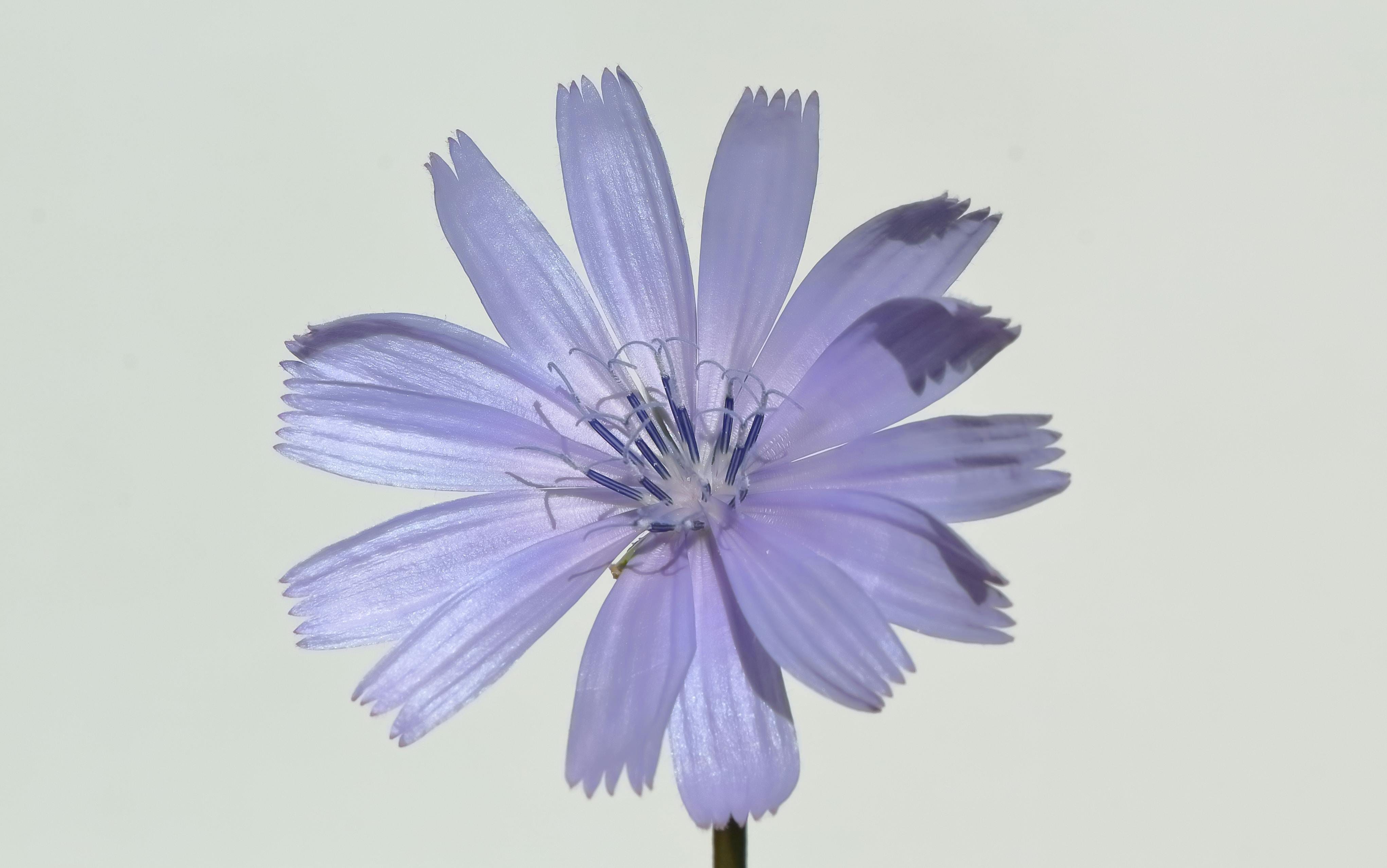
Chicory
Starting point of prebiotic research — the most inulin-rich root, with EFSA-approved defecation effect.
In 1 minute
What does it provide? Native inulin/oligofructose (ITF) at high concentration (root contains up to 40–68% on dry-matter basis) — selective bifidogenic effect, butyrate-positive SCFA shift (SCFA = short-chain fatty acid; butyrate = primary energy source for colonic epithelial cells), EFSA-recognized defecation maintenance at ≥ 12 g/day.
How much? Chicory coffee (roasted root) 1–2 cups/day; chicory inulin supplement 5–12 g/day, with gradual increase (low & slow).
When to avoid? Gallstones (choleretic effect), pregnancy (uterine-stimulating potential at large doses), IBS elimination phase, Asteraceae allergy.
Chicory was already cultivated in ancient Egypt and used as both medicinal and food plant — from the gardens of pharaohs it passed into the Greco-Roman world, where Horace mentions it as a modest Mediterranean food sustaining his days alongside olives and mallow; Pliny in a similar passage of Naturalis Historia notes wild chicory's digestion-supporting, fever-easing power. From the Renaissance onward, the species is particularly common in herbaria: it's standard fare in the great 16th-century German and Flemish herbals, recommended for liver, gallbladder, and cooling "bitter" remedies. (PMC)
The 18th–19th centuries brought a turning point: roasted chicory root became an important and cheap coffee substitute, especially in France, where during the Continental Blockade it replaced absent bean coffee. From there it spread into New Orleans coffee culture too — the 19th-century "café au lait," still served in hot milk form at Café du Monde today, is the classic form of the coffee-chicory blend. Meanwhile in this period another side branch became important: the root's main polysaccharide, inulin, was first described in 1804 by Valentin Rose, a Berlin pharmacist, isolated from elecampane (Inula helenium) root — the "fructan" nature was refined during the 19th century, and with this chicory became the starting point of modern prebiotic research. (Smithsonian Magazine, ScienceDirect)
🔬 Scientific Background
Chicory root's inulin and oligofructose content is outstanding (40–68% on dry-matter basis), and this made it the reference substrate of modern prebiotic research. From the 1990s, Gibson, Roberfroid, and colleagues demonstrated the bifidogenic effect in human studies, since confirmed by more than a hundred RCTs and several meta-analyses.
Inulin arriving in the colon is selectively fermented by Bifidobacterium and Lactobacillus genera, producing a characteristic butyrate shift in the end-product SCFA profile (because lactate and acetate produced by bifidobacteria are converted to butyrate by butyrate-producing Faecalibacterium prausnitzii and Anaerostipes). This "bifidogenic chain" is the classic mechanism described by Cherbut and others.
According to EFSA's 2015 health claim evaluation, intake of native chicory inulin at ≥ 12 g/day has a causal relationship with maintenance of normal defecation frequency. In clinical studies the effect appears within 2 weeks, with dose-dependent gas formation (transient, decreasing after adaptation).
- + Live cultures (yogurt, kefir, live probiotic): classic synbiotic principle — B. animalis + chicory inulin together yield stronger colonization and diversity increase.
- + Resistant starch (RS2/RS3 — cooked-cooled potato, banana, legumes): broader fermentation profile, less gas individually.
- + β-glucan (oats, barley): slower-fermenting, balanced SCFA response alongside inulin's rapid fermentation.
- + Chicory coffee with milk or plant milk: classic French "café au lait au chicorée" — calcium-absorption-supporting polyphenol matrix.
- + Roasted vegetable side (beetroot, carrot): bitter-sweet flavor synergy, polyphenol diversity.
- Strong acid + long heat (pH ≤ 4, ≥ 60 °C, 30+ min): inulin hydrolysis to fructose — prebiotic yield decreases, glycemic load increases.
- Sudden large dose (10+ g) of inulin on empty stomach in IBS-sensitive individuals: severe bloating, gas, abdominal cramps.
- Iron supplementation + large chicory polyphenol intake: time separation (≥ 2 hours).
- Gallstone flare + high-dose chicory inulin: choleretic effect may provoke colic.
- Anticoagulant (warfarin) + large vitamin K-rich chicory leaves: INR fluctuation — consistent dose recommended.
- Gallstones, active biliary disease, cholangitis: choleretic effect — avoid during flare.
- Pregnancy (high-dose supplement): uterine-stimulating potential in animal studies; dietary amounts OK.
- IBS elimination phase: avoid in the first 4–6 weeks, small-dose reintroduction (1–2 g).
- Asteraceae allergy: cross-reactivity with chamomile, mugwort, ragweed.
- Fructose malabsorption (FM): inulin's fructose may worsen burning syndrome.
- Severe SIBO: fermentable substrate worsens symptoms until SIBO is treated.
- Infant under 12 months: avoid concentrated inulin supplements.
Daily/weekly serving
Chicory coffee: 1–2 cups/day from roasted-ground root (1–2 tsp for filter or moka pot).
Chicory inulin supplement: start with 2 g/day, increase by 2 g weekly, target 8–12 g/day.
Chicory leaf (radicchio, witloof): 50–100 g in salad 2–3×/week.
Preparation pattern
- Chicory coffee: 1–2 tsp ground roasted chicory in 200 ml boiling water, 4 min steep, strain.
- Inulin powder: 2 g (≈ ½ tsp) in lukewarm water, yogurt, smoothie, with meals.
- Witloof salad: halve lengthwise through center, cut out hard core, slice into strips or leaf-by-leaf.
Classic patterns
Chicory caffè au lait (New Orleans): ⅔ hot milk + ⅓ chicory coffee + cane sugar — classic breakfast drink.
Witloof gratin (Belgian): poached witloof + béchamel + ham + cheese — baked to golden brown.
Radicchio alla griglia: halved red radicchio grilled, olive + balsamic reduction.
Trevisano risotto: diced trevisano into risotto with gorgonzola — bitter-salty-creamy classic.
Storage
Fresh witloof/radicchio: refrigerated in dark place 5–7 days. Chicory coffee (ground): airtight, dark place 3–6 months. Inulin powder: dry, airtight, room temperature 12–18 months.
What not to do
Don't cook witloof 30+ min — bitter compounds leach out. Don't start with 10+ g inulin — severe bloating. Don't add inulin to boiling vinegar (pH ≤ 3) — hydrolysis.
Endive is a related species of the chicory genus (Cichorium) — with curly-leaved ("frisée") or wider, smoother-leaved ("escarole") variants. A Mediterranean salad staple of classic French and Italian cuisine.
Differences from chicory:
- Inulin content lower than Witloof chicory or chicory root (5—8% on dry-matter basis versus witloof's 12—15%)
- Bitter character — similar sesquiterpene lactone profile (lactucin, lactucopicrin)
- Vitamin K, folate, vitamin A (β-carotene) higher than in witloof
- Water-soluble fiber moderate-to-high
Clinical use: the classic "escarole soup" (Italian traditional) is an element of the Mediterranean anti-inflammatory diet; as a salad, its mild bitterness supports digestion (bile-emptying activator). The vitamin K content requires consistent intake on warfarin therapy.
Microbiome perspective: moderate inulin content gives indirect bifidogenic effect — similar mechanism to chicory but weaker effect. High oxalate content requires attention in those prone to kidney stones.
FODMAP: Monash green up to 75 g (similar to witloof chicory, moderate fructan). Contraindications: same as chicory — gallstones, high-dose raw consumption during IBS flare.
References
[1] EFSA NDA Panel. Scientific Opinion on the substantiation of a health claim related to "native chicory inulin" and maintenance of normal defecation. EFSA Journal 2015;13(1):3951.
[2] Roberfroid M et al. Dietary modulation of the human colonic microbiota: updating the concept of prebiotics. Nutr Res Rev 2010;23(2):164–185.
[3] Cherbut C. Inulin and oligofructose in the dietary fibre concept. Br J Nutr 2002;87 Suppl 2:S159–S162.
[4] Kolida S, Meyer D, Gibson GR. A double-blind placebo-controlled study to establish the bifidogenic dose of inulin in healthy humans. Eur J Clin Nutr 2007;61(10):1189–1195.
[5] Micka A et al. Effect of consumption of chicory inulin on bowel function in healthy subjects with constipation: a randomized, double-blind, placebo-controlled trial. Int J Food Sci Nutr 2017;68(1):82–89.
[6] Le Bastard Q et al. The effects of inulin on gut microbial composition: a systematic review of evidence from human studies. Eur J Clin Microbiol Infect Dis 2020;39(3):403–413.
[7] Apolinário AC et al. Inulin-type fructans: a review on different aspects of biochemical and pharmaceutical technology. Carbohydr Polym 2014;101:368–378.
[8] Monash University. Chicory inulin FODMAP content. Monash FODMAP database.