


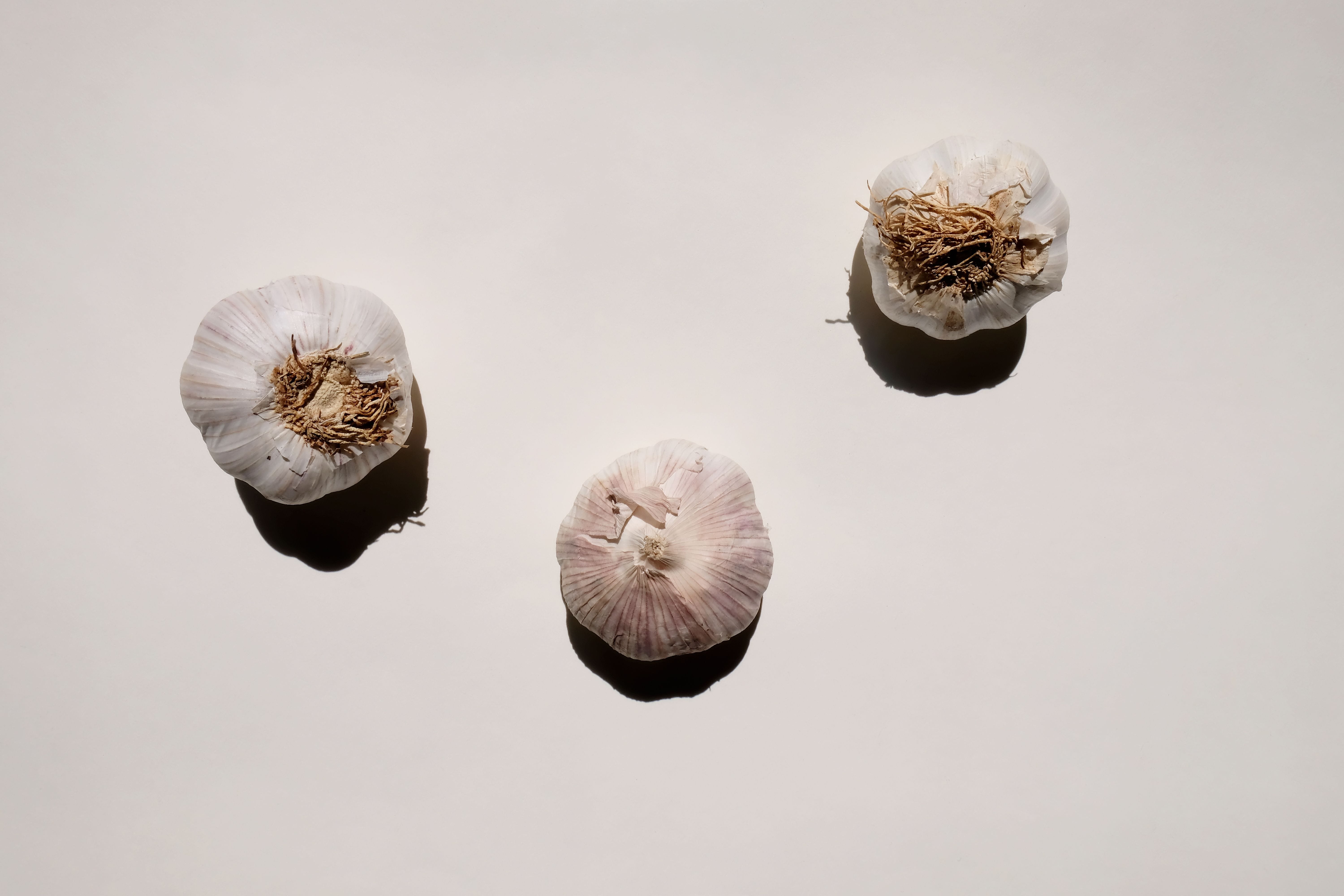
Garlic
From antiquity to cardiology — fructan prebiotic and sulfur-compound allicin in a single clove.
In 1 minute
What does it provide? Fructans and sulfur compounds (allicin, diallyl sulfides, S-allyl-cysteine/SAC) — prebiotic + antimicrobial dual effect, blood-pressure-lowering and lipid-modulating potential.
How much? 1–2 cloves of fresh garlic (≈ 3–6 g)/day; AGE (aged garlic extract) supplement 600–1200 mg/day for cardiovascular indication.
When to avoid? Warfarin/DOAC (anticoagulant interaction), 7–10 days before scheduled surgery, IBS elimination phase, active peptic ulcer, GERD flare.
Garlic's homeland is Central Asia, from where it spread along the Silk Road to both ends of the world; in ancient Egypt it was already a dietary and medicinal staple from the 3rd millennium BCE, and was part of pyramid builders' daily rations — according to Herodotus, an inscription beside the Cheops Pyramid recorded the amount spent on onions, garlic, and radishes for the workers' provisions. The Ebers Papyrus (ca. 1550 BCE) mentions it in several recipes, recommending it for 32 diseases, and dried garlic cloves were found in Tutankhamun's tomb. In Greco-Roman medicine, Hippocrates and Dioscorides prescribed it for digestive complaints, infections, and "vigor"; Olympic athletes reportedly considered it an endurance enhancer, and Roman soldiers even took the portable "medicine" on campaigns. (PMC)
In medieval Europe and the Middle East it was present as both food and medicinal herb, a staple of peasant cooking and monastic medicine — though Hildegard of Bingen cautioned against excessive raw garlic consumption, the monastery herbaria prescribed it regularly. Modern herbal and medical books consistently mention its antiseptic, expectorant, and circulation-supporting role; during the 1918 influenza pandemic it was a popular defensive measure across Europe, and Louis Pasteur documented garlic's antibacterial effect as early as 1858. Modern historical reviews emphasize garlic's continuous, multi-millennia "food–medicine" dual role. (PMC)
🔬 Scientific Background
Garlic's main bioactive system is the alliin–alliinase axis: in an intact clove, alliin (a stable sulfur-containing amino acid) and the alliinase enzyme are in separate cellular compartments. Crushing or chopping brings them together, and within 60 seconds allicin (diallyl-thiosulfinate) forms — this is responsible for garlic's characteristic pungent smell and largely for its bioactivity. Allicin is highly labile: under heat, acid, and time it rapidly converts to more stable diallyl sulfides (DAS, DADS, DATS) and vinyldithiins.
Aged garlic extract (AGE) has a different profile: instead of allicin, water-soluble S-allyl-cysteine (SAC) is the main active ingredient, which is stable and has well-documented bioavailability. AGE has the best evidence for moderate hypertension reduction (average 7–9 mmHg systolic, Ried 2020 meta-analysis), lipid modulation, and anti-aggregant effect.
The fructan fraction (raw garlic ≈ 17–18% on dry-matter basis) provides significant prebiotic contribution: in human RCTs, garlic extract induced microbiota shift (Lactobacillus/Clostridiales ratio change), and the GarGIC trial documented blood-pressure reduction and gut flora modulation in parallel in hypertensives. The antimicrobial side of sulfur compounds is paradoxical: in vitro broad-spectrum bactericidal, but in vivo at dietary amounts the commensal microbiota suffers no harm — the prebiotic fructans compensate.
- + Extra-virgin olive oil + tomato (sofrito): allicin stabilization, polyphenol synergy, "Mediterranean base plate."
- + Lemon/lime (in brief contact): acid stabilizes the thiosulfinates.
- + Live cultures (yogurt-tzatziki): garlic fructan + Lactobacillus synbiotic principle.
- + Legumes (hummus, dahl): fiber + GOS + ITF combo, butyrate-positive.
- + Meat/fish (iron uptake): quercetin-like effect, non-heme iron utilization.
- + Crush → rest 10 min → gentle heat: maximizes allicin formation and partially carries it through cooking.
- Warfarin, DOACs (apixaban, rivaroxaban, dabigatran, edoxaban): clinically documented INR rise and bleeding risk — avoid in large amounts, AGE supplement clearly contraindicated.
- Aspirin/clopidogrel + large amount of fresh garlic: additive anti-aggregant effect.
- HIV protease inhibitors (saquinavir): documented plasma level drop — avoid.
- Cyclosporine, tacrolimus: documented level decrease.
- GERD flare + raw garlic: severe reflux.
- Raw garlic on empty stomach: GI irritation, nausea, stomach pain.
- Long boiling with discarded liquid: water-soluble fructan + thiosulfinate leach out.
- IBS elimination phase: avoid in the first 4–6 weeks; reintroduce with garlic-infused oil.
- Anticoagulant therapy (warfarin, DOAC): large amounts and supplements should be avoided; dietary 1-2 cloves OK with medical supervision.
- 7–10 days before scheduled surgery: stop AGE supplement and reduce fresh consumption.
- Active peptic ulcer, GERD flare: avoid raw.
- Breastfeeding: the infant gets mildly "garlicky" tasting milk — not harmful, often preferred, but excessive amounts to be avoided.
- Allium allergy (rare, IgE-mediated): complete avoidance.
- Infant under 8 months: avoid.
- HIV therapy (PI-based): documented drug interaction.
Daily/weekly serving
1–2 cloves of fresh garlic (≈ 3–6 g)/day. AGE supplement: 600–1200 mg/day for cardiovascular indication.
Preparation pattern
- Peel (presses easily with a knife's flat side).
- Crush or finely mince.
- Rest for 10 minutes — this is the allicin formation time.
- Add to hot oil or food toward the end of cooking (≤ 30 sec high heat, or 1-2 min medium heat).
Classic patterns
Sofrito base: olive oil + finely chopped garlic + tomato.
Tzatziki: yogurt + grated cucumber + crushed garlic + olive + mint — synbiotic classic.
Aglio e olio: spaghetti + olive oil + sliced garlic (browned rosé) + chili + parsley.
Confit: whole cloves in oil at 90 °C for 1-2 hours — sweet, creamy, bread-spread.
Hummus: chickpea + tahini + crushed garlic + lemon + olive — GOS + ITF + polyphenol.
Storage
Whole clove head: dry, dark, ventilated place 2-3 months. Peeled cloves: refrigerated 7-10 days. Crushed garlic in oil (homemade): refrigerated max 4 days only (botulinum risk!). Commercial infused oil: per label.
What not to do
NEVER keep homemade garlic oil at room temperature (anaerobic environment → C. botulinum risk). Don't fry at 200+ °C for minutes (bitter, burnt taste). Don't add at the start of long soups (flavor loss and aroma profile reduction).
References
[1] Ried K. Garlic lowers blood pressure in hypertensive subjects, improves arterial stiffness and gut microbiota: a review and meta-analysis. Exp Ther Med 2020;19(2):1472–1478.
[2] Cavallito CJ, Bailey JH. Allicin, the antibacterial principle of Allium sativum. I. Isolation, physical properties and antibacterial action. J Am Chem Soc 1944;66:1950–1951.
[3] Lawson LD, Hunsaker SM. Allicin bioavailability and bioequivalence from garlic supplements and garlic foods. Nutrients 2018;10(7):812.
[4] Borrelli F et al. Garlic (Allium sativum L.): adverse effects and drug interactions in humans. Mol Nutr Food Res 2007;51(11):1386–1397.
[5] Ried K et al. The effect of aged garlic extract on gut microbiota, inflammation, and cardiovascular markers in hypertensives: The GarGIC Trial. Front Nutr 2018;5:122.
[6] Piscitelli SC et al. The effect of garlic supplements on the pharmacokinetics of saquinavir. Clin Infect Dis 2002;34(2):234–238.
[7] EMA/HMPC. Community herbal monograph on Allium sativum L., bulbus. 2017.
[8] Linus Pauling Institute. Garlic and organosulfur compounds. Oregon State University.