

Chia Seed
Soldier food of Aztec warriors — gel-forming mucilage fiber and one of the plant kingdom's highest ALA contents in a tiny seed.
In 1 minute
What does it provide? High α-linolenic acid (ALA, ω-3) content (≈ 17 g/100 g), gel-forming mucilage, insoluble fiber (≈ 34 g/100 g), polyphenols (caffeic acid, quercetin), calcium, and oxalate — viscous fiber effect + postprandial glycemia reduction.
How much? 1–2 tbsp/day (≈ 15–25 g) SOAKED. Clinical studies have used 14–25 g/day doses.
When to avoid? NEVER DRY (esophageal obstruction documented!), oxalate-kidney-stone tendency, anticoagulants + high ALA intake, salvia allergy.
Chia (Salvia hispanica) is native to Mesoamerica — today's Mexico and Guatemala area — and was a staple of Aztec and Maya cultures alongside corn, beans, and amaranth. According to written and ethnobotanical sources, the seed was used as food, as a drink (the water-soaked "chia fresca" or "agua de chía"), as oil, and as medicine, and was even collected as tribute into imperial warehouses. Aztec warriors constantly carried a "pinole-like" chia-honey food in small leather pouches, because a single handful carried enough energy with protein and fat for several days of hunting — the nourishing base of long campaigns. The name chia itself comes from the Nahuatl word "chian," meaning "oily."
Post-conquest 16th-century sources — especially Bernardino de Sahagún's monumental Florentine Codex — describe in detail the use and varieties of "chian/chía"; and the Codex Mendoza mentions the wide cultivation of chia and Tenochtitlán's annual supply of several hundred tons. Under colonial rule, chia almost completely disappeared from official culture — the Spanish tried to eradicate the seed associated with pagan Aztec gods — and survived only in Indian villages. The species' modern renaissance began in the 20th–21st centuries, when it was rediscovered as a high omega-3 source and technological hydrocolloid; today it is the wellness kitchen's little black-and-white "superfood" star, and chia pudding is a global phenomenon. **(PMC, JSTOR Florentine Codex)
🔬 Scientific Background
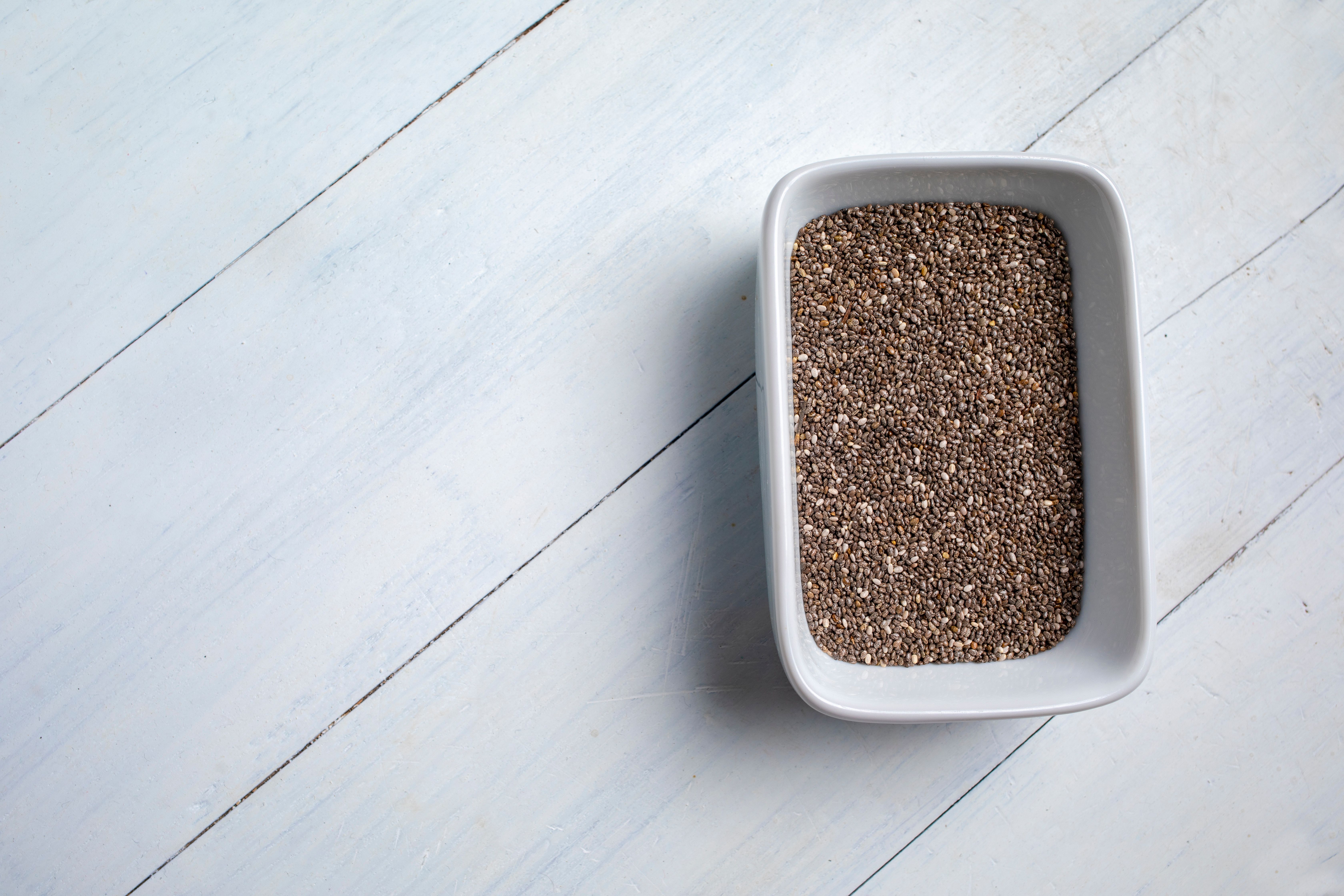
Chia seed has a uniquely dual matrix: the mucilage (gel-forming slime) on the seed surface can take up 10–12 times its own weight in water — hence the viscous "chia pudding" effect. Total fiber content is ≈ 34 g/100 g, of which about 4–5 g is soluble (mucilage). The oil contained in the seed makes up ≈ 30% fat content, with a 55–66% ALA ratio — one of the highest ALA contents in the entire plant kingdom.
Clinical evidence concentrates in three areas. Postprandial glycemia: Vuksan 2010's RCT showed that adding 3–24 g chia to a carbohydrate meal significantly lowers the postprandial glucose peak — viscous mucilage slows gastric emptying and glucose absorption. Blood pressure (T2D): in a 12-week RCT (Vuksan 2017), chia significantly reduced systolic blood pressure. ALA bioavailability: according to Nieman 2012, GROUND chia raises plasma ALA and EPA levels 2–3× better than WHOLE seed (which often passes through unchanged). The conversion rate to EPA remains low (5–10%), and to DHA almost nothing (< 1%).
EFSA-approved claim: "ALA contributes to the maintenance of normal blood cholesterol levels" — the favorable effect is achieved with a daily ALA intake of 2 g (this is ≈ 12 g chia).
Microbiome-level evidence is mainly in vitro and animal: limited fermentation of chia mucilage produces SCFA increase (mainly acetate) and improvement of gut barrier function. Human microbiome RCTs are few, but the general prebiotic role of viscous fiber is translatable.
- + Soaking (5–15 minutes or overnight gel): the gel consistency is safer and provides the full mucilage effect.
- + Freshly ground (when ALA is the goal): plasma ALA/EPA 2–3× higher than from whole seed.
- + Yogurt/kefir + berries: classic "chia pudding" pattern — synbiotic + polyphenol matrix.
- + Oatmeal or whole-grain muesli: β-glucan + mucilage synergy, broader SCFA profile.
- + Calcium-rich matrix (yogurt, fortified plant beverage): reduces oxalate absorption.
- + Along with a meal (glycemic goal): baked into bread, sprinkled on a slice, mixed into a drink — even 3–7 g gives acute glycemic benefit.
- + Smoothie hydration: soaks up water like a sponge, creamy texture.
- NEVER DRY + with solid food! A documented esophageal obstruction case (Rawla 2017) after dry chia + water. ALWAYS pre-soak OR drink with plenty of water.
- Anticoagulants (warfarin, DOAC) + large chia intake: theoretical bleeding-risk increase (ALA + viscous fiber). Culinary amounts are safe, therapeutic-dose supplements to be avoided.
- High heat, long baking (≥ 180 °C, 20+ minutes): ALA oxidation. In seed form inside dough it is protected, gentle baking is recommended.
- Medications + viscous gel (at the same time): the mucilage can bind medications — time separation (≥ 2 hours).
- High oxalate intake + low fluid intake: kidney-stone risk.
- Too large dose (> 50 g/day): GI symptoms (bloating, diarrhea, nausea).
- Dysphagia, esophageal stricture, achalasia: viscous gel can get stuck. As liquid, thoroughly diluted.
- Active bowel obstruction, severe bowel stricture (stricturing Crohn's): to be avoided (viscous gel can cause obstruction).
- Severe kidney disease, oxalate-kidney-stone tendency: chia is rich in oxalate (300–600 mg/100 g) — dose control, pair with calcium.
- Anticoagulant therapy + intentional high chia intake: medical consultation.
- Salvia allergy (rare): to be avoided.
- Infant (under 1 year): choking risk with unsoaked seed; small amount can be given soaked.
- 1–2 weeks before planned surgery: precaution — discontinue high-dose supplement-level chia (theoretical bleeding risk).
- Acute diverticulitis flare: to be avoided, safe in remission.
Daily serving
1–2 tbsp (≈ 15–25 g) soaked. Maximum 50 g/day, start with a small dose and increase gradually.
Preparation pattern
- Classic chia pudding: 2 tbsp chia + 200 ml liquid (milk, plant milk, kefir) → stir, wait 15–20 minutes → becomes gel.
- Freshly ground (ALA goal): 1 tbsp whole seed + flash-ground in coffee grinder → on top of yogurt/smoothie.
- Baked into bread/cookie: dough moisture activates the mucilage — protected during baking.
Classic patterns
Chia pudding breakfast: 2 tbsp chia + 200 ml kefir + ½ tbsp honey + berries + 1 tbsp walnut — overnight, fresh breakfast.
Chia egg (vegan): 1 tbsp ground chia + 3 tbsp water → 5 minutes → "egg substitute" in baking (pancake, brownie).
Agua de chía (classic Mexican): 2 tbsp chia + 500 ml water + lime juice + minimal honey — refreshing summer drink.
Chia oatmeal: rolled oats + 1 tbsp chia + milk → 5 minutes simmer — protein + fiber + ω-3.
Smoothie thickener: 1 tsp chia + any smoothie → 10 minutes rest → creamy consistency.
Storage
Whole chia: in an airtight jar, in a cool dark place — 1–2 years (the hydrophobic mucilage and polyphenol layer protect it). Ground chia: refrigerated, max 1–2 weeks (oxidation).
What not to do
NEVER eat dry chia with solid food. Don't bake above 180 °C for 30+ minutes. Don't store ground chia at room temperature for days.
References
[1] Vuksan V et al. Reduction in postprandial glucose excursion and prolongation of satiety: possible explanation of the long-term effects of whole grain Salba (Salvia hispanica L.). Eur J Clin Nutr 2010;64(4):436–438.
[2] Vuksan V et al. Salba-chia (Salvia hispanica L.) in the treatment of overweight and obese patients with type 2 diabetes: a double-blind randomized controlled trial. Nutr Metab Cardiovasc Dis 2017;27(2):138–146.
[3] Nieman DC et al. Chia seed supplementation and disease risk factors in overweight women: a metabolomics investigation. J Altern Complement Med 2012;18(7):700–708.
[4] EFSA Panel on Dietetic Products, Nutrition and Allergies. Scientific Opinion on the substantiation of health claims related to ALA. EFSA Journal 2009;7(9):1252.
[5] Rawla P et al. Dysphagia, esophageal obstruction, and chia seeds. Am J Emerg Med 2017;35(8):1212.e1–1212.e2.
[6] Sandoval-Oliveros MR, Paredes-López O. Isolation and characterization of proteins from chia seeds (Salvia hispanica L.). J Agric Food Chem 2013;61(1):193–201.
[7] Knez Hrnčič M et al. Chia seeds (Salvia hispanica L.): an overview — phytochemical profile, isolation methods, and application. Molecules 2019;25(1):11.
[8] Monash University. High and Low FODMAP foods. Monash FODMAP database.