


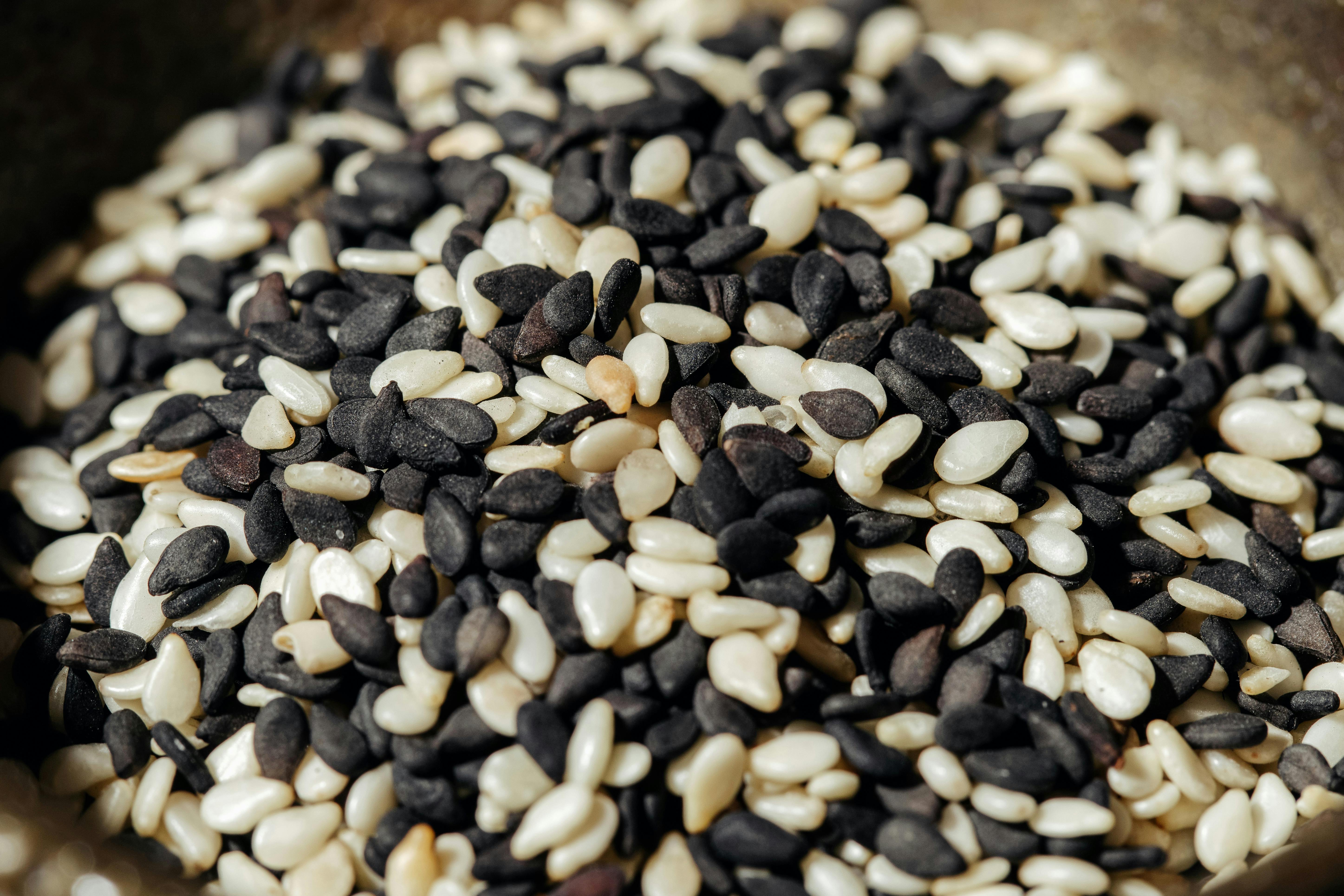
Sesame Seed
Drink of Assyrian gods — sesamin lignans, high calcium, and the unmatched bioavailability of tahini (ground paste).
In 1 minute
What does it provide? Sesamin lignans (gut bacteria convert to enterolactone — weak phytoestrogen + antioxidant), outstanding calcium content in the unhulled form (≈ 975 mg/100 g), γ-tocopherol (the most biologically effective vitamin E isomer), and phytosterols (≈ 400–600 mg/100 g — LDL-lowering). RCT meta-analysis: sesame/sesame oil lowers LDL cholesterol and triglycerides in T2D (Khalesi 2016).
How much? 1–2 tbsp/day (≈ 10–30 g) seed OR 2 tbsp tahini (ground paste — higher lignan bioavailability than whole seed). In clinical studies: 25–40 g/day for 4–8 weeks.
When to avoid? Confirmed sesame allergy (IgE-mediated; the allergen Ses i 1 is HEAT-STABLE — roasted and tahini are also reactive; since 2023 in the USA, allergen labeling is mandatory), calcium-oxalate kidney-stone tendency (unhulled sesame is high in oxalate), large doses on anticoagulant treatment, infants under 1 year raw, simultaneous tetracycline/quinolone antibiotic (calcium chelate — keep 2-hour separation).
Sesame is one of the world's oldest oilseeds, with domestication tied to the Indian subcontinent; reliable archaeobotanical finds appear in masses from the second half of the 3rd millennium BCE. The plant and its oil reached Mesopotamia by trade, where Herodotus noted that in Babylonia almost all oil was pressed from sesame seed. According to Assyrian mythological texts, the gods drank sesame wine before they created the world — the seed even inscribed itself into the era's mythology. The well-known "Open Sesame!" magic spell from the Ali Baba tale also conceals the old observation that ripe sesame pods pop open by themselves with a tiny snap — a wonderful natural metaphor for opening hidden treasures.
Classical Greek and Roman authors also mention the seed, and it was a widespread food and medicinal plant across the Mediterranean and the Near East: among the Romans, a dessert called "sesamum" made from a mixture of sesame and honey was served at the end of wedding feasts. In the Levant, sesame oil and tahini (ground paste) are still kitchen staples — hummus, halva, baklava all revolve around the little black-and-white seed. With modern globalization, sesame is now an everywhere-available ingredient, from the top of the hamburger bun to the daily oil of Korean and Japanese kitchens. **(Springer, UCL Homepages)
🔬 Scientific Background
Sesame's bioactive matrix is unique because of its lignan content. Lignans: sesamin (≈ 0.5 g/100 g), sesamolin, sesamol — the seed's unique aroma and antioxidant stability also come from here. Fatty acid profile: oleic acid (≈ 40%) + linoleic acid (≈ 45%) + γ-tocopherol (the most biologically effective of the tocopherol isoforms). Calcium: 975 mg/100 g UNHULLED (hulled is only 60 mg) — an outstanding plant source. Phytosterols: ≈ 400–600 mg/100 g — outstanding among seeds, LDL-lowering mechanism.
Clinical evidence arrives from two directions. Lignan bioavailability: in Penalvo 2005's human study, sesame sesamin caused measurable enterolactone elevation in plasma (≈ 10× baseline) even after a single dose. Tahini (ground paste) gives a HIGHER plasma enterolignan level at the SAME lignan intake than whole seed — grinding enhances bioavailability and microbial conversion. Lipid profile: according to 2024 meta-analysis (Khalesi 2014, updates), sesame/sesame oil reduces TC (≈ −15 mg/dL), LDL, and TG in the T2D population; HDL does not change meaningfully. Evidence is moderate quality and heterogeneous.
At the microbiome level, in vitro and association data show that enterolactone levels move together with lignan intake and the abundance of the "lignan-converting" species of the gut flora profile (especially Clostridium and Eggerthella genera).
The sesame allergen Ses i 1 (2S albumin), Ses i 2, and Ses i 3 — HEAT-STABLE, NOT inactivated by cooking/roasting. In the USA it became the 9th mandatorily labeled allergen in 2023.
- + Tahini form (ground paste): higher bioavailability than whole seed — advantage for lignan goal.
- + Roasting (moderate, 150 °C, 10–12 minutes): sesamolin → sesamol/sesaminol conversion, antioxidant enhancement.
- + Lemon juice + olive oil (hummus, baba ghanoush): classic Levantine pattern — vitamin C improves non-heme iron absorption, olive MUFA improves carotenoid bioavailability.
- + Sprouting/soaking: reduces phytate/oxalate load, improves calcium bioavailability.
- + Yogurt/kefir: synbiotic synergy, lignan converter support.
- + Stir-fried Asian vegetables + a few drops of sesame oil (at the end): gentle addition preserves γ-tocopherol and the delicate aroma.
- + Salt substitute gomashio: ground sesame + sea salt mixture — Japanese tradition, moderate sodium, high calcium.
- High heat, long roasting (≥ 200 °C, 20+ minutes): lignan conversion exceeds the gentle level, acrylamide formation, flavor breakdown.
- Iron supplementation + large sesame intake: phytates chelate iron — ≥ 2 hours separation.
- Tetracycline/quinolone antibiotics + high calcium intake (unhulled sesame, tahini): chelate formation → antibiotic level drop. Separate by 2 hours.
- Levothyroxine + high fiber/phytate at the same time: absorption decrease. Medication 30–60 minutes earlier.
- High oxalate intake + low fluid intake: kidney stone risk (unhulled sesame is loaded with oxalate).
- Rancid/off-smelling sesame oil: ROS load.
- Sesame allergy (confirmed, IgE-mediated): strict total avoidance. The allergen is HEAT-STABLE — roasted, tahini, oil are equally allergenic. Adrenaline auto-injector (EpiPen) carriage required. Allergy has shown significant increase since 2010, especially in children.
- Unhulled sesame + chronic kidney disease: high oxalate, potassium, phosphorus — dose control, hulled form or tahini advantageous.
- Kidney stones (calcium-oxalate stone tendency): unhulled sesame is oxalate-rich — choose hulled sesame, or moderate serving + plenty of fluid + calcium pairing.
- Anticoagulant therapy + intentional high sesame intake: medical consultation (theoretical risk).
- Infant (under 1 year): small amount, soaked/ground. Sesame allergy is a growing pediatric problem — heightened attention.
- Chronic kidney disease (stage 3+): moderately high potassium, phosphorus — dose control.
- Hormone-sensitive tumor (ER+ breast cancer): lignans have weak phytoestrogen effects — clinical data tend to show beneficial effect; consult oncologist during active chemotherapy.
- Active peptic ulcer: moderate serving, in gentle form.
Daily serving
1–2 tbsp (≈ 10–30 g) seed, or 2 tbsp tahini, or 1–2 tsp toasted sesame oil (as a flavor enhancer).
Preparation pattern
- Roasting (gentle): 140–150 °C, 8–12 minutes, or in a pan 2–3 minutes with continuous shaking — flavor deepening, polyphenol conversion.
- Making tahini: 200 g roasted sesame + 2–3 tbsp neutral oil → blend to a creamy paste. 1 month in fridge.
- Sprouting: 4–6 hours soak → rinse 2× daily → 1–2 days → phytate reduction.
Classic patterns
Hummus: cooked chickpeas + 2–3 tbsp tahini + lemon juice + garlic + olive oil → classic Levantine sauce.
Baba ghanoush: roasted eggplant + tahini + lemon juice + garlic + olive oil — smoky eggplant paste.
Halva: tahini + sugar/honey + nuts → Eastern dessert, in moderation.
Gomashio (Japanese): roasted sesame + sea salt ground together → on top of rice/vegetables, sodium-moderating.
Tahini-lemon salad dressing: 2 tbsp tahini + lemon juice + water + garlic + parsley — over green salad.
Asian-style roasted vegetables: unrefined sesame oil at the END of cooking (small drop) — flavor enhancer.
Storage
Whole sesame: in an airtight jar, in a cool dark place — 6–12 months. Hulled sesame: 3–6 months. Tahini: refrigerated, 3–6 months (may separate on top — stir). Sesame oil: in a dark bottle, refrigerated, 6 months (toasted), 3 months (unrefined).
What not to do
Don't roast above 200 °C. Don't fry with toasted sesame oil at high heat. Don't consume rancid/off-smelling product. With sesame allergy, do NOT consume in any form.
Black sesame is the dark pigmented variety of sesame — a classic element of East Asian, Indian, and Korean kitchens. The pigment matrix gives an antioxidant capacity significantly higher than that of white sesame varieties.
Differences from white sesame:
| Parameter | White sesame | Black sesame |
|---|---|---|
| Anthocyanin content | virtually none | 50—150 mg/100 g |
| Lignans (sesamin, sesamolin) | medium | often higher (Cheng 2006) |
| ORAC (antioxidant capacity) | baseline | 2—3× that of white |
| Amino acid profile | identical | identical |
| Oil content | ≈ 50% | slightly lower (≈ 45%) |
Clinical evidence partly overlaps with white sesame — the Sankar 2006 J Med Food hypertension RCT is extrapolable to both variants. Specifically for black sesame: Wu 2006 Eur J Clin Nutr — improving lipid profile in postmenopausal women using 25 g/day black sesame paste for 8 weeks. From a microbiome standpoint, the anthocyanin matrix indicates Akkermansia-supporting potential similar to black elderberry (IV.26) — direct human RCT evidence is scarce.
Donor-diet interpretation: the dual strength of black sesame (lignan + anthocyanin) is its own category. Other parameters (allergen, FODMAP, oxalate, factory quality) are identical to white sesame.
Tahini is the finely ground paste of sesame seed (hulled or unhulled) — a classic base of Middle Eastern, Mediterranean, and North African kitchens. The light, creamy version is made from hulled sesame ("light tahini"), or the brownish, flavorful version from unhulled ("dark tahini").
Nutrient profile per 100 g tahini (USDA NDB #12166):
- 595 kcal, 17 g protein, 53 g fat (predominantly MUFA + PUFA), 22 g carbohydrate, 9 g fiber
- Calcium 426 mg (RDI 33%); up to 1000 mg/100 g in the unhulled variety
- Iron 8.9 mg (50% RDI), magnesium 95 mg, phosphorus 732 mg
- Lignans (sesamin, sesamolin) more concentrated than in whole seed
Clinical relevance: thanks to its concentrated format, a small serving (1—2 tbsp = 15—30 g) is a significant micronutrient supplement. Tahini-based hummus (chickpea + tahini + lemon + olive oil) is a complete amino acid matrix. High oxalate content — kidney-stone-prone individuals should use controlled dosing.
Buying: only 100% sesame seed composition, without added sugar or oil. "Stone-ground" processing preserves lignan content. Allergen warning for sesame is mandatory in the EU (also in the USA since 2023 — FASTER Act).
References
[1] Penalvo JL et al. Quantification of lignans in food using isotope dilution gas chromatography/mass spectrometry. J Agric Food Chem 2005;53(24):9342–9347.
[2] Khalesi S et al. Sesame fractions and lipid profiles: a systematic review and meta-analysis of controlled trials. Br J Nutr 2016;115(5):764–773.
[3] Wu WH et al. Sesame ingestion affects sex hormones, antioxidant status, and blood lipids in postmenopausal women. J Nutr 2006;136(5):1270–1275.
[4] Coulman KD et al. Whole sesame seed is as rich a source of mammalian lignan precursors as whole flaxseed. Nutr Cancer 2005;52(2):156–165.
[5] Warren CM et al. Prevalence and severity of sesame allergy in the United States. JAMA Netw Open 2019;2(8):e199144.
[6] FDA. FASTER Act of 2021 — sesame as the 9th major food allergen. Effective January 1, 2023.
[7] Pathak N et al. Bioactive constituents of Sesamum indicum: a comprehensive review. J Pharm Pharmacol 2014.
[8] Monash University. High and Low FODMAP foods. Monash FODMAP database.