


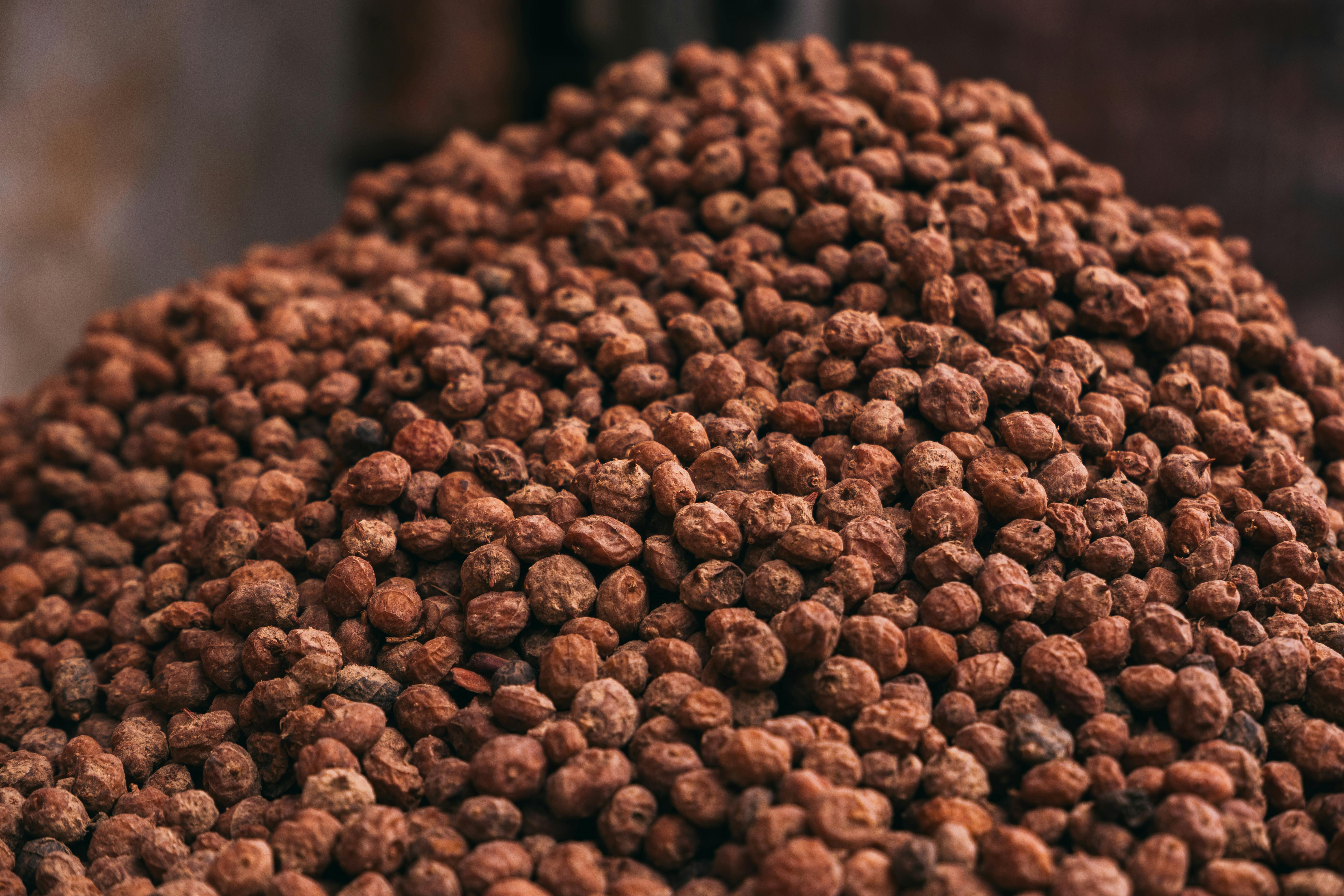
Tigernut
The bowl of early humans — staple diet of Paranthropus boisei and the tuber behind Valencian horchata; gluten-free, RS-rich, FODMAP-green.
In 1 minute
What does it provide? Resistant starch (23–48% of the tuber's starch is partly "resistant" — meaning the small intestine doesn't digest it, but the colonic bacteria ferment it into butyrate), insoluble fiber (8–15%), and oleic-acid-dominant MUFA fat (≈ 25%, similar to olive oil). Gluten-free, lactose-free alternative. Tigernut is NOT a nut — it's a sedge tuber.
How much? 30–50 g/day of soaked tuber or 300 ml unsweetened horchata. Human pilot RCT (Cabello-Olmo 2021, n=31): 300 ml/day of natural orxata for 3 days enriched butyrate-producing bacteria (Faecalibacterium, Bifidobacterium, Akkermansia).
When to avoid? Heavily sweetened commercial horchata (8–12% added sugar, glycemic load), stage 3+ chronic kidney disease (phosphorus + potassium), active IBD flare (insoluble fiber), the sweet version in uncontrolled diabetes, infant < 1 year as standalone food, simultaneous iron supplementation (≥ 2 hours separation — polyphenols chelate iron).
Cyperus esculentus — tigernut and the small round tuber called "earth-almond" in Hungarian — was a plant domesticated and consumed early in ancient Egypt: archaeological and iconographic evidence attests that tigernut cakes were already made from it in the 15th century BCE — depicted on the walls of Vizier Rekhmire's tomb chamber. The literature mentions it as "snack of the gods" and also reports medicinal and perfume uses; charred tubers have been found in several pharaohs' tombs, intended as travel provisions for the deceased in the afterlife. Its name is even hidden in the mandatory Latin naming of the botanical family: esculentus means "edible" — in the eyes of antiquity, it was a natural table delicacy. According to African anthropological research (Macho 2014), tooth wear and isotope evidence of Paranthropus boisei (the "nutcracker hominid"), who lived 2.4–1.4 million years ago, suggests that Cyperus tubers made up a significant part of the staple diet — meaning it is an ancient and truly "early-human food."
In the Middle Ages, during the al-Andalus period, the species reached today's Valencia region through Arab mediation, where the orxata made from chufa (horchata de chufa) was born — according to tradition, a Moorish girl first offered it to King James I of Aragon, who liked it so much he exclaimed: "aó é orçata!" ("this is gold indeed!") — and the Catalan saying turned into horchata. Valencia still makes chufa-orxata with protected designation of origin (DO), and horchata is just as obligatory a summer drink on the Catalan coast as ice cream is in the Mediterranean. Chufa is today a traditional, gluten-free, and lactose-free seed alternative in Southern Europe and West Africa, available worldwide. **(Cambridge UP, Macho 2014 PLOS ONE)
🔬 Scientific Background
Tigernut's bioactive matrix contains three key fractions. Starch: ≈ 23–48% — A-type crystallinity, variable amylose content (10–27%). Cooling-reheating (retrogradation) increases the RS3 fraction; the untreated tuber alone is already a significant resistant-starch source. Fiber: ≈ 8–15% (insoluble-dominant), high water- and oil-binding capacity — also technologically favorable. Polyphenols: gallic acid, p-coumaric acid, ferulic acid, catechin, luteolin, rutin — medium-to-high antioxidant capacity.
Fatty acid profile: ≈ 25% fat, mainly oleic acid (≈ 65–75%, MUFA) — similar to olive oil or almond. Calcium (≈ 80 mg/100 g), magnesium, iron, phosphorus — micronutrient-rich.
Clinical evidence is limited but instructive. Human microbiome pilot (3 days, n=31; Cabello-Olmo 2021): 300 ml/day of natural, unsweetened orxata significantly shifted the stool microbiota toward butyrate-associated patterns — Faecalibacterium, Bifidobacterium, Lachnospira enrichment, plus Akkermansia and Christensenellaceae elevation. The effect is responder-type (depends on individual baseline microbiota) and is measurable already after 3 days. In vitro fermentation: chufa flour behaves as an RS source, but is not the strongest in butyrate response — the polyphenol fraction contributes as a complementary microbiota modulator.
The anthropological-evolutionary context is especially interesting: per Paranthropus boisei isotope and tooth wear analysis (Macho 2014, PLOS ONE), Cyperus tubers made up the largest calorie fraction — meaning chufa is an "ancient human food," not a new wellness trend.
- + Natural, unsweetened horchata: this is the form that gave the butyrate response in the human RCT.
- + Soaking (24 hours): consume dried tubers after soaking — better texture, less gas formation.
- + RS3 formation (cool-reheat): boiled-and-cooled chufa delivers more resistant starch.
- + Fermentation (water kefir, LAB): synbiotic chufa drink — acidification, live culture.
- + Inulin/FOS or whole-grain cereal: broader SCFA profile — per human data, butyrate-associated genera strengthen.
- + Mediterranean meal: olive MUFA + chufa MUFA + vegetables — composite matrix.
- + Instead of sweetening: minimal cinnamon, vanilla: flavor complement without sugar.
- Heavily sweetened commercial horchata: the traditional commercial form contains 8–12% added sugar — glycemic load, pointless for microbiome goals.
- Enzymatic starch hydrolysis (industrial sweetening): reduces the RS fraction — potentially weaker prebiotic effect.
- High heat, long cooking: hydrolyzes starch, reduces the RS fraction. Gentle processing (max 100 °C) recommended.
- Iron supplementation + large chufa intake: polyphenols chelate iron — ≥ 2 hours separation.
- Large serving without soaking: GI bloating due to high fiber/starch — gradual introduction.
- Rancid/moldy dried tuber: discard immediately.
- Cyperaceae allergy (extremely rare): to be avoided. Cross-reaction with other Cyperus species possible, but almost never relevant in a nutritional context.
- Active peptic ulcer: moderate serving, in gentle form (orxata).
- Active IBD flare: insoluble fiber irritation — safe in remission.
- Chronic kidney disease (stage 3+): moderate phosphorus + potassium — dose control. Oxalate is not critically high, but should be monitored.
- Severe diabetes (uncontrolled): sweetened horchata to be avoided; safe and potentially beneficial in unsweetened form (RS effect).
- Infant (under 1 year): can be given in small amounts, soaked. Does NOT replace breast milk/formula.
- Nut-like allergic reaction: if an unexpected allergic symptom occurs from chufa consumption, stop immediately — consider cross-contamination of the current batch (with other nuts/seeds in the same facility).
Daily serving
30–50 g soaked tuber, or 300 ml unsweetened natural horchata.
Preparation pattern
- Soaking: 50 g dried chufa + water, 24–48 hours (change water 1×) → soft, slightly sweet texture.
- Making horchata: 200 g soaked chufa + 1 liter water + minimal cinnamon → blender → strain through muslin. Refrigerated 2–3 days.
- Grind into flour: dried chufa → fine flour with blender/coffee grinder → base for gluten-free baking.
- RS3 formation: chill boiled chufa for 12 hours in a cold place → reheat or use cold on salad.
Classic patterns
Horchata de chufa (classic Valencian): soaked chufa + water + minimal cinnamon → chilled, alongside fartones (sweet pastry).
Chufa pudding: soaked chufa + plant milk + chia + minimal honey → overnight, breakfast.
Gluten-free baking: chufa flour + almond flour + egg + minimal honey → pancake, muffin.
Smoothie thickener: 1 tbsp chufa flour + banana + plant milk + cinnamon.
Chufa praline: soaked chufa + dark chocolate + cinnamon → bonbon-like snack.
Storage
Dried tuber: in an airtight jar, in a cool dark place — 1–2 years. Soaked tuber: refrigerated, 2–3 days. Horchata (freshly made): refrigerated, 2–3 days. Chufa flour: airtight in fridge, 6 months.
What not to do
Don't eat dry (hard, gas). Don't choose sweetened commercial horchata for microbiome goals. Don't hydrolyze the RS fraction with enzymes/long cooking. Don't mix into the diet of someone with nut/almond allergy without consideration.
References
[1] Cabello-Olmo M et al. Tiger nut (Cyperus esculentus) consumption modulates gut microbiota and short-chain fatty acid production in healthy adults: a pilot study. Nutrients 2021;13(6):1903.
[2] Macho GA. Baboon feeding ecology informs the dietary niche of Paranthropus boisei. PLOS ONE 2014;9(1):e84942.
[3] Sánchez-Zapata E et al. Tiger nut (Cyperus esculentus) commercialization: health aspects, composition, properties, and food applications. Compr Rev Food Sci Food Saf 2012;11(4):366–377.
[4] Roselló-Soto E et al. Tiger nut and its by-products valorization: from extraction of oil and valuable compounds to development of novel healthy products. Innov Food Sci Emerg Technol 2018.
[5] Bamishaiye EI, Bamishaiye OM. Tiger nut: as a plant, its derivatives and benefits. Afr J Food Agric Nutr Dev 2011;11(5):5157–5170.
[6] Pascual B et al. Chufa (Cyperus esculentus L. var. sativus Boeck.): an unconventional crop — studies related to applications and cultivation. Econ Bot 2000;54(4):439–448.
[7] Cortés C et al. Determination of carotenoids, vitamins A and E, and crystalline carbohydrates in tiger nut. Food Chem 2005.
[8] Monash University. High and Low FODMAP foods. Monash FODMAP database.