
Elderberry
Europe's anthocyanin champion — upper respiratory immunomodulation, Akkermansia support, but the raw berry contains
Elderberry in 1 minute
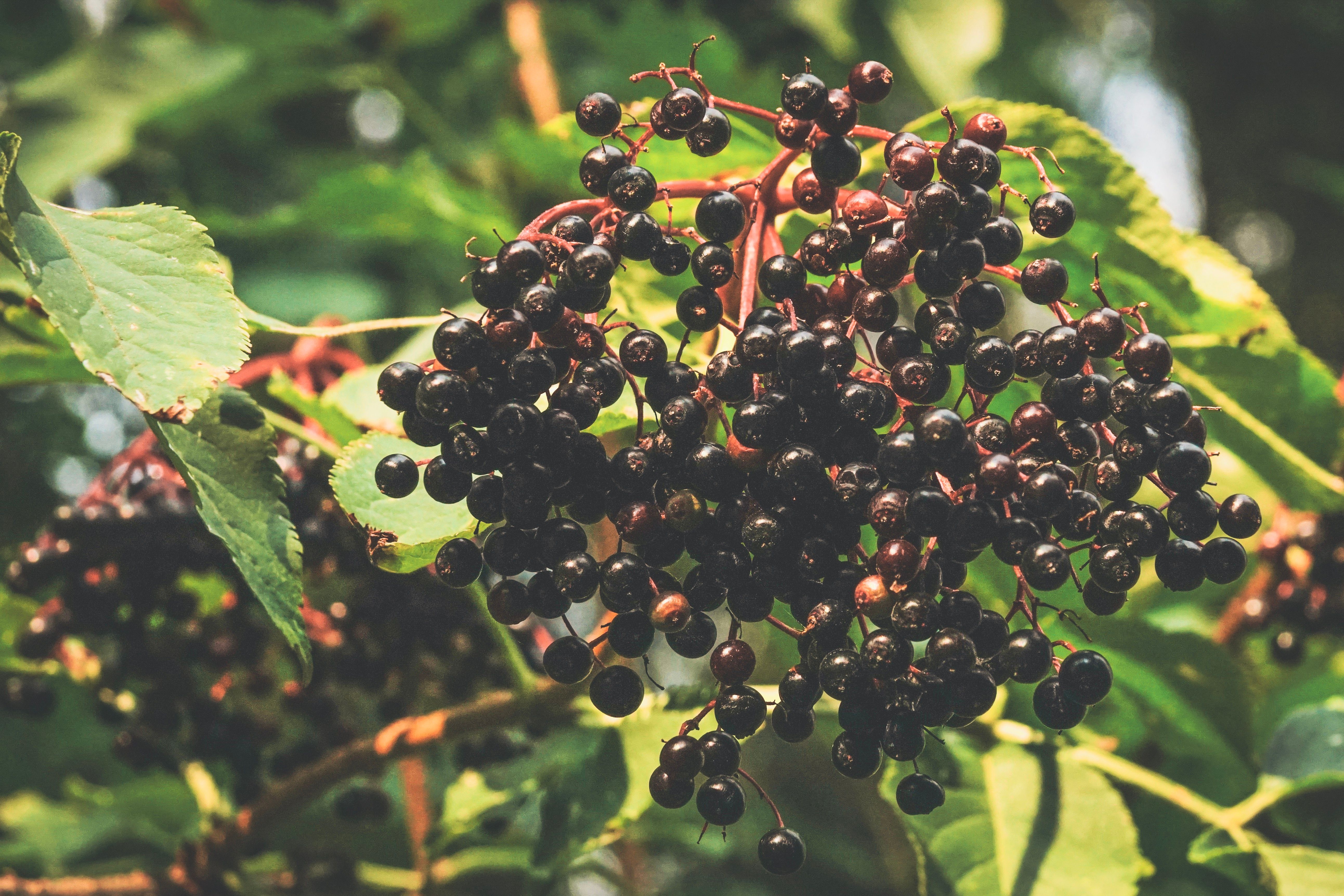
What does it provide? Anthocyanins (cyanidin-3-glucoside + cyanidin-3-sambubioside 200—1500 mg/100 g fresh berry), flavonoids (quercetin, rutin, kaempferol), chlorogenic acid, and vitamins A and C. It belongs to the European anthocyanin champions — concentration-wise it rivals black currant and bilberry.
How much? 10—15 g dried or 30—50 g cooked berries / day, or 15—30 ml standardized elderberry syrup (Sambucol formula: ≈ 8 g elderberry-equivalent / 15 ml). Clinical RCTs (Tiralongo 2016, Zakay-Rones 2004) used this dose.
When to avoid? RAW, UNRIPE BERRY IS FORBIDDEN (cyanogenic glycoside — sambunigrin). Leaves, bark, and roots are always toxic. May only be consumed in cooked or dried/processed form. Autoimmune disease under immunosuppressive therapy: consult (immunomodulation may worsen control).
Black elderberry is one of Europe's oldest medicinal plants. Hippocrates called it "nature's medicine chest"; Dioscorides referred to it as "medicinal chest" in De Materia Medica. In Historia Naturalis Pliny lists preparations made from flowers, berries, and bark for cough, wound healing, and fever. In medieval Europe, the elder was regarded as the "village pharmacy" — it stood in every farmyard, and folk tradition held that the garden witch's protective spirit lived inside. Irish Brehon Laws (8th century) strictly regulated the cutting of elder trees — it was considered a sacred plant.
Modern research exploded after 1990: in 1995, Israeli virologist Madeleine Mumcuoglu patented the Sambucol formula (standardized berry extract) for influenza symptomatic treatment. Zakay-Rones 1995 and 2004 J Int Med Res RCTs delivered classic human evidence. From the 2010s, research on the anthocyanin-microbiome axis (Hawkins 2019 meta-analysis, Tiralongo 2016 air-traveler RCT) expanded the clinical indications. In Hungary, elderberry syrup (Margaret Island-style syrup) is a classic summer drink, and elderberry pálinka is part of the Upper Hungarian fruit-distillate tradition.
Scientific Background
The main bioactive fraction of black elderberry is the anthocyanin matrix: cyanidin-3-glucoside (C3G), cyanidin-3-sambubioside, and cyanidin-3,5-diglucoside dominate. The anthocyanin content of ripe berries on a dry-weight basis ranges from 200 to 1500 mg/100 g (variety-, season-, and ripening-dependent) — in the European anthocyanin ranking, alongside black currant and bilberry.
Clinical evidence is most robust for upper respiratory infections. In Zakay-Rones 2004 J Int Med Res RCT, Sambucol syrup (4× 15 ml/day for 5 days) shortened symptom duration by an average of 4 days in patients with confirmed influenza A/B compared with placebo. Tiralongo 2016 Nutrients (n=312 air travelers) tested standardized 600—900 mg/day elderberry extract for travel cold prevention: significantly shorter symptom duration and fewer days spent in the symptomatic state. Hawkins 2019 Complement Ther Med meta-analysis synthesized 4 RCTs (180 participants): elderberry significantly reduced upper respiratory symptom duration.
The proposed mechanism is multidirectional: (1) hemagglutinin inhibition — Roschek 2009 Phytochemistry showed effective in vitro neutralization against influenza A H1N1; (2) cytokine modulation — IL-6, TNF-α reductions in human pilots; (3) anthocyanin bioactivation — C3G is converted to protocatechuic acid (PCA) by colonic microbiota (Czank 2013 AJCN human metabolism), and PCA acts systemically on endothelial function.
At the microbiome level, elderberry anthocyanins selectively support the Akkermansia muciniphila and Bifidobacterium proportions — human pilot studies and in vitro fermentation models (Le Sayec 2022 Mol Nutr Food Res providing the aronia analogy) show consistent results. Anthocyanin-mediated gut-barrier strengthening (mucin-2 expression enhancement) is documented in preclinical models; human data is limited — hence the evidence is ★★.
Safety issue — CRITICAL: Raw, ripe elderberry contains cyanogenic glycosides (sambunigrin, prunasin) in the seed; leaves, bark, and roots in significant quantities. When eaten raw, sambunigrin hydrolysis releases hydrogen cyanide — nausea, vomiting, abdominal cramps, and at high doses neurological symptoms (CDC 1984 documented mass poisoning in California, 25 people, from fresh "herbal juice"). Cooking (≥ 80 °C, 10 min) or drying completely breaks down the glycoside — so all commercial products (syrup, extract, dried berry) are safe.
- + Vitamin C sources (rosehip, citrus, kiwi): synergistic anti-influenza evidence.
- + Zinc sources (oyster, pumpkin seed, pork): immune-receptor synergy.
- + Honey (small amount): classic "elderberry syrup + honey" recipe for respiratory symptom relief.
- + Ginger + lemon juice: classic "winter cocktail" matrix.
- + Kefir or yogurt: synbiotic polyphenol-LAB principle.
- + Cold water or sour tea: low-temperature extract for maximum anthocyanin content.
- + Dark chocolate: dual polyphenol matrix.
- RAW, ripe berry: cyanogenic glycoside — vomiting, diarrhea, neurological symptoms. FORBIDDEN.
- High-temperature, long cooking (≥ 120 °C, > 30 min): significant anthocyanin degradation — color and efficacy decrease.
- Iron supplement at the same meal: polyphenols may chelate iron — ≥ 2 hour separation recommended.
- Immunosuppressive therapy (corticosteroids, calcineurin inhibitors, biologics): elderberry-mediated cytokine modulation may worsen control.
- High-dose supplement long-term (> 6 weeks) in children: chronic-effect evidence is lacking.
- Vermouth, gin, white wine in high doses: ethanol + high anthocyanin may increase oxidative stress.
- Autoimmune disease (RA, SLE, MS, Crohn's) under immunosuppressive therapy: elderberry is immunomodulatory (IL-6 ↑) — avoid or use under medical supervision.
- Pregnancy (dietary amount): small-dose syrup is safe; high-dose supplement (≥ 1200 mg/day dried equivalent) long-term to be avoided — safety RCT is lacking.
- Children under 3 years: only with medical consultation, in small doses (5—10 ml syrup); high-dose capsules not recommended.
- Diabetes with insulin-pump treatment: elderberry syrup is high in sugar (commercial syrups are 50—70% sugar) — caution. Sugar-free (xylitol) variants preferred.
- Kidney stones (oxalate): moderate oxalate content — monitoring recommended.
- Allergy (rare, IgE-mediated): primarily cross-reactivity from flower allergens.
- 1—2 weeks before surgery: mild antiplatelet effect of anthocyanins — pause high-dose supplement.
- Zakay-Rones Z et al. Randomized study of the efficacy and safety of oral elderberry extract in the treatment of influenza A and B virus infections. J Int Med Res 2004;32(2):132—140. https://pubmed.ncbi.nlm.nih.gov/15080016/
- Tiralongo E et al. Elderberry supplementation reduces cold duration and symptoms in air-travellers: a randomized, double-blind placebo-controlled clinical trial. Nutrients 2016;8(4):182. https://www.mdpi.com/2072-6643/8/4/182
- Hawkins J et al. Black elderberry (Sambucus nigra) supplementation effectively treats upper respiratory symptoms: a meta-analysis. Complement Ther Med 2019;42:361—365. https://pubmed.ncbi.nlm.nih.gov/30670267/
- Roschek B Jr et al. Elderberry flavonoids bind to and prevent H1N1 infection in vitro. Phytochemistry 2009;70(10):1255—1261.
- Czank C et al. Human metabolism and elimination of cyanidin-3-glucoside: a 13-C-tracer study. Am J Clin Nutr 2013;97(5):995—1003.
- Wieland LS et al. Elderberry for prevention and treatment of viral respiratory illnesses: a systematic review. BMC Complement Med Ther 2021;21:112. https://link.springer.com/article/10.1186/s12906-021-03283-5
- CDC. Poisoning from elderberry juice — California. MMWR 1984;33(13):173—174.
- EMA/HMPC. European Union herbal monograph on Sambucus nigra L., fructus. 2014 (rev. 1).
- Monash University. Elderberry low-FODMAP serving guide (raw fruit not recommended).
- Le Sayec M et al. Anthocyanin-rich aronia berry supplementation modulates gut microbiota in humans — randomized crossover trial. Mol Nutr Food Res 2022;66(7):e2101099 (analogous evidence for the anthocyanin-Akkermansia axis).